Central Europe in Fall: Why I Love Vienna, Prague, Budapest & Berlin

Discover why fall is one of the best times to visit Central Europe, with seasonal ideas for Vienna, Prague, Budapest, and Berlin. From autumn foliage, vineyards, thermal baths, and historic cafés to museums, festivals, opera, and luxury hotels, this guide explores what makes each city especially rewarding from September through November.
Affiliate Disclosure(*): Some links on this page are affiliate links. If you make a booking or purchase through one of these links, The Traveler’s Triptych may earn a referral fee at no additional cost to you. Our recommendations are independently selected and reflect our editorial judgment and deeply curated approach to travel.
Autumn is, admittedly, my favorite time of year. Full stop. It’s no surprise then that it’s also my favorite time to travel, especially when the destination is Central Europe.
If you’re anticipating a trip to the region, I can’t recommend this time of year enough. The summer crowds have begun to recede. The days are crisp, inviting suede, corduroy, wool, and leather boots. Everything takes on that golden glow. A certain “moodiness” settles over the atmosphere in a way that’s hard to define but uniquely appealing. Even Wiener schnitzel, goulash, strudel, a mélange, or a glass of wine become more than a lunch stop.
As fall approaches, Berlin, Prague, Vienna, and Budapest begin to settle back into themselves. It becomes easier to slow down. To linger. There’s less pressure to “conquer” the destination, checking off every recommended landmark, and more room for an interplay between museums and cafés, wooded parks, and leafy promenades.
For travelers who enjoy history, culture, architecture, wine, hearty meals, meandering walks, and fall foliage, an urban vacation in one of Central Europe’s leading cities hits all the right notes.
Why Visit Central Europe in Fall
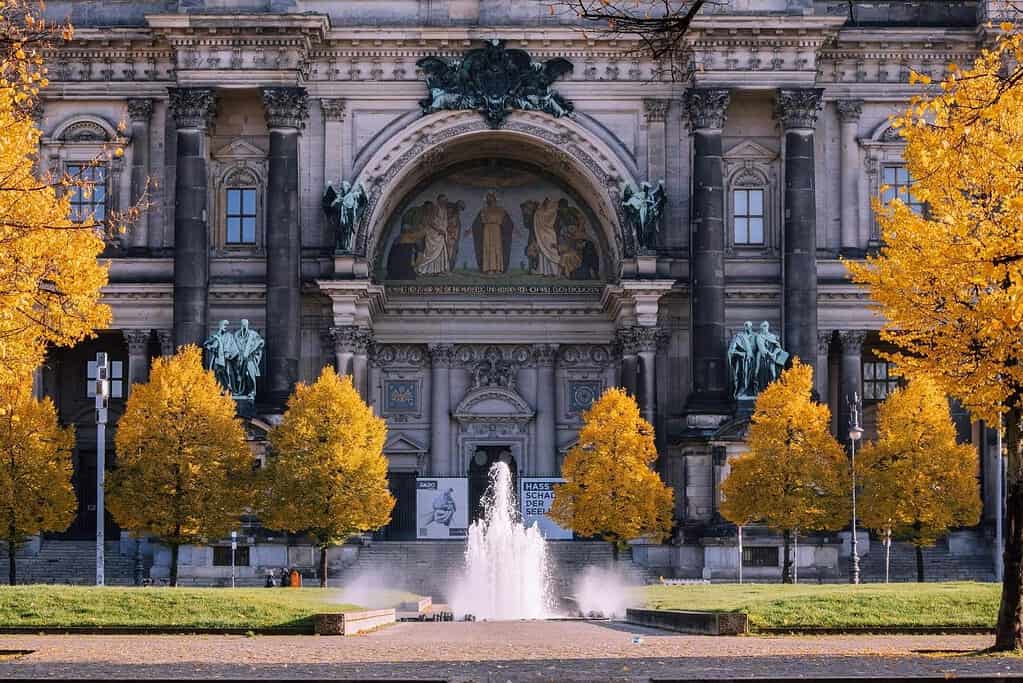
Autumn foliage frames the Berliner Dom, softening the monumental architecture at the heart of Museum Island.
Fall is often sold as “shoulder season,” with the emphasis on smaller crowds and lower prices. Those can be advantages, but they miss the big picture.
September is hardly undiscovered, and major events can still fill hotels and restaurants. What makes autumn compelling is not the absence of other travelers. It’s how naturally these cities suit the season.
You can spend much more of the day outside than you might expect.
A persistent misconception about Central Europe’s great capitals is that they are primarily stone cities: palaces, churches, museums, grand squares, and blocks of historic architecture. They are all those things, but they are also remarkably green.
Roughly half of Vienna is green space. Nearly 45 percent of Berlin is forest, water, parks, allotments, or agricultural land. Prague City Tourism says forests, parks, and gardens cover about one-fifth of the city. Budapest adds Margaret Island, City Park, and Buda’s terraced gardens and wooded hills.
In fall, that greenery changes the architecture itself: golds, reds, and browns warm Prague’s terra-cotta rooftops, Vienna’s stone façades, and Budapest’s Danube panoramas. In Berlin, they soften the city’s more muscular mix of Prussian, modernist, and contemporary architecture.
Don’t fixate on bad weather ruining the day. You have lots of options.
Is rain likely? Yes. Gray skies? Increasingly so as the season advances. But I have become suspicious of destinations that require good weather to work. Central Europe does not.
If you wake to blue skies, go outside: walk through a park, climb a hill, visit a vineyard, or explore a neighborhood.
If rain arrives, settle into a café or museum. All that’s required is to shift your mindset. To me, pauses aren’t time taken away from sightseeing. They’re another way of experiencing a place and its people.
All four cities have an extraordinary density of worthwhile interiors: museums, palaces, churches, galleries, cafés, boutiques, and concert halls. Plan B can be every bit as good as Plan A.
When the weather improves, just head back outside.
It’s the perfect time for antiquing.
Fall is also an excellent time to browse Central Europe’s flea markets and antique shops. Cooler weather makes wandering outdoor stalls more pleasant, while gray afternoons seem particularly well suited to dealers filled with old books, prints, maps, porcelain, jewelry, and other unexpected treasures.
You’ll find options in all four cities. In Vienna, the Art and Antiques Market at Am Hof offers a more curated alternative to the sprawling flea market at the Naschmarkt, with paintings, books, manuscripts, coins, porcelain, and other higher-quality pieces. If it’s raining, head over to the Dorotheum, one of Europe’s oldest auction houses.
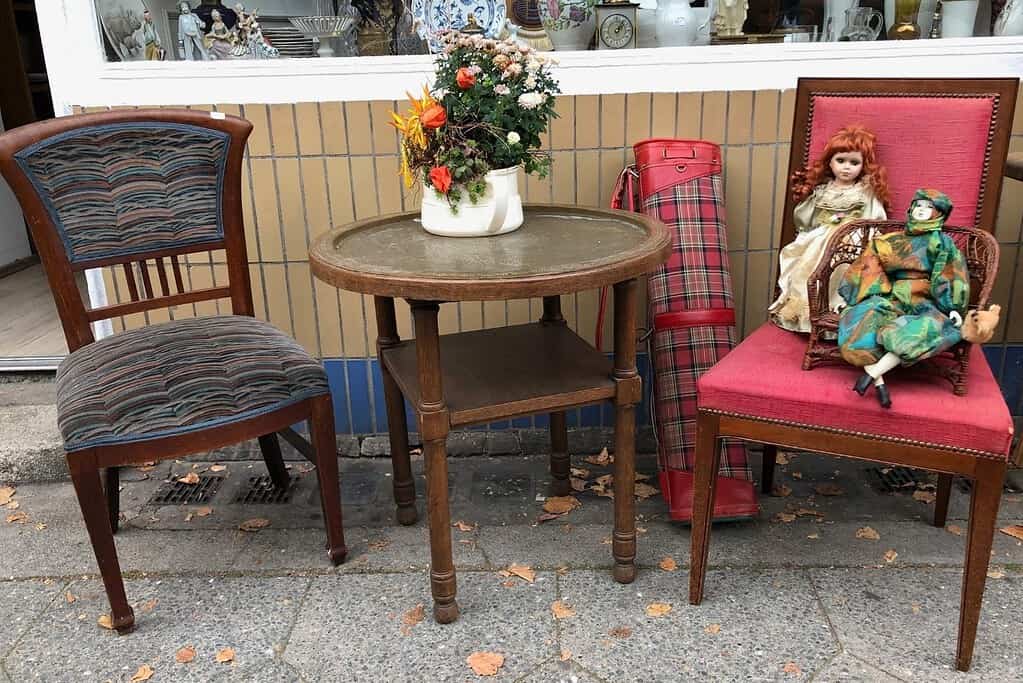
Antique dolls on display at a shop in Charlottenburg in Berlin. Photo: Catherine Barnes.
In Berlin, the long-running market on Straße des 17. Juni mixes antiques, collectibles, vintage finds, and assorted curiosities, with many professional dealers among the vendors.
In Prague, Prague Antique in the Old Town offers a decidedly more polished experience than some other locations, with jewelry, porcelain, paintings, clocks, sculpture, and furniture.
In Budapest, Falk Miksa Street is lined with antique shops, galleries, and antiquarian booksellers and is one of the city’s best areas for higher-end browsing.
You don’t need to be a serious collector. Part of the pleasure is simply looking, and occasionally finding something with a story worth taking home.
Central European cuisine begins to make sense.
You can certainly eat a steaming bowl of Hungarian goulash in August. Two months later, it’s noticeably more satisfying.
What seems too heavy in summer becomes autumn comfort food: soups and stews, dumplings, roast meats, schnitzel, paprikash, strudels, and rich cakes. Seasonality also appears in game, forest-foraged mushrooms, pumpkins, and wine-harvest traditions.

Autumn at Vienna’s Naschmarkt, where pumpkins, root vegetables, and other seasonal produce begin to shape the flavors of the season. Photo: Catherine Barnes.
It’s wine season.
Vienna is unusual among major capitals for the scale of winegrowing within its city limits. In fall, the vineyards turn color and a trip to a Heuriger (a traditional wine tavern) becomes a seasonally immersive experience.
One of my favorite juxtapositions is spending the morning with Schiele, Klimt, Moser, Gerstl, and Kokoschka at the Leopold Museum, then heading into the hills for an afternoon among the vines.
Even the cemeteries are beautiful.
This may be a hard sell for some travelers. It shouldn’t be.
These are not macabre detours. Some of the most meaningful urban landscapes are places of remembrance.
European cemeteries can be extraordinary repositories of architecture, sculpture, history, culture, and biography. Autumn only enhances the atmosphere, particularly in Vienna and Prague.
Vienna in Fall: Wine, Art, and a Touch of Melancholy
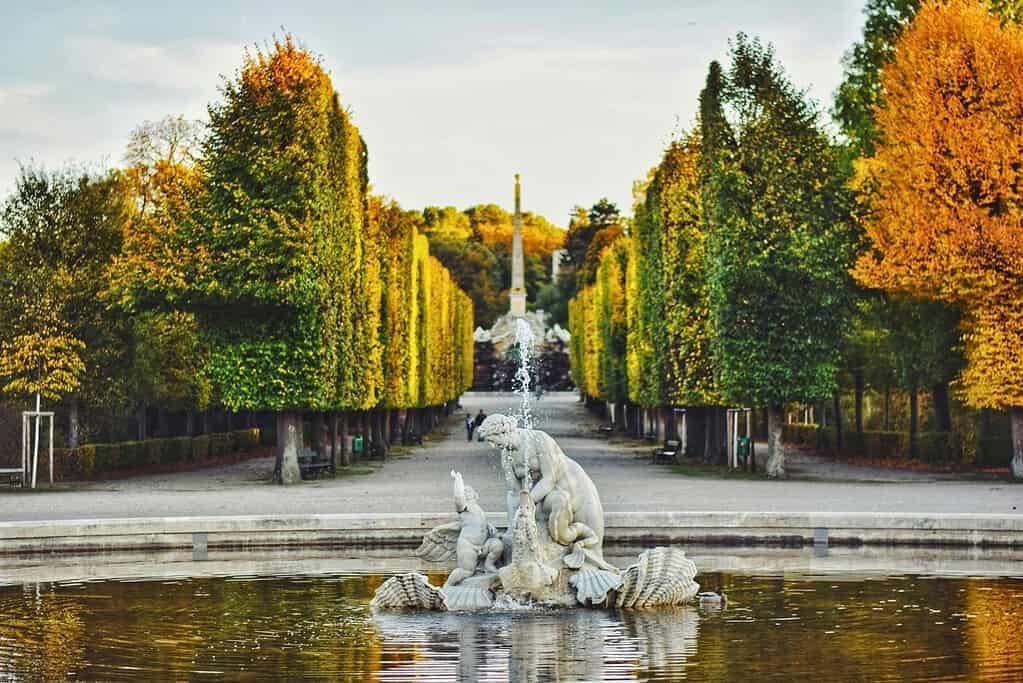
Autumn settles over the gardens at Schönbrunn, where one of the park’s Naiad fountains sits among formal avenues and changing foliage.
My love of Vienna is hardly a secret. There’s almost nothing I associate with the city that doesn’t become more appealing as temperatures begin to fall.
Cafés? Obviously.
Concerts and the opera? The main cultural season is underway.
Parks? Changing color.
Wine? Harvest season.
Museums? Always.
Cemeteries? It’s Vienna. Culture is immortal.
Vienna’s own tourism board acknowledges the sentimental feel of the city in fall, almost bordering on a postcard cliché. But it’s true.
Explore Vienna’s vineyards and Heuriger
Head toward Vienna’s wine-growing edges — Nussdorf, Grinzing, Neustift am Walde, or Stammersdorf — and the city begins to feel quite different.
You can walk through vineyards, look back toward the city, and eventually settle into a Heuriger for wine and something to eat.
The experience combines landscape, local tradition, history, food, and wine, with enough distance from the principal attractions to add perspective.
See the parks as part of the architecture
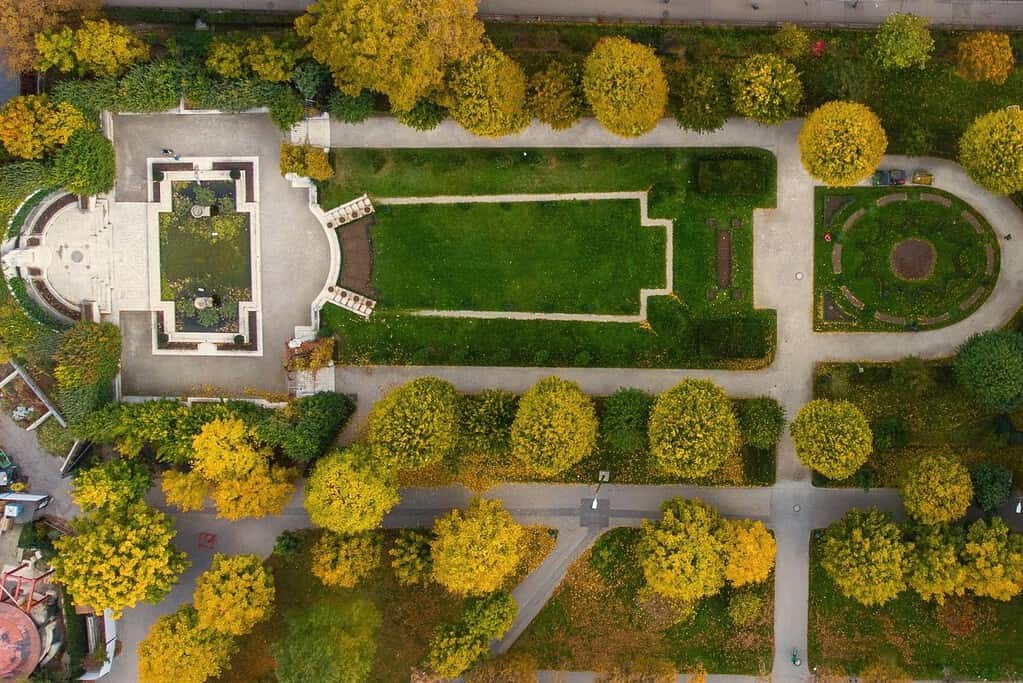
Aerial view of the Volksgarten with its geometric landscaping, tree-lined lanes, and orientation toward the Empress Elisabeth (“Sisi”) Monument.
The Volksgarten and Burggarten are intimate choices beside the Hofburg and Ringstrasse, with formal plantings, statues, paths, and mature trees that offer an easy pause between major sights.
Stadtpark is broader and more open, with lawns, mature trees, bridges, and winding paths that come into their own as the season changes.
At Schönbrunn, the palace grounds are integral to the experience, with long axial views, wooded paths, and formal gardens warming as the leaves turn.
The Prater offers something different. Beyond the amusement park, the Hauptallee runs for miles beneath an avenue of trees. Less manicured than the imperial gardens, it’s still well-suited for a long, unhurried autumn walk.
For a more country-like escape, head to Hermesvilla in the Lainzer Tiergarten. Emperor Franz Joseph built the villa for Empress Elisabeth (Sisi) in the hope that the secluded setting might persuade her to spend more time in Vienna. Surrounded by woodland and walking paths, it feels far removed from the imperial center. For more on Hermesvilla and its connection to Sisi, see our Sisi Guide to Vienna.
My advice? Don’t treat the city’s green spaces merely as routes between important attractions. Sometimes, the green space is the attraction.
Tarry in a museum
The Kunsthistorisches Museum alone can absorb hours. Add the Albertina, Leopold Museum, Belvedere, MAK, Wien Museum, the Secession, and many smaller institutions, and poor weather begins to look less threatening.
Autumn also brings Kunstherbst, Vienna’s “autumn of art,” with exhibitions, gallery programs, and art fairs across the city.
Pick one museum. Dwell there. Be inspired. Then have lunch and go for a walk; another collection will be waiting tomorrow.
FALL FESTIVALS IN VIENNA
Fall also brings some of Vienna’s most appealing annual events. The Vienna Wine Hiking Day turns the city’s vineyards into a network of walking routes and tasting stops; Vienna Design Week spreads exhibitions and installations across the city; and the Viennale, Vienna’s international film festival, gives late October and early November a distinctly cinephile energy.
Linger over coffee (or hot chocolate)
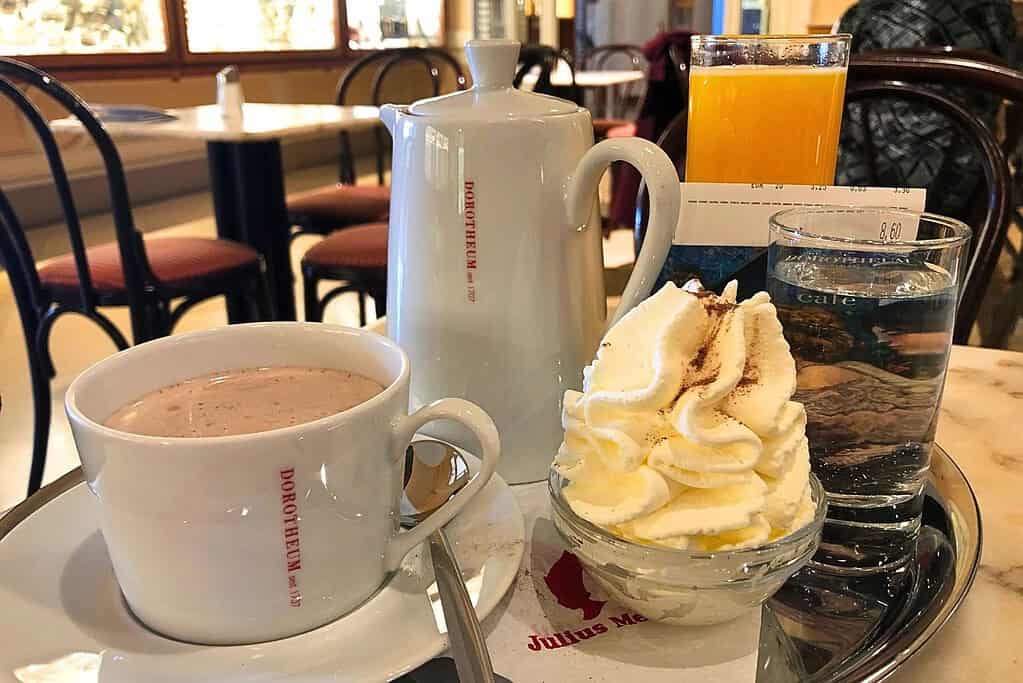
Hot chocolate with fresh cream, served in the traditional Viennese style with a glass of water on a silver tray at the café inside the Dorotheum, one of the Europe’s oldest auction houses. Photo: Catherine Barnes.
Vienna’s coffeehouses need little introduction, but don’t let their fame turn them into just another checklist stop.
Don’t photograph the marble-top tables, Thonet chairs, chandeliers, newspaper racks, and cake-filled vitrines only to rush back out the door.
Go when you actually want to sit down, and stay a while.
After an hour or two outdoors, a warm interior and a Melange or hot chocolate with fresh cream serve a purpose.
Let the coffeehouse culture take over: put your phone away, read something printed on paper, scribble in your journal, or simply people-watch.
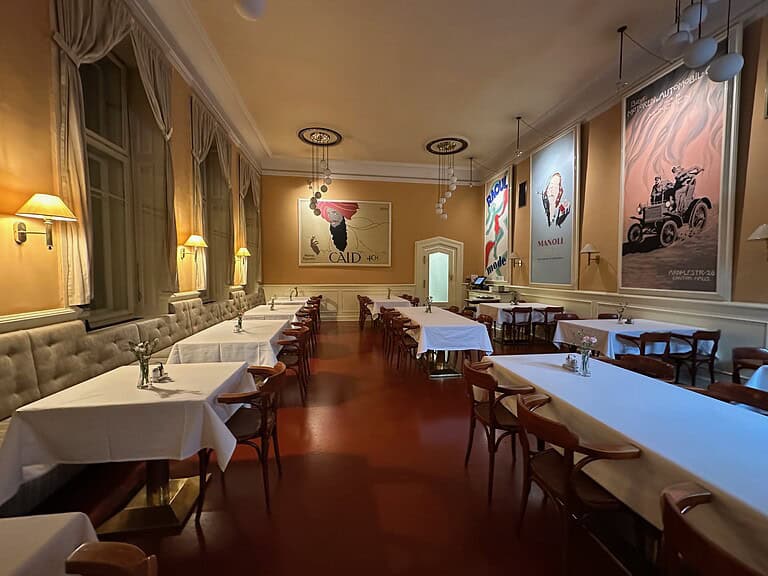
There are so many cafés in Vienna, it can be hard to narrow down your choices. I tend to prefer the traditional ones, although the city has a growing number of modern coffee bars on offer. To help you figure out where to go, take a look at our Vienna Pause series, which features guides to the city’s Imperial, Old Town, and Bohemian cafés, along with some more unique settings.
Visit Zentralfriedhof
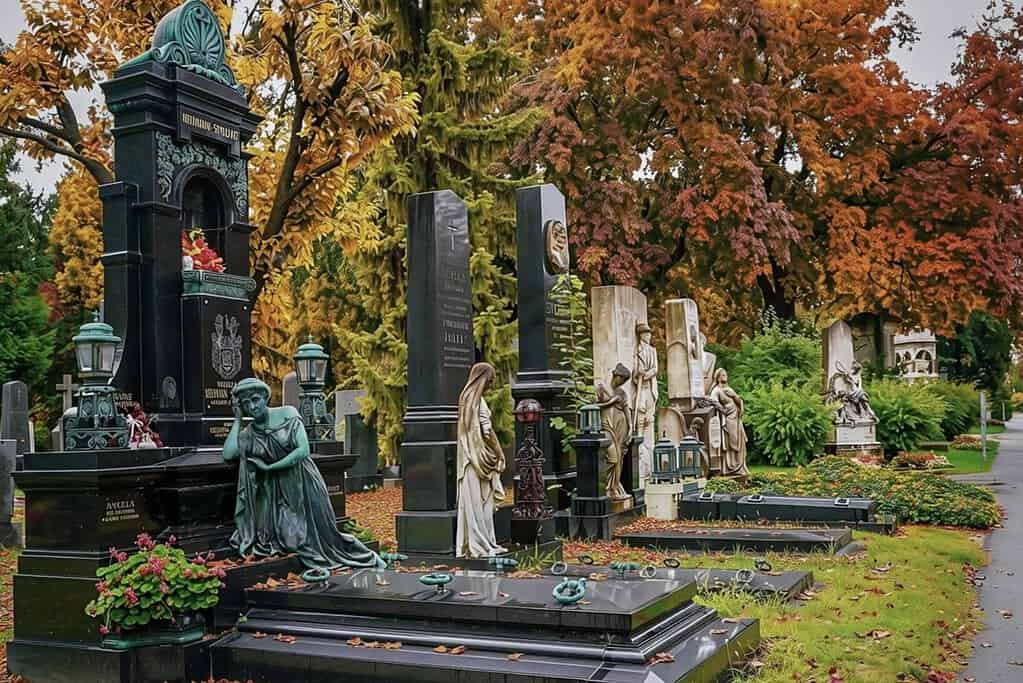
Elaborate monuments and tree-lined paths help make Vienna’s Zentralfriedhof feel as much like a vast sculpture garden as a cemetery.
Few places better illustrate Vienna’s relationship with memory than Zentralfriedhof (Central Cemetery). Opened in 1874, the roughly 590-acre cemetery contains about 330,000 gravesites and is the burial place of some three million people. Over time, dedicated areas for Protestant, Jewish, Muslim, and Orthodox faiths, and, since 2005, Buddhist burial grounds joined the predominantly Catholic cemetery.
Interred there you’ll find composers, opera singers, ballerinas, princes, statesmen, generals, artists, writers, poets, chess grandmasters, inventors, revolutionaries and even assassins (most surprisingly, the Italian anarchist, Luigi Lucheni, who murdered Empress Elisabeth of Austria).
Among the best-known people buried there are Ludwig van Beethoven, Johannes Brahms, Franz Schubert, and Johann Strauss I and II.
The graves, mausoleums, and statues form a vast sculpture garden of traditional, modern, and abstract styles. Some memorials are solemn; others are playful or even irreverent — a grand piano here, a crowned cat smoking a cigarette there.
Actress and inventor Hedy Lamarr, who co-developed and patented a frequency-hopping system that helped lay the groundwork for later wireless technologies, is memorialized by metal rods and spheres that resolve into a three-dimensional portrait when viewed from the right angle.
If you want to seek out specific graves, pick up a cemetery map at Gate 2 or use the official smartphone guide, which includes interactive navigation to many of the cemetery’s best-known residents.
Beyond the graves, the site is part wilderness, part garden, and part network of walking paths. Its natural habitat supports numerous animal species, while the Art Nouveau Church of St. Charles Borromeo offers another reason to visit.
Don’t rush your time there. Take a contemplative walk. Or, from October through March, you can even take a night tour.
If Zentralfriedhof feels too far afield, consider the Imperial Crypt beneath the Capuchin Church in the city center. The Imperial Crypt is the burial place of 150 Habsburgs, including 12 emperors and 19 empresses and queens. It contains the tombs of Maria Theresa and Franz I, Emperor Franz Joseph, Empress Elisabeth, and Crown Prince Rudolf. It offers a more concentrated, and distinctly imperial, encounter.
Take in a performance
Music is omnipresent in Vienna. Museums, composers’ apartments, and monuments preserve its history, while chamber ensembles, church concerts, recitals, and smaller venues keep it alive year-round.
No matter the time of year, visitors are rarely short of opportunities to hear Mozart, Strauss, Beethoven, and others associated with the city in myriad venues throughout the city, including many that cater to tourists.
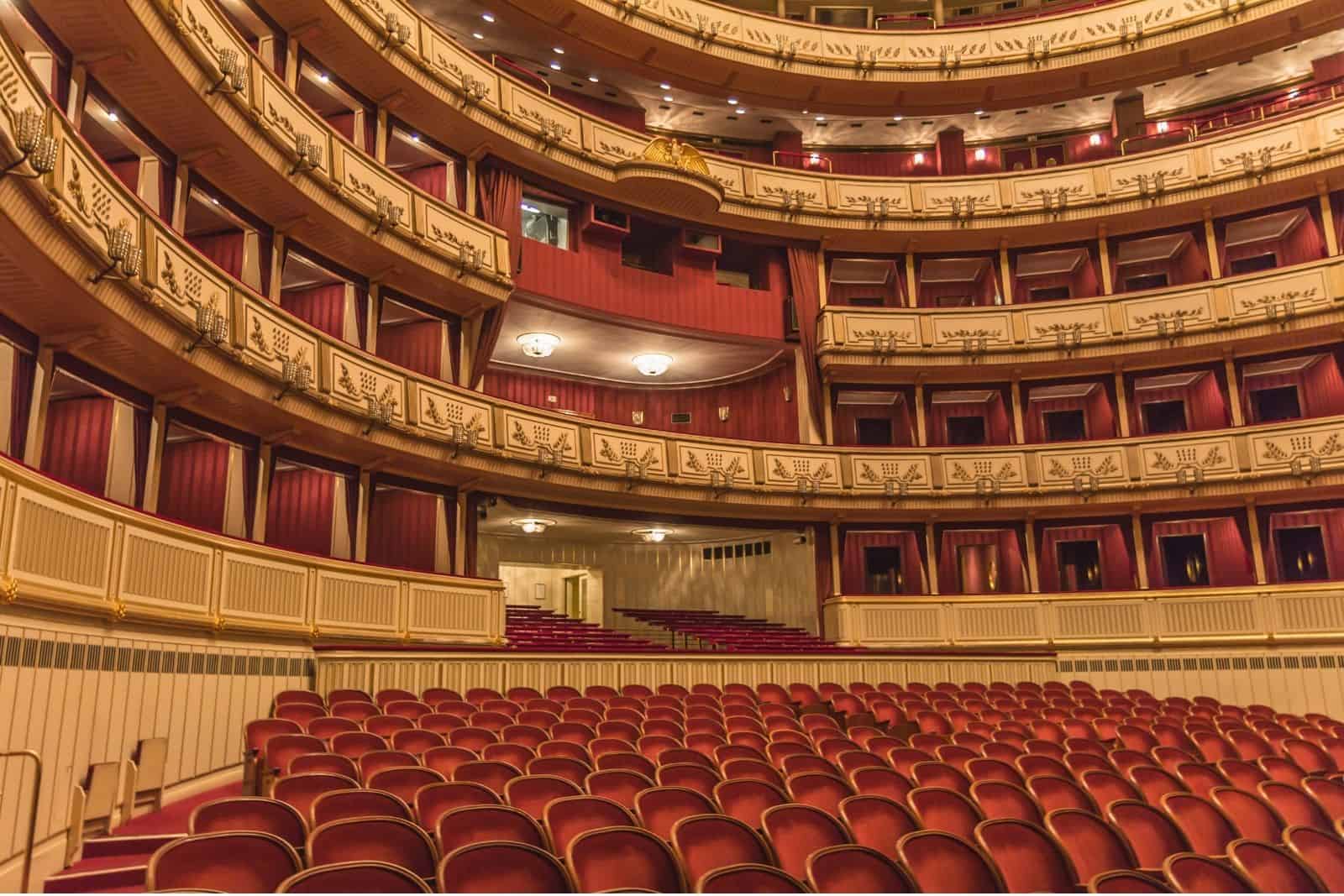
The Vienna State Opera, where the fall cultural season brings one of the city’s grandest performance spaces fully back to life.
Fall, however, is when Vienna’s major stages return to full stride. The Vienna State Opera, Musikverein, Konzerthaus, and other leading institutions launch their principal seasons.
When darkness sets in, make the most of it
Shorter days aren’t always a disadvantage.
In 2026, Light of Creation pairs light and original music inside the Votive Church on numerous autumn evenings. Beginning November 6, Imperial Lights turns part of Schönbrunn Palace Park into an illuminated walking route. Neither matches Berlin’s citywide Festival of Lights in scale, but both make good use of the earlier darkness.
Where to stay in Vienna in fall?
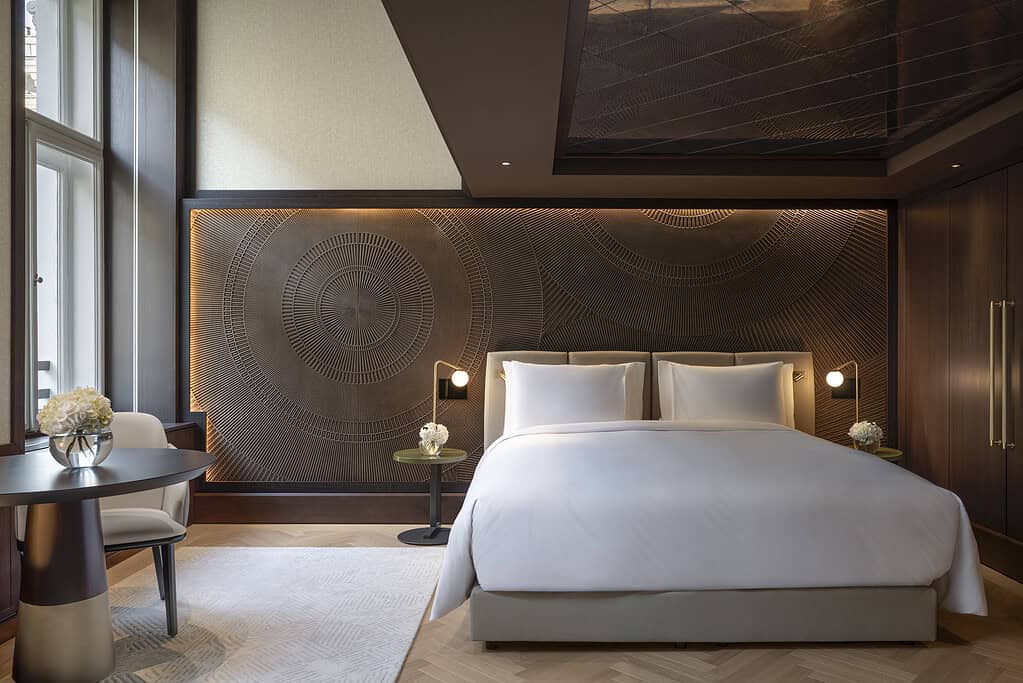
My pick for an autumn stay is the Almanac Palais Vienna. Set within two 1870s palais buildings on the Ringstrasse, this luxury property brings a contemporary sensibility to a decidedly Viennese setting. The hotel is directly opposite Stadtpark, and selected rooms and suites overlook the park itself, an especially appealing prospect when its trees begin to turn. The combination of historic architecture, sophisticated modern design, art, spa facilities, and an exceptionally central location makes this a strong choice for travelers who want both city culture and an easy daily connection to the season outside.
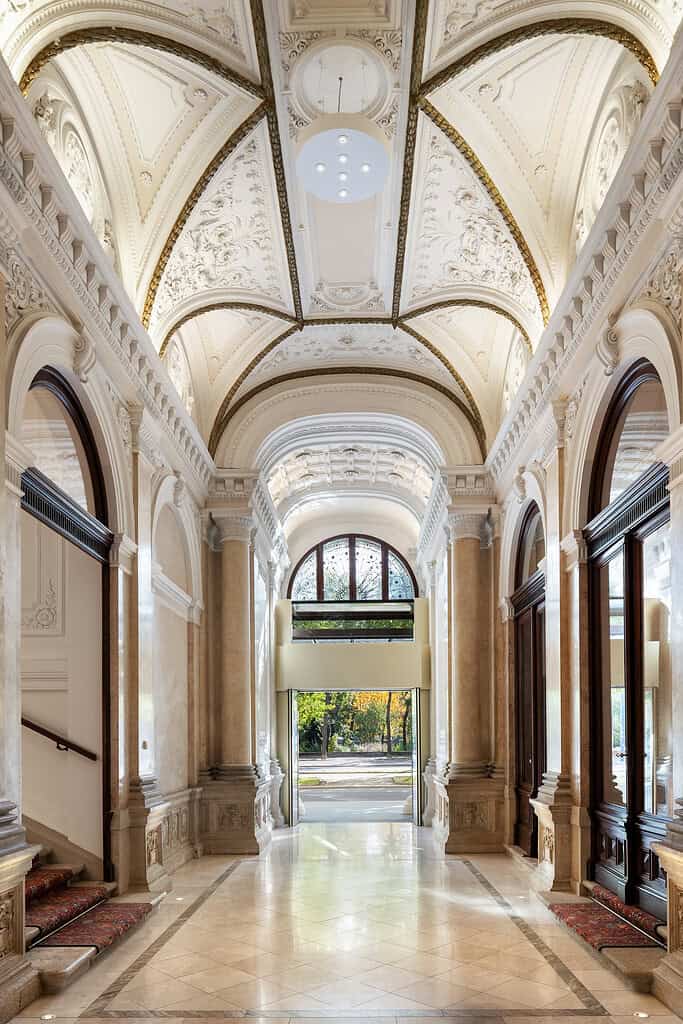
View of Stadtpark during autumn from the ornate entryway of Almanac Palais luxury hotel in Vienna. Photo: Courtesy of Almanac Palais Vienna / Tony Gigov.
Almanac Palais Vienna
Address: Parkring 14–16, 1010 Vienna, Austria
Phone: +43 1 266 0108
Nearby: Stadtpark, Vienna Konzerthaus, Museum of Applied Arts (MAK)
*Affiliate links may earn us a referral fee at no additional cost to you.
Want more choices? Explore our recommended shortlist at Grand Addresses Vienna: A Travel Designer’s Guide to Luxury Hotels.
Prague in Fall: Views, Gardens, and Layers of History
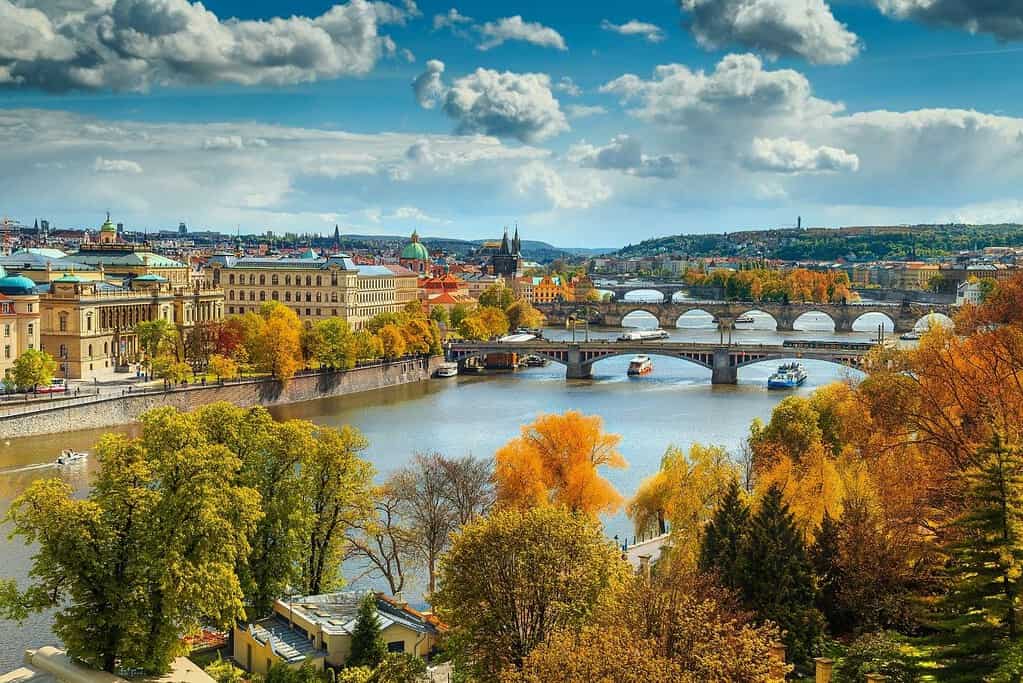
Prague in autumn, with the Vltava, Charles Bridge, and the city’s historic rooftops framed by fall color.
Prague’s autumn strength is topographical.
Prague rises and falls, with higher vantage points opening sweeping views across the rooftops. Cobblestone streets curve out of sight before revealing towers and courtyards; gardens climb the hillsides; bridges open panoramas across the Vltava.
A route that looks short on a map may unfold through squares, lanes, staircases, courtyards, and overlooks.
Autumn only intensifies that experience, warming the city’s stone and terra-cotta palette with changing leaves.
Explore Prague’s parks and gardens
Prague offers green spaces at every elevation.
Petřín is the obvious place to begin. Its gardens, orchards, and paths provide autumn color and changing views over Prague; the Seminary Garden alone contains more than 2,100 fruit trees.
Letná offers a different perspective. Its broad lawns and tree-lined paths sit high above the Vltava, with clear views of Prague’s layered skyline and the succession of bridges toward the historic center.
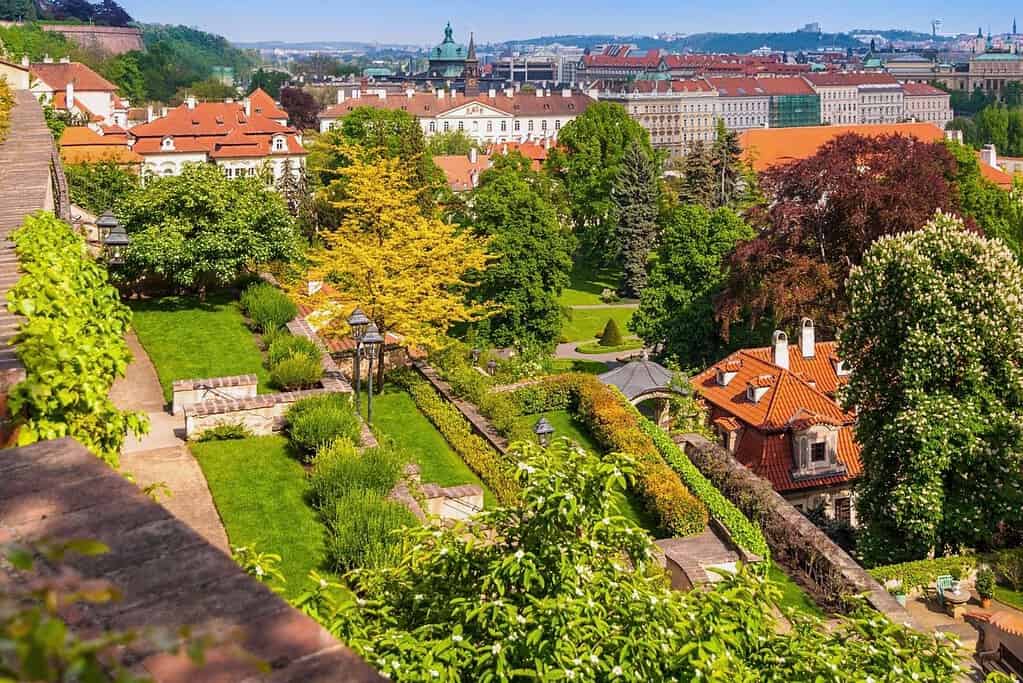
From the upper slopes of Malá Strana, Prague’s terraced gardens unfold through the historic center, with formal greenery, red rooftops, and church domes layered across the hillside.
Lower down, Stromovka is tied more to everyday city life. Once a royal game reserve, it’s now one of Prague’s largest parks, with ponds, mature trees, and broad walking paths.
At river level, Kampa Island is quieter and more intimate. Between the Vltava and Čertovka canal, its tree-lined paths, lawns, historic buildings, and river views feel removed from nearby Malá Strana even though Charles Bridge is just steps away.
Discover Vyšehrad
First-time visitors often miss Vyšehrad because it sits beyond the most heavily touristed center. When I worked in Prague, my apartment was nearby, and it became one of my favorite places for a fall walk.
The historic fortress complex sits above the Vltava, combining ramparts, panoramic views, significant architecture, walking paths, and one of Prague’s most important cemeteries.
While much more intimate in scale than the Central Cemetery in Vienna, it also constitutes a sculpture garden worth visiting. More than 600 prominent Czech cultural figures are buried there, including composers Antonín Dvořák and Bedřich Smetana, writer and playwright Karel Čapek, and Art Nouveau artist and designer Alfons Mucha.
Also visit the Basilica of Sts. Peter and Paul. Its origins date to the 11th century, but the present exterior is largely Neo-Gothic. Inside, rich Art Nouveau wall and ceiling paintings by František Urban and Marie Urbanová-Zahradnická show the influence of Alfons Mucha.
Vyšehrad is the kind of place that rewards curiosity rather than checklist tourism centered on the castle, beer halls, and Charles Bridge.
Inhabit Prague’s Urban Gothic
Fall brings a particular drama to Prague’s Gothic architecture. Lower light, earlier dusk, shifting skies, and occasional low-lying mist accentuate St. Vitus Cathedral, the Church of Our Lady before Týn, the Old Town Bridge Tower, and the Powder Gate. Because these medieval structures remain embedded in the everyday cityscape, exploring Gothic Prague in autumn feels like moving through time itself.
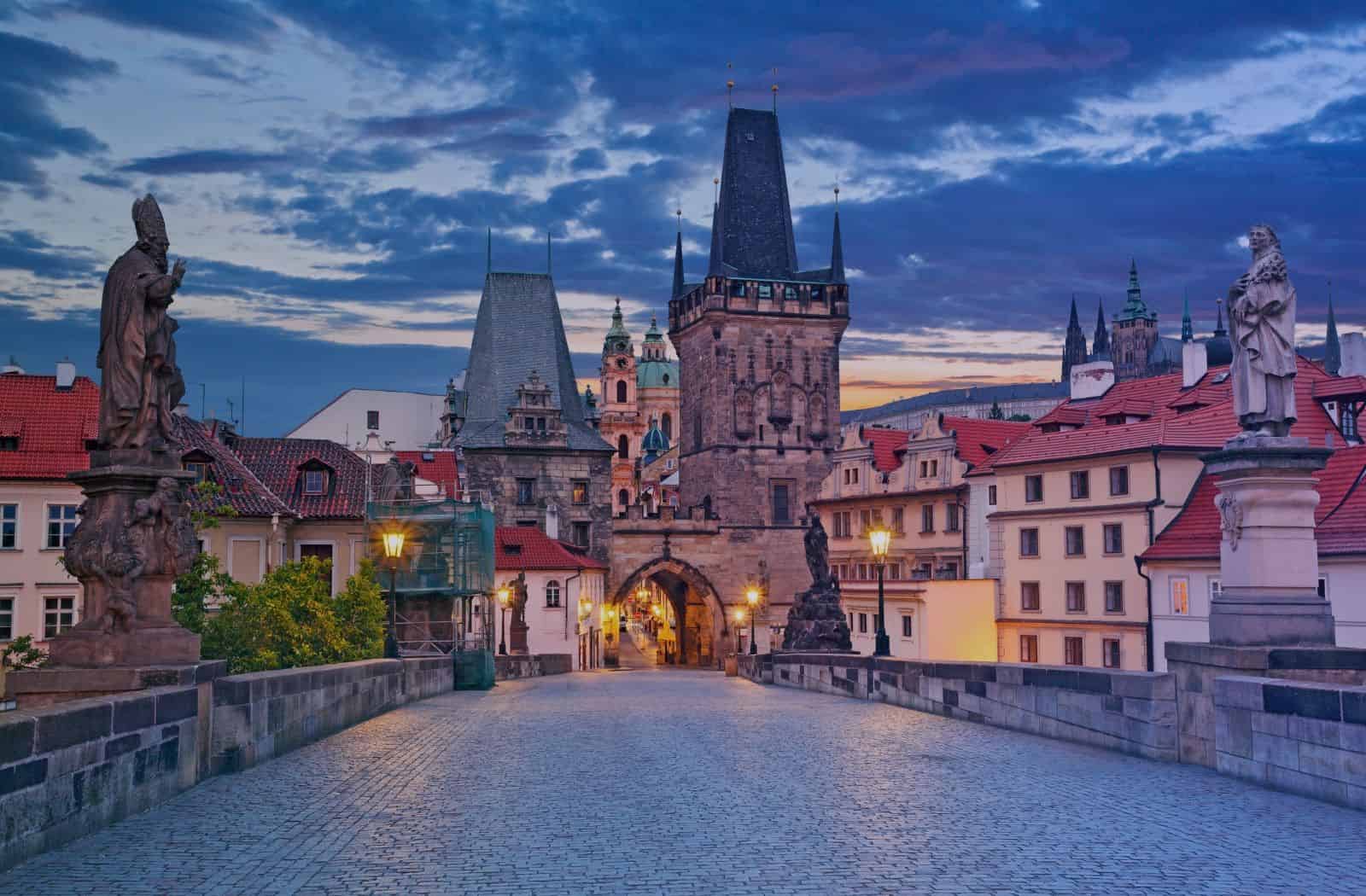
Charles Bridge and the Gothic Lesser Town Bridge Tower at dusk, with St. Vitus Cathedral rising in the distance.
Revel in the Glow: Prague Light Festivals
Berlin may have Europe’s most internationally familiar Festival of Lights, but it doesn’t have a monopoly on autumn illumination.
Prague’s annual Signal Festival, typically held in mid-October, uses light, projection, architecture, and public space as its canvas. In 2026, it runs October 15–18 across the city center and Dejvice.
Berlin’s Festival of Lights overlaps in 2026, running October 9–18, making it possible to experience both on one Central European trip.
Use café culture to understand the city
Look beyond coffee and cake and Prague’s cafés become entry points into Art Nouveau, Czech Cubism, First Republic history, literature, and the intellectual life of the city.
This is where Prague’s café culture differs from Vienna’s. The latter tends toward ritual and continuity; Prague’s historic cafés often feel tied to particular intellectual movements, political eras, and experiments in design — almost small social-history museums, but with seriously better pastries.
To find the cafés that appeal most to you, refer to our Prague Pause series on the city’s Literary (a good starting point), Modernist, and Art Nouveau cafés.
Where to stay in Prague in fall?
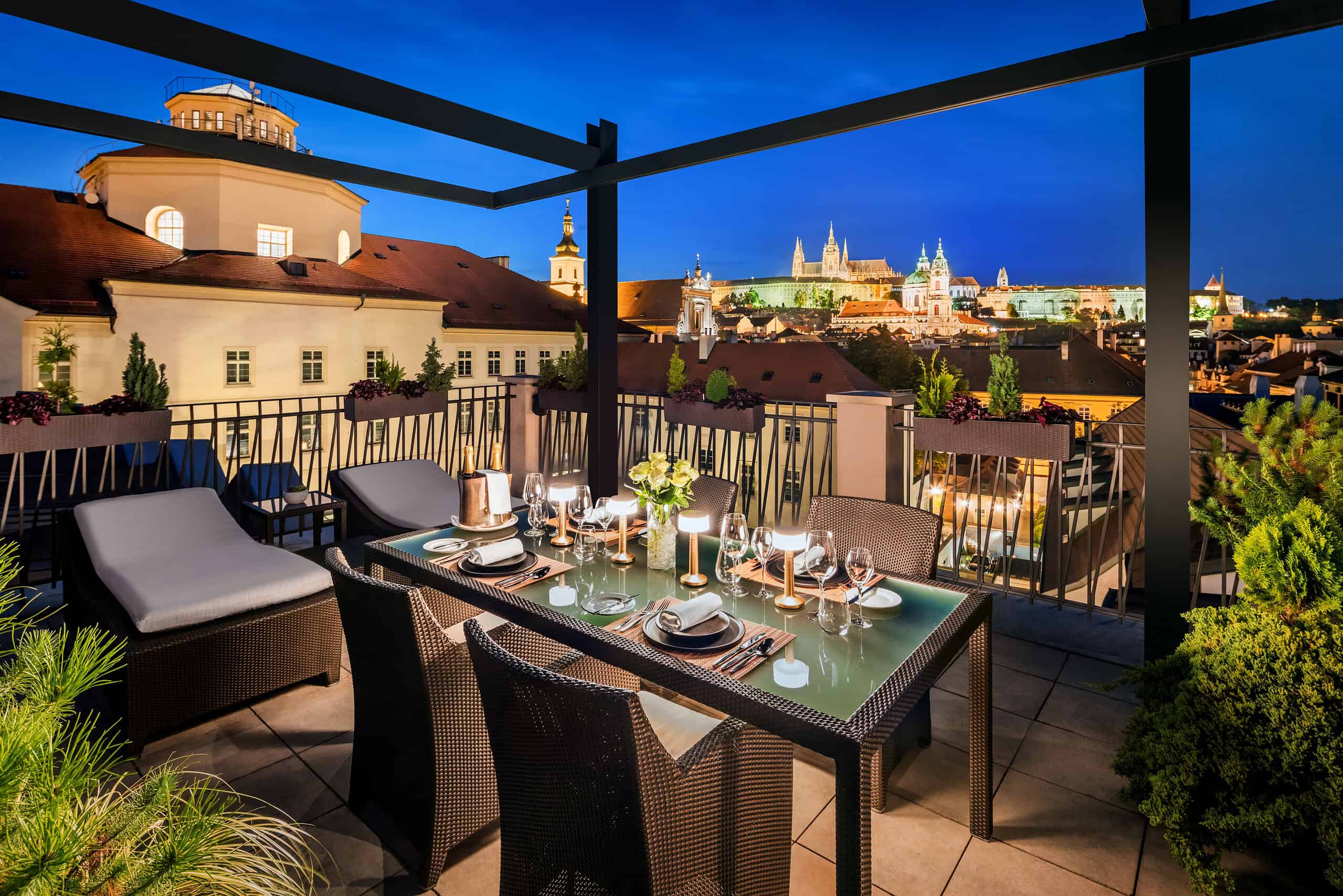
Prague’s Mandarin Oriental luxury hotel, set in a former monastery boasts views of the castle and St. Vitas Cathedral as well as Kampa Island, right beyond its doorstep. Courtesy: Mandarin Oriental Prague.
Tucked into the quieter streets of Malá Strana, Mandarin Oriental, Prague occupies a former Dominican monastery with roots in the 14th century. The secluded setting is calming despite being within easy walking distance of major sights. For fall, the real attraction is its position just steps from Kampa, with Petřín’s larger parkland rising nearby — a rare combination of five-star luxury, history, and tranquility in the heart of Prague.
Mandarin Oriental Prague
Address: Nebovidská 459/1, 118 00 Malá Strana, Prague, Czech Republic
Phone: +420 233 088 888
Nearby: Kampa Park, Museum Kampa, Lennon Wall, Charles Bridge, Petřín Hill and Gardens
*Affiliate links may earn us a referral fee at no additional cost to you.
Want more choices? Explore our recommended shortlist at Grand Addresses Prague: A Travel Designer’s Guide to Luxury Hotels.
A WORD OF CAUTION
I would think twice before choosing Halloween weekend for Prague if your priority is a quieter, more atmospheric visit. The narrow lanes, small squares, and compact streets of Old Town and Malá Strana already concentrate foot traffic more intensely than in cities like Berlin or Budapest. Add costumed revelers and nightlife crowds, and those same historic spaces can become cramped and more than a bit intoxicated.
Budapest in Fall: Steam, Paprika, and Tokaji
Budapest may provide the most sensual version of fall.
Here the season is about contrasts: cool air and hot thermal water; long walks and substantial food; the formality of Andrássy Avenue and the uneven lanes of Buda; bright afternoons giving way to earlier evenings when the illuminated city asserts itself.
Get into hot water
Thermal bathing is worthwhile year-round, but considerably more memorable once the air temperature drops.
There’s something deeply satisfying about warm water and chilly autumn air, or an indoor soak in an ornate setting befitting a palace.
For an hour or two, you can simply stop.
Széchenyi Thermal Bath
Széchenyi is the grand, theatrical choice and probably the best introduction for a first-time visitor. Set in Városliget (City Park), its Neo-Baroque complex combines indoor facilities with large outdoor pools. It’s also the easiest bath to pair with City Park or a walk along tree-lined Andrássy Avenue.
Rudas Thermal Bath
For something older and more atmospheric, choose Rudas on the Buda side. Its centerpiece is a 16th-century Ottoman thermal bath beneath a dome, while a modern rooftop panorama pool overlooks the Danube. That contrast is what makes Rudas distinctive.
Lukács Thermal Bath
Choose Lukács for a more local feel. Long associated with medicinal bathing, it has less architectural spectacle than Széchenyi or Rudas but a calmer atmosphere and a stronger sense that people are there to use the baths rather than photograph them.
And What About Gellért?
Normally, Gellért Thermal Bath would be at the top of this list for its Secession-era interiors, mosaics, stained glass, and historic connection to Hotel Gellért. It has been closed for renovation since October 1, 2025, with reopening planned for 2028.
Walk Buda while walking still feels good
Summer heat can make walking Budapest’s hills considerably less charming, and a bit more sweaty. Fall is another matter.
The Castle District, Gellért Hill, Tabán, and the broader Buda side reward walking once temperatures drop and foliage begins to turn. The climbs feel more manageable, and the city reveals itself in layers.
This is where Budapest’s geography becomes easiest to understand. Pest stretches flat across one side of the Danube while Buda rises on the other. From the heights, Parliament, the bridges, and Pest’s boulevards unfold below, framed by gardens and changing color.
The pleasure is not only the vista but the route: castle lanes, stone steps, small gardens, Tabán, and paths that suddenly open onto the river.
If you simply arrive at Fisherman’s Bastion, take the obligatory photograph, visit Matthias Church, and move on, you have missed much of the experience.
Find Budapest’s green side
Budapest’s green spaces are less formal than Vienna’s and less tightly woven into the historic core than Prague’s, but in fall the contrast between river, hills, and architecture can be striking.
Margaret Island is the easiest place to step away from the city without really leaving it. Set in the Danube, it is largely parkland, with mature trees, paths, gardens, fountains, and views toward both Buda and Pest.
City Park combines landscape and culture. Behind Heroes’ Square, tree-lined paths connect Széchenyi Thermal Bath, Vajdahunyad Castle, the Museum of Fine Arts, the Museum of Ethnography, and House of Music Hungary.
For something more expansive, head into the Buda Hills around Normafa, János Hill, and Zugliget, where the city gives way to wooded paths, viewpoints, and a stronger sense of countryside.
For a country-like excursion, Gödöllő Royal Palace offers Budapest’s clearest parallel to Vienna’s Hermesvilla. A favorite retreat of Empress Sisi, it sits amid palace grounds and parkland northeast of the city. For more on Gödöllő and Elisabeth, see our Sisi Travel Guide.
The point is not simply that the trees are beautiful. Budapest, like Vienna and Prague, lets you move easily between urban culture and natural space.
Indulge in Hungarian comfort foods

Hungarian gulyás, a hearty beef-and-vegetable soup that’s the perfect comfort meal on a cool fall day.
Autumn is when I want Hungarian food.
After a long walk, give me gulyás, the country’s savory beef-and-vegetable soup.
As the cold sets in, give me paprikás, a paprika-rich stew finished with sour cream; pörkölt, a thicker meat stew; or stuffed cabbage filled with seasoned meat and rice.
Then give me coffee and Dobos torte, the layered sponge cake with chocolate buttercream and a caramel top.
And most importantly, a glass of Tokaji (or two), the celebrated wine from northeastern Hungary, produced in both sweet and dry varieties.
Hungarian cuisine is broader and more sophisticated than the collection of paprika-heavy clichés might suggest. Traditional restaurants with home-style cooking abound, but Budapest’s contemporary restaurant scene gives you another reason to plan your evenings purposefully.
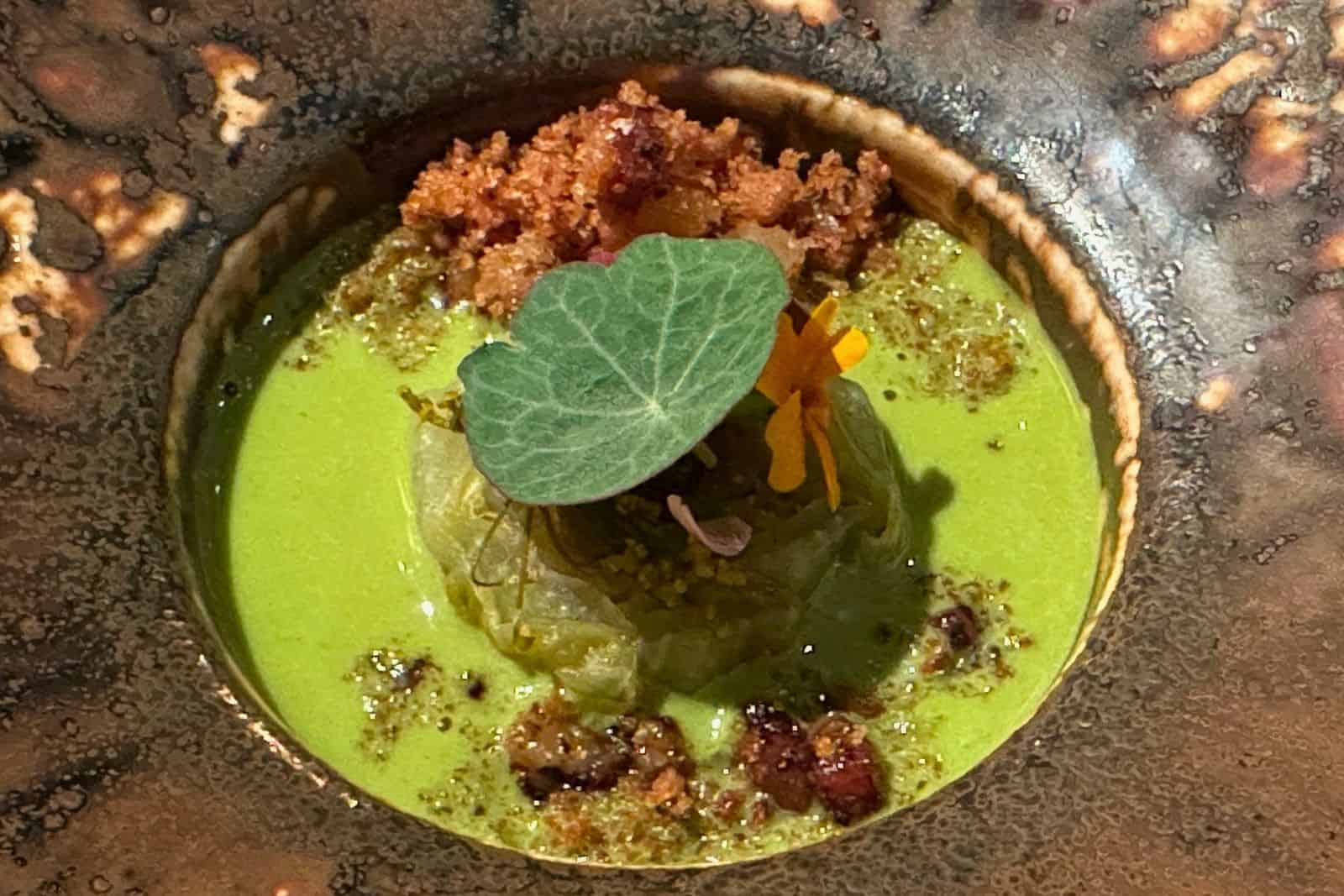
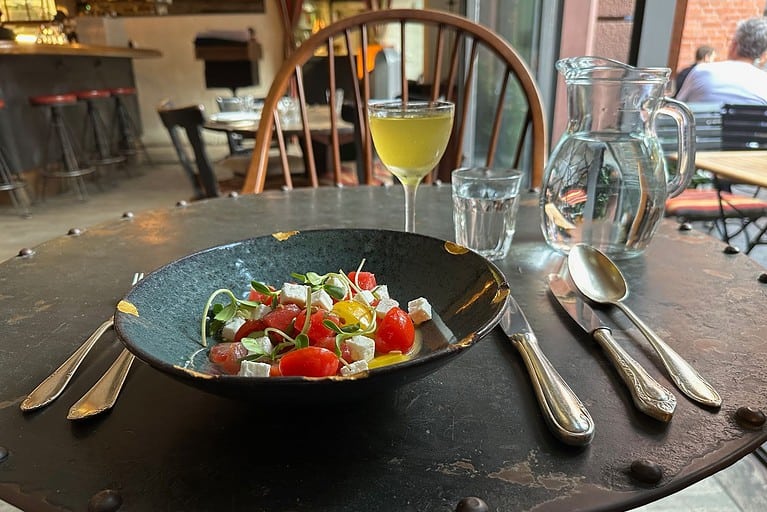
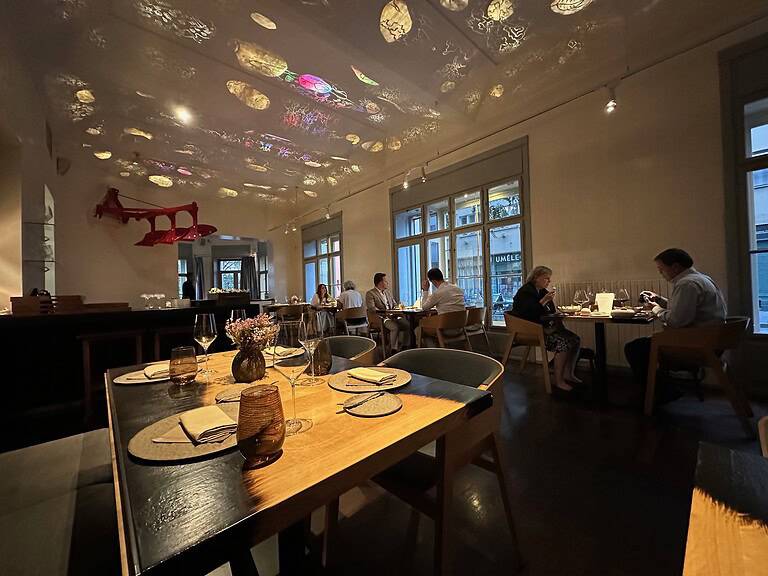
At SALT Budapest, seasonal, foraged, and fermented ingredients long rooted in Hungarian cooking are reinterpreted in distinctly modern dishes. Photo: Catherine Barnes.
For our top fine-dining picks in Budapest, check out Savoring Budapest.
Use museums to understand Hungary rather than merely admire Budapest
Budapest is easy to experience superficially: the river is beautiful, Parliament dramatic, the bridges photogenic, Buda Castle imposing, and the cafés grand.
But Hungary’s complicated, contested history is central to understanding the city.
On a gray day, or when you simply want more context, spend time in the Hungarian National Gallery, Hungarian National Museum, Museum of Fine Arts, or another collection that moves the experience beyond scenery.
For travelers interested in Central Europe’s layered history, Vienna and Budapest are especially rewarding when considered together. Their shared Habsburg past creates obvious connections, while their sharply different trajectories after World War II provide an equally revealing counterpoint. Seen side by side, each helps explain the other, not only as a former imperial capital, but as a city shaped very differently by the political order that followed.
Where to stay in Budapest in fall?
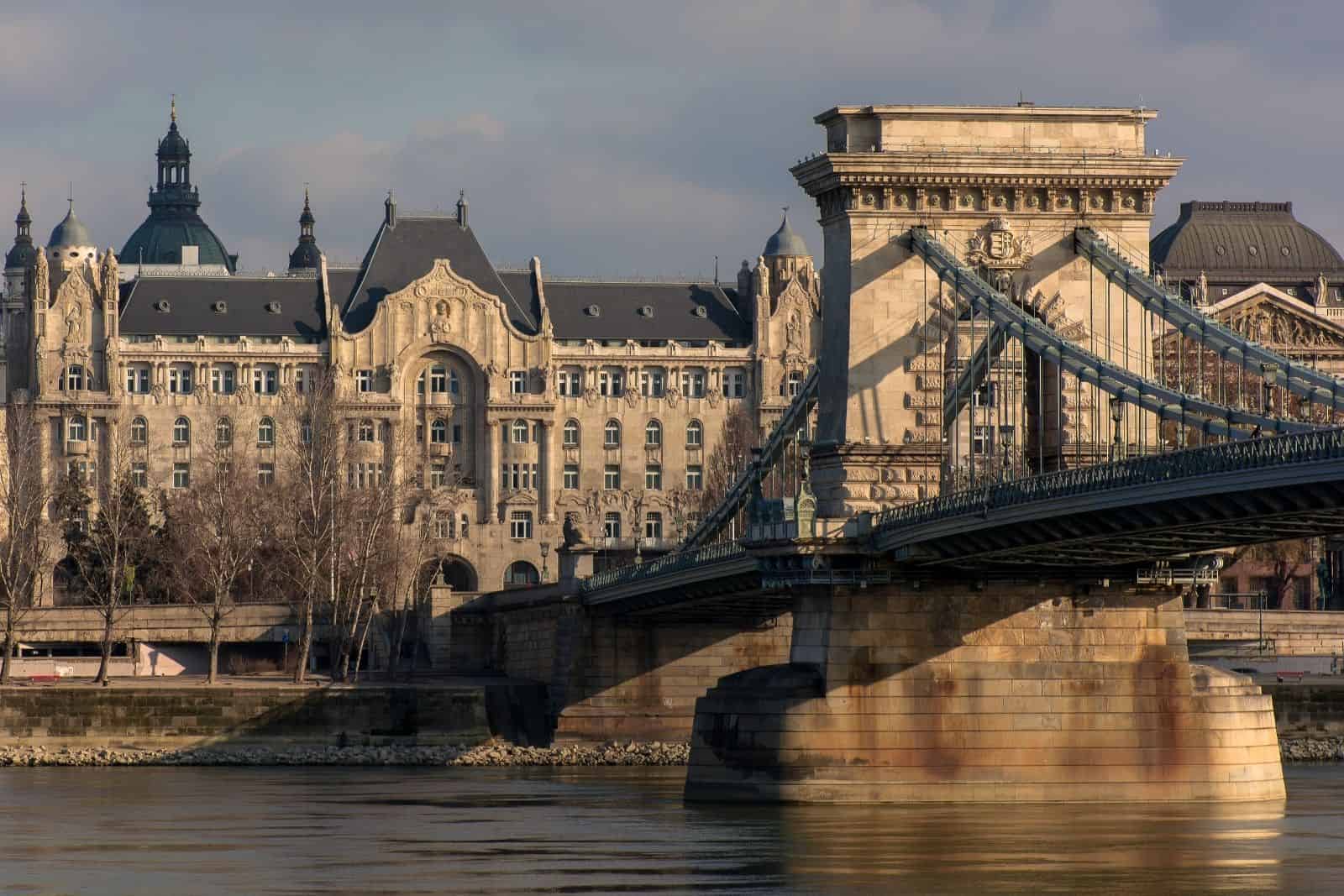
View of the Széchenyi Chain Bridge over the Danube with the Four Seasons Gresham Palace hotel at dusk.
Budapest’s Four Seasons Hotel Gresham Palace is the exception to the park-at-the-door formula, and deliberately so. The restored 1906 Art Nouveau landmark combines remarkable architecture with the polished service expected of Four Seasons. What earns it a place here is the view: directly facing the Chain Bridge and Danube, the hotel looks toward Buda Castle and the autumn-colored slopes of Buda. By day they bring seasonal color to the panorama; after dark, the illuminated riverfront supplies the warm city glow. Few hotel settings capture Budapest quite so completely.
Four Seasons Gresham Palace
Address: Széchenyi István tér 5–6, 1051 Budapest, Hungary
Phone: +36 1 268 6000
Nearby: Széchenyi Chain Bridge, Danube Promenade, St. Stephen’s Basilica, Shoes on the Danube Bank, Elizabeth Square
*Affiliate links may earn us a referral fee at no additional cost to you.
Berlin in Fall: Parks, Festivals, and Neighborhoods
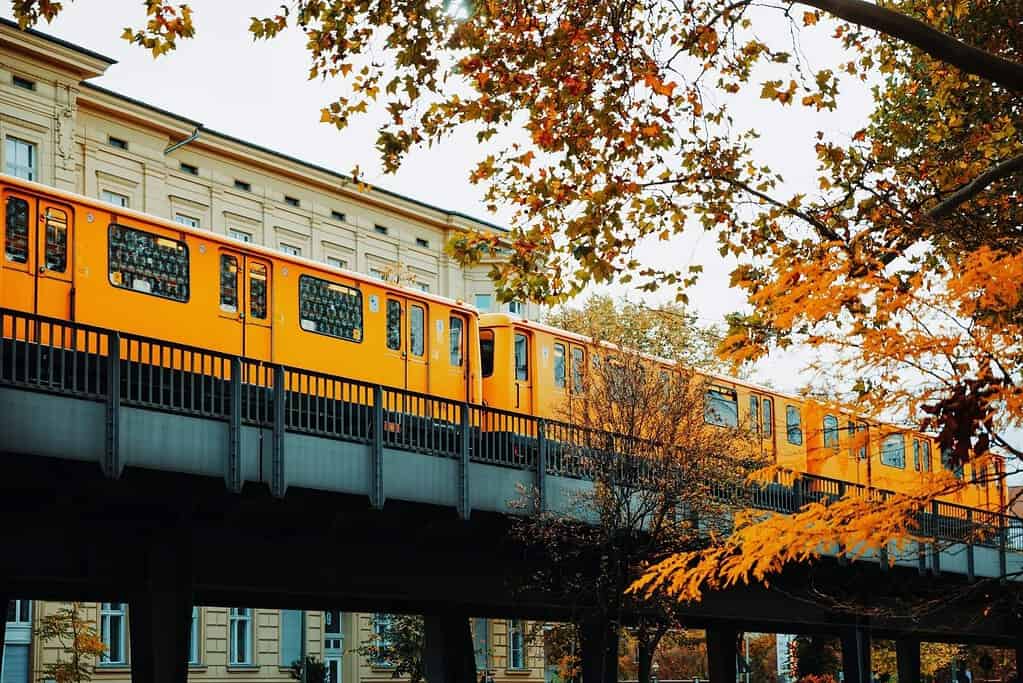
Berlin’s yellow U-Bahn cuts through the colors of autumn, a reminder that even the city’s everyday infrastructure becomes part of the seasonal landscape.
Berlin isn’t conventionally beautiful in the way Prague is, nor does it offer Vienna’s imperial coherence or Budapest’s theatrical relationship with the Danube.
Berlin makes you work harder, and rewards those who do.
Autumn may be when the city makes the most sense.
Berlin does not require sunshine to justify itself. That’s fortunate because it isn’t a famously sunny city.
Its museums, memorial sites, galleries, theaters, clubs, and neighborhoods can carry a trip in almost any weather. When the sun does appear, enormous parks, lakes, and woodland stand ready to claim the day.
Walk through a forest in the middle of your city trip
The Tiergarten may be Berlin’s most obvious green space, but its scale is easy to underestimate. I learned that the hard way on my first visit. Fresh off an international flight, I set out through the park toward Museum Island; an hour later, my legs were wobbly and trees surrounded me in every direction.
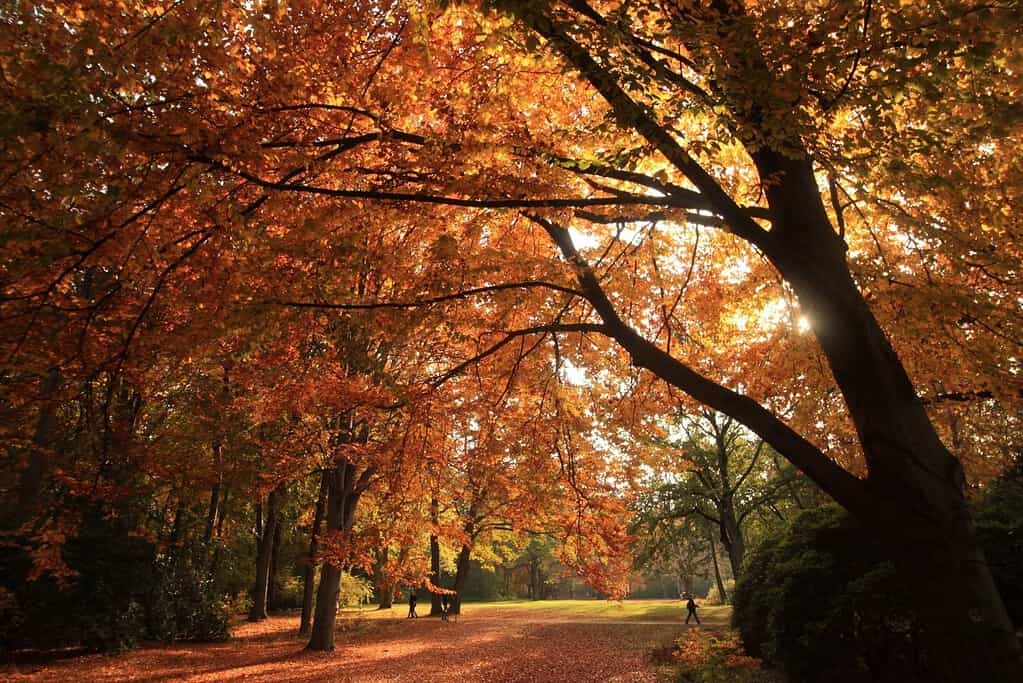
Autumn in Berlin’s Tiergarten, where mature trees and broad lawns turn the heart of the city into a sea of gold and rust.
Covering roughly 520 acres in the heart of the city, the Tiergarten stretches from the Brandenburg Gate and Reichstag west toward the Zoo. I eventually reached my destination thoroughly worn out. Now I give the park time for what it does best: nature, quiet, and fresh air, not merely a straight line between points A and B.
Alternatively, the gardens of Charlottenburg Palace offer a more formal autumn landscape, while Grunewald expands the possibilities dramatically, bringing extensive woodland and lakes within easy reach of the center.
This is museum weather
Few cities make an overcast day easier to salvage. Berlin has around 170 museums, more than its average annual number of rainy days, so bad weather rarely leaves you short of options.
Collections span ancient art and archaeology, classical and contemporary art, modernism, Jewish history, the divided city and GDR, photography, natural history, applied arts, and much more.
Then there are places that resist the word “museum:” the Topography of Terror, former Stasi sites, surviving sections of the Berlin Wall, bunkers, and memorial landscapes.
Berlin continually asks what cities should do with difficult history, one reason intellectually curious travelers so often return.
You rarely finish with Berlin. You simply stop for the day.
Autumn is when Berlin’s cultural calendar explodes.
The theater, opera, and concert seasons are underway. Exhibitions open. Berlin Food Week typically arrives in early October, followed closely by the annual Festival of Lights, and Berlin Science Week, which runs in early November.
For ten nights, major buildings and public spaces become canvases for large-scale light art. In 2026, the Festival of Lights runs October 9–18.
There’s something uplifting about watching familiar architecture transform after dark.
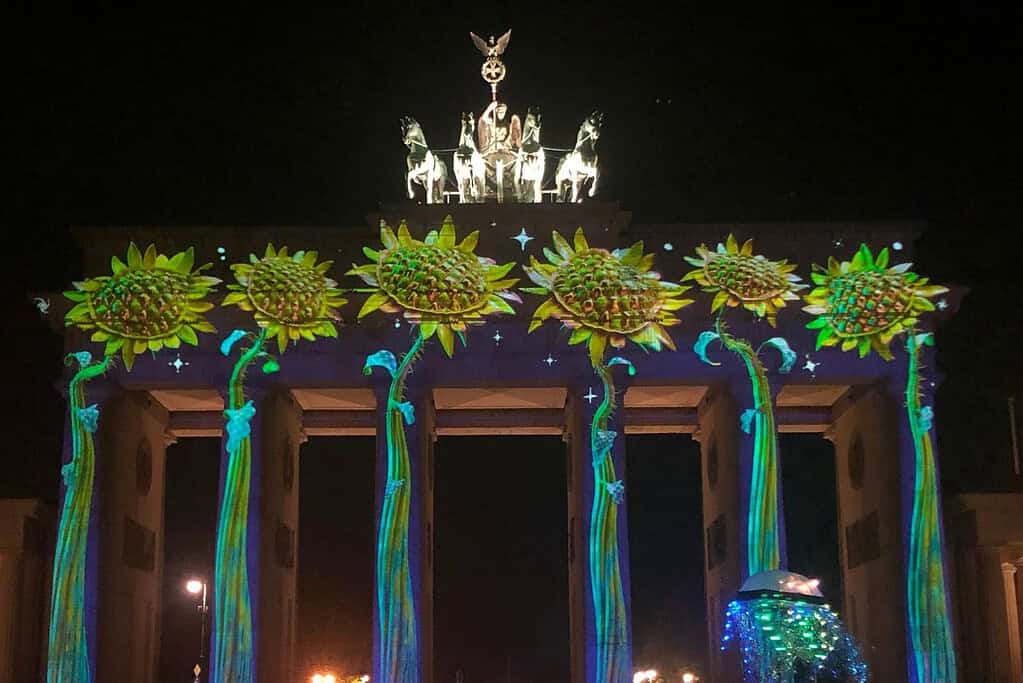
Berlin’s Festival of Lights transforms landmarks across the city each autumn, including the Brandenburg Gate. Photo: Catherine Barnes.
And then there’s the International Berlin Burlesque Festival.
Berlin’s cultural life has never been confined to opera houses, concert halls, and museums. Cabaret, variety theater, satire, avant-garde circus, and unconventional performance are part of its creative identity.
The International Berlin Burlesque Festival taps into that tradition with performances that can be glamorous, playful, theatrical, political, or experimental. While a hard pivot from the Philharmonie, it’s an enjoyable one for fans of cabaret and burlesque.
The emphasis is on costumes, choreography, stagecraft, and acceptance. Workshops run alongside the festival, and the opening chorus line often features participants (one year including a fierce lady in her 70s).
The audience is part of the fun: some arrive casually, while others opt for top hats and tails, flapper dresses, showgirl costumes, leather, and plenty of flair and self-expression.
This festival typically overlaps with the Festival of Lights. The 14th edition runs October 15–18, 2026, at Heimathafen Neukölln and the historic Wintergarten Varieté.
Fall brings historical weight to Berlin’s calendar
Autumn in Berlin also carries historical weight. October 3 is German Unity Day; November 9 marks the proclamation of the German Republic in 1918, the 1923 Beer Hall Putsch, the Nazi pogroms of 1938, and the fall of the Berlin Wall in 1989.
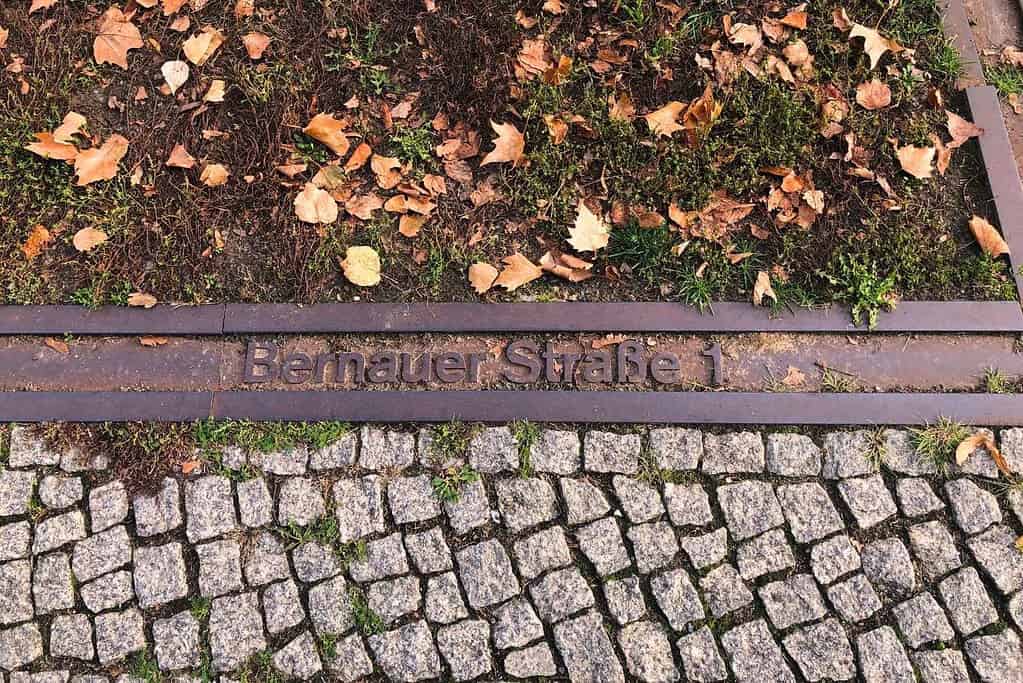
Along Bernauer Straße, markers trace the former path of the Berlin Wall, an understated reminder of the city’s divided past beneath the colors of autumn. Photo: Catherine Barnes.
You don’t need to organize a trip around anniversaries to feel that history. In Berlin, the past repeatedly interrupts the present.
Explore neighborhoods, not just landmarks
Berlin’s urban core was radically reshaped by World War II and the city’s subsequent division. Although reconstruction has been ongoing for decades, many of the city’s most interesting cultural, architectural, and historical sites remain widely dispersed.
Venture beyond the central landmarks and other layers of Berlin emerge in Charlottenburg, Schöneberg, Kreuzberg, Neukölln, Prenzlauer Berg, and beyond. Some of the city’s most memorable discoveries happen away from the center.
Where to stay in Berlin in fall?
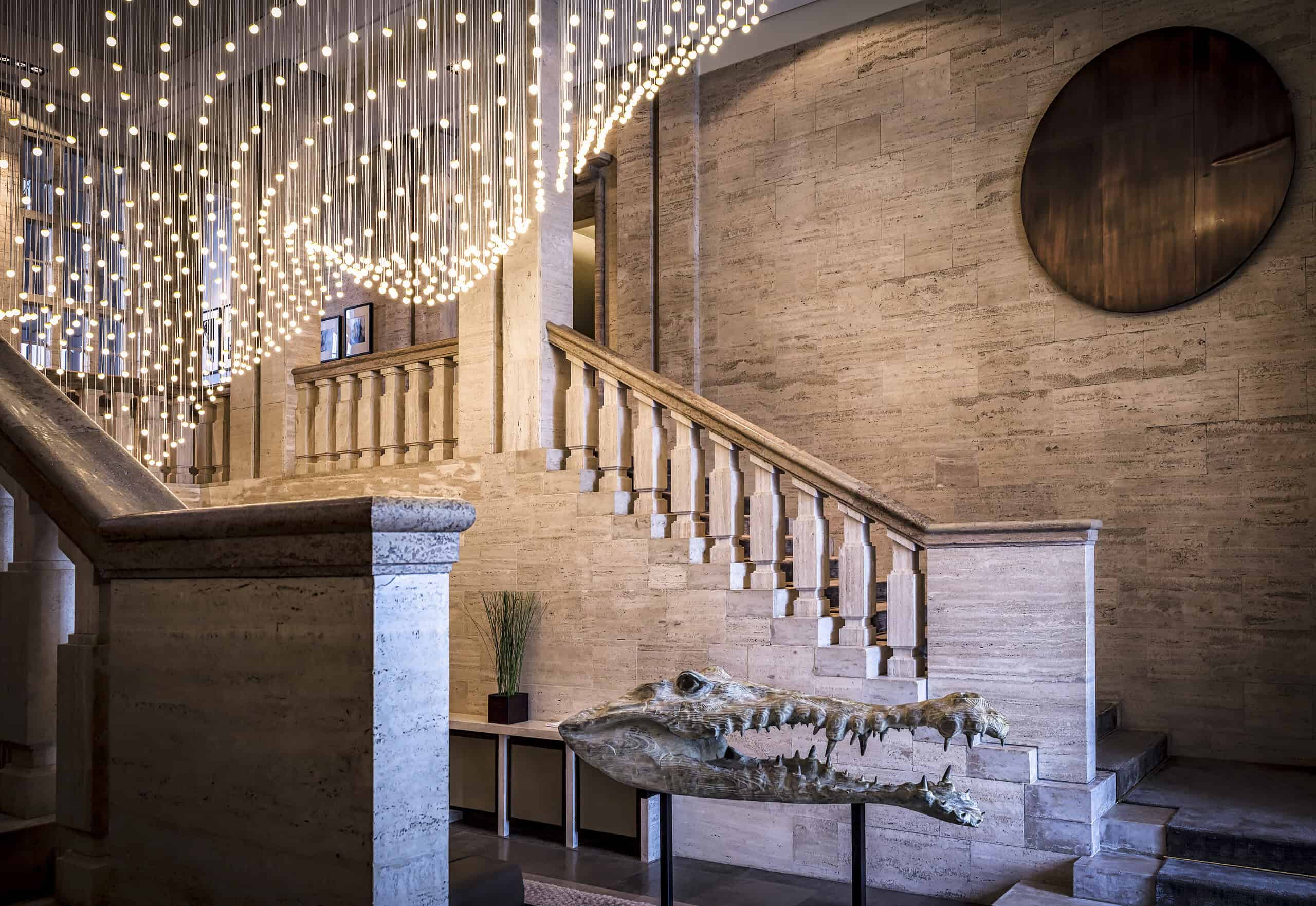
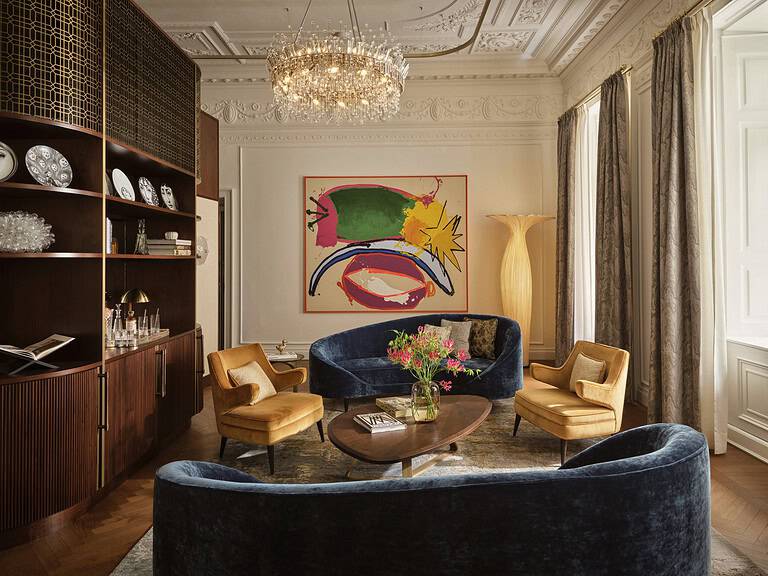
Historic architecture meets contemporary design in the lobby of Das Stue, Berlin. Photo: Courtesy of Das Stue.
Housed in Berlin’s former Danish Embassy, Das Stue pairs the monumental lines of its historic building with contemporary interiors and an atmosphere that’s impeccably designed and quietly luxurious rather than formal. Its greatest asset in fall is its location: the Tiergarten is quite literally on the doorstep, and some rooms and suites look directly over the park or neighboring Berlin Zoo. For travelers who want to step out into miles of autumn foliage while remaining firmly in central Berlin, it is difficult to imagine a better base.
Das stue
Address: Drakestraße 1, 10787 Berlin, Germany
Phone: +49 30 311 722-0
Nearby: Tiergarten, Berlin Zoo, Victory Column, Kaiser Wilhelm Memorial Church, Kulturforum
*Affiliate links may earn us a referral fee at no additional cost to you.
When to Visit Central Europe in Fall?
Fall in Central Europe encompasses a wide range of travel conditions. The best month depends on your preferences and priorities.
September is often warm without being oppressively so, with useful daylight. Performance schedules resume. The trade-off? More visitors than the phrase “shoulder season” might suggest. If avoiding crowds is your principal goal, September may not be the right fit.
For me, October is the sweet spot. You begin to get real foliage, temperatures are cooler but comfortable, and festival calendars offer a particularly diverse mix of activities. Crowds are fewer, if not exactly few. But at this point, it starts feeling like a visit with fewer demands.
November asks more of you. Days are shorter, weather can be gray, and the trees are giving up their leaves. But if your plans focus on museums, cafés, food, cozy bars, opera, and other performances, you can often expect fewer visitors and, depending on dates, better hotel rates.
Regardless of the month, autumn makes the transition between outside and inside feel particularly natural.
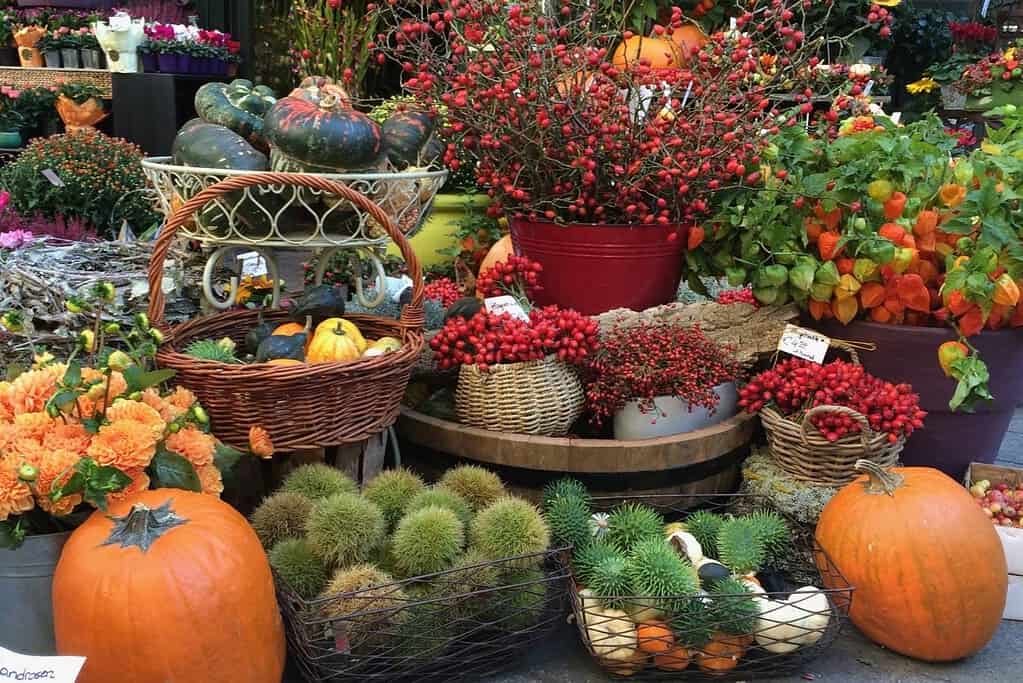
Autumn arrives even in the smallest details: seasonal flowers, berries, pumpkins, and foliage spill from a florist’s display on Vienna’s Stephansplatz. Photo: Catherine Barnes.
How to Travel to Central Europe in Fall?
What I love about these cities in autumn is not simply their changing colors. It’s the way a day can hold both discovery and repose: something to stimulate my mind, somewhere beautiful to walk, and a warm place to settle afterward. If you’re planning a trip to Central Europe in fall, consider the following:
Give yourself permission to slow down and enjoy the simple pleasures that autumn offers for a restorative and memorable trip to Central Europe this fall.