Prague Pause: A Travel Designer’s Guide to Cafés as Civic Spaces

Historic cafés in Prague explored through culture, architecture, and civic life — from the Café Louvre and Kavárna Slavia to the Café Savoy.
Prague was the city that first turned my studies of Eastern European and Soviet political history from an abstraction into a lived experience. Starting with work trips in the early 90s, over many visits, and culminating in a stint as a resident, I observed the human dynamics of daily life over cake, a newspaper, and many a piping cup in cafés that were steeped in history and lore.
In this Prague Pause series, I’ve translated those experiences into a select roster of cafés chosen for their backstories, architecture, and ambiance, the icing on the cake, if you will, to what emerges from the pot, the kitchen, and the pastry cart.
This first installment of the series considers where Prague fits within broader Central European café culture and what distinguishes its institutions from those in Vienna and Budapest. It further explores the role of Prague’s cafés as civic salons through the lens of three of its most notable establishments.
Jump to: Café Louvre | Café Slavia | Café Savoy
Prague Café Culture in the Shadow of the Habsburgs
Central Europe is famed for its café culture. If you’ve traveled around the region to any extent, you know there’s a recognizable ritual and rhythm around these institutions. Within that shared tradition, each café has its own character, shaped by its history, décor, and a cast of “regulars” who’ve animated its rooms. Writers, artists, dissidents, and revolutionaries passed through all three capitals, leaving behind stories that fuel the lore even today.
Prague’s historic cafés share the same Austro-Hungarian roots as their cousins in Vienna and Budapest. Across the region, you can expect strong coffee, layered cakes, and simple, comforting dishes. Each city adds its own accent, Vienna with its chocolate-and-apricot torte, Budapest with its paprika-tinged goulash, and Prague with its potato dumplings (“bramborové knedlíky”).
Still, each city’s cafes have a slightly different feel. Vienna’s cafes evolved into public drawing rooms, where the UNESCO-recognized “Kaffeehauskultur” blends everyday sociability with a lingering sense of Habsburg refinement set against imperial ornamentation.
Explore the Viennese Pause café series—an editorial guide to Vienna’s café culture: Imperial Cafes | Old Town Institutions | Bohemian Hideaways | Culinary Detours.
Budapest’s historic cafés, meanwhile, took on an almost theatrical grandeur. Many were housed in stately town homes (“palais”) that doubled as literary clubs and political salons, feeding a self-conscious fin-de-siècle cultural scene and, later, revolutionary debate.
A Budapest Pause café series is forthcoming, focusing on Budapest’s café culture and historic coffeehouses.
Prague’s heritage cafés sit at a slightly different crossroads, at least architecturally. Here cafés leaned more decisively into the modernism of the early 20th-century, moving from Art Nouveau to Orientalism, Czech Cubism and Art Deco. Culturally, many were tied to the Czech national revival and later to dissident life, serving as meeting grounds for opposition thinkers, most notably Václav Havel, well into the late 20th century.
For other posts in the Prague Pause series, see: Art Nouveau Cafes | Early Modernist Cafes.
Prague’s Cafés and Social Change
In Prague, the spaces themselves often feel more experimental than imperial. Even where grand styles were perpetuated through the use of gilding, wood inlay, frescos, crystal, and other ornamental details, Prague’s cafes were never meant just for elites.
Instead, they democratized the experience of grandeur, providing places where clerks, journalists, students, and small tradespeople could temporarily inhabit a lifestyle otherwise inaccessible to them.
CIVIC LIFE
Cafés as a Third Space
To appreciate the public role cafés played in Prague at the turn of the 20th century, it helps to place them in the context of the era’s infrastructure, technology, and economics. While cafés are often remembered as creative and intellectual salons, they also served as essential urban spaces.
Cafés offered reliable heating, electric lighting, and running water—amenities not uniformly available in Prague’s urban housing at the time. They provided a warm, well-lit place to linger away from home, without the expense or social barriers of private clubs.
For those without private offices—lawyers, writers, journalists, and traders—Prague’s cafés also stood in as a place to work and to conduct business long before modern-day coffee shops that shall here remain unnamed. It wasn’t uncommon for regulars to receive mail or messages at their favorite café, or for waiters to serve as informal gatekeepers.
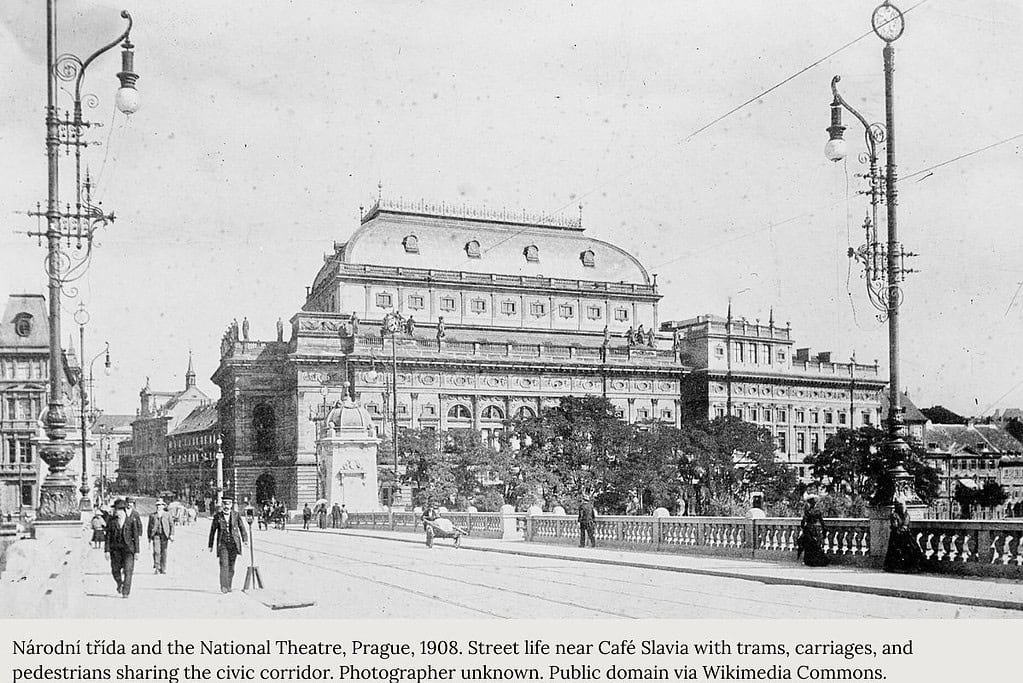
Cafés also subscribed to multiple domestic and international newspapers and journals, allowing patrons to spend hours reading for the price of a cup of coffee. During periods of political volatility—from the late Habsburg era through the First Republic and the interwar years—cafés became informal information hubs where news circulated freely and publicly.
Beyond coffee and cake, many Prague cafés offered billiards, chess, and card games. More than trivial diversions, these games provided structured sociability that encouraged extended stays and culturally acceptable interaction across class lines.
In this way, Prague’s cafés served not only as intellectual and creative salons but also as shared urban infrastructure—public rooms that supported the rhythms of everyday civic life.
Sources: Pinsker, Shachar M., A Rich Brew: How Cafés Created Modern Jewish Culture (NYU Press, 2018); Schorske, Carl E., Fin-de-Siècle Vienna: Politics and Culture (Vintage, 1981); Radio Prague International, “Cafés: Prague’s Living Rooms of the City.”
The Best Civic Cafés in Prague
Jump to: Kavárna Slavia | Café Savoy
Café Louvre
Brainstorms and Billiards
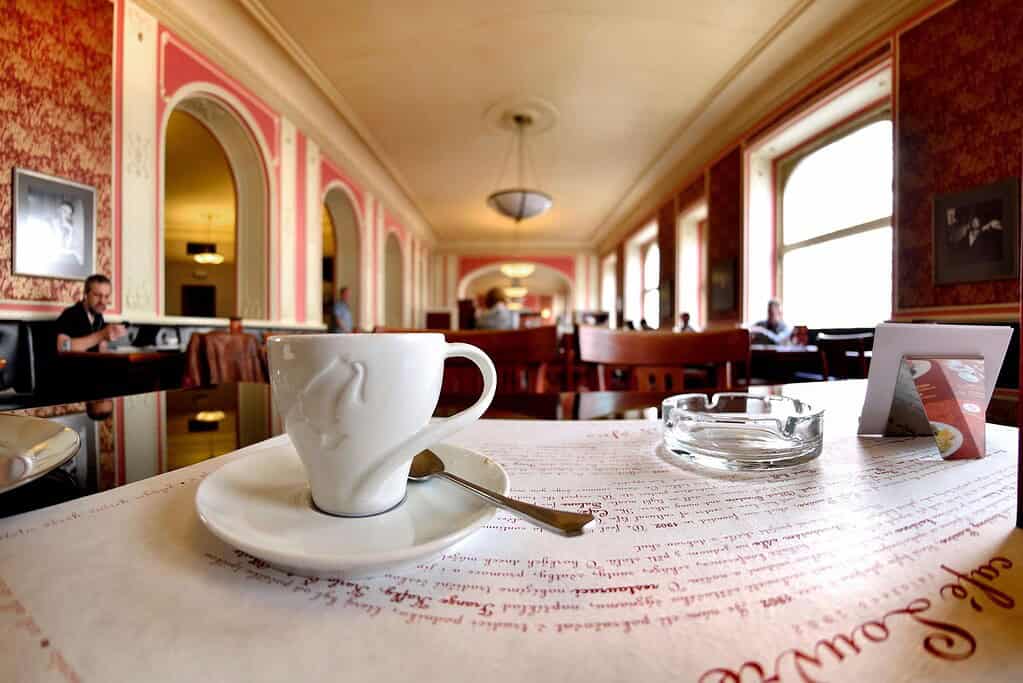
Photo: Pjr Travel/Alamy
Opened in 1902, Café Louvre is one of Prague’s enduring grand cafés—deeply beloved by locals and well worth a place on any thoughtful visitor’s shortlist. Known for its generous menu, classic sweets, and long tradition of lingering, it’s also linked to prominent intellectuals, among them Albert Einstein, and associations, including Berta Fantova’s German Philosophical Circle, PEN (the local chapter of the international writers association), and the Sursum Art Association, which decried realist artistic trends, dealing instead with spiritual and cult issues.
The café has also played a dramatic role in the city’s history. It entered Prague’s modern lore in 1948, when—following the Communist takeover—its furnishings and equipment were thrown out of the windows, a political act with deep symbolic implications. The premises were used for a variety of purposes in the subsequent years and fell into disrepair before the space was renovated and reopened in 1992.
POLITICAL CONTEXT
Defenestration as a Political Act
Defenestration—the act of throwing something, or someone, out a window—has deep roots in Prague’s history. The city is famously associated with multiple political defenestrations dating back to the 15th century, when windows became instruments of power, protest, and rupture.
Three major historic incidents (1419, 1483, and 1618) saw political figures cast from windows during periods of upheaval. The 1618 defenestration at Prague Castle helped trigger the Thirty Years’ War. Later, the 1948 death of Foreign Minister Jan Masaryk was widely viewed as a politically motivated defenestration in the modern era.
Sources: Public Domain Review, “Windows onto History”; Radio Prague International, “The First Defenestration of Prague: What Was It and Why Did It Happen?”
Upon entering the massive townhouse at Národní 22, you’ll encounter an impressive marble staircase. Proceed upward to the first floor, where you’ll pass through a sizable receiving area. While there, check out the antique map depicting Prague’s café scene (with period images) from 1902, when the Café Louvre. It’s a reminder of just how dense the city’s café network was at the turn of the century.
The café boasts multiple salons, each with its own personality. The pink and yellow main salon always reminds me of macarons. At the front end of the salon is a room with walls reminiscent of pistachio ice cream. When I first started going to the cafe, this space served as the no-smoking section (Prague went smoke-free in 2017). Originally, it was created for use by women, who were admitted to the café without male escorts, a socially progressive practice at the time.
At the opposite end and off to the side is the billiards room, the most masculine of the spaces, grounded by dark wood paneling and burgundy carpeting, with neutral walls and brass light fixtures.
There are also additional dining areas (both enclosed and balcony) that feel a bit more French and provide a more reserved and intimate dining experience.
Beyond the rooms themselves, the Café Louve takes on distinct moods depending upon when you go, whether for lunch, weekday breakfast, weekend brunch, mid-afternoon break for coffee and cake, dinner, or late-night billiards. For the people watching alone, it’s worth repeat visits at various hours.
What’s On Offer
A grand Belle Époque café that brings plenty of local lore, it’s ideal for travelers who crave historic atmosphere and lively energy. Modeled on Viennese cafés, it offers coffee and tea, homemade desserts, Czech and international main dishes, daily lunch specials, and a full drinks list.
Known For
The extensive menu includes house cakes and pastries, traditional Central European dishes (goulash, schnitzel, etc.), robust breakfast/brunch offerings, and billiards.
Service
The café’s overall reputation is quite good, with well-run service despite high volume.
My Take
For the best people-watching, sit in the main salon, with a view that takes in the length of the café and the billiards room to the side. Prepare to stay for a while. I particularly enjoy long lunches on Friday afternoons when locals consume copious amounts of food and alcohol and debate the issues of the day. Whatever else you get, I’d highly recommend the café’s famous hot chocolate, which will require a spoon to consume.
VISITOR INFORMATION
Website: cafelouvre.cz
Address: Národní 22, 110 00 Praha 1
Hours: Weekdays, 08:00 AM – 11:30 PM; Saturday and Sunday, 09:00 AM – 11:30 PM. Tea service is also available at 5:00 PM.
Nearby: National Theatre (Národní divadlo) near Národní Street, the Vltava riverside, and New Town shopping
Kavárna Slavia
Dissent and an Absinthe Haze
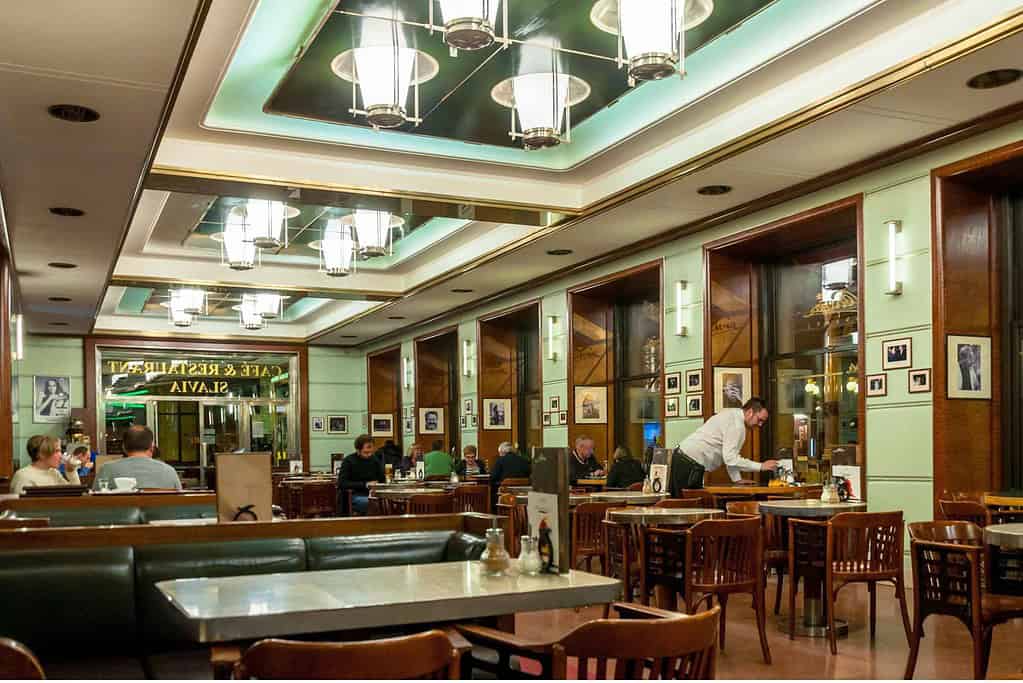
Photo: Veronika Pfeiffer/Alamy
Along the same street as the Café Louvre, but predating it by 20 years, give or take a few, sits the Kavárna Slavia (on the ground floor of the Palác Lažanských). This local institution has remained plugged into Prague’s literary and political heartbeat even during the darkest days of Communism, including after the crushing of the Prague Spring in 1968.
To better understand the distinction between a café, kavárna, and cukrárna, take a look at the Prague Pause post on Art Nouveau Cafes.
The café came into existence around the time of the National Theater, which sits across Narodni street, offering theatergoers and actors alike a place to take refreshment. The walls are adorned with photos of the performers, writers, artists, intellectuals, and bohemians who have frequented the café over its long history.
The current décor dates to the First Republic. An excellent example of Czech Art Deco design, the Café Slavia is more streamlined and functional than the other cafés featured here. Its interior features rose-hued flooring, pale walls, warm woods, Thonet chairs, and dark green leather banquettes.
By day, light pours into the space through large plate-glass windows that extend along two sides of the café, offering impressive views of the Vltava River, the National Theater, Prague Castle, and the Charles Bridge. At night, aluminum and opaline lanterns, along with a dramatic neon-green halo light, produce a soft glow.
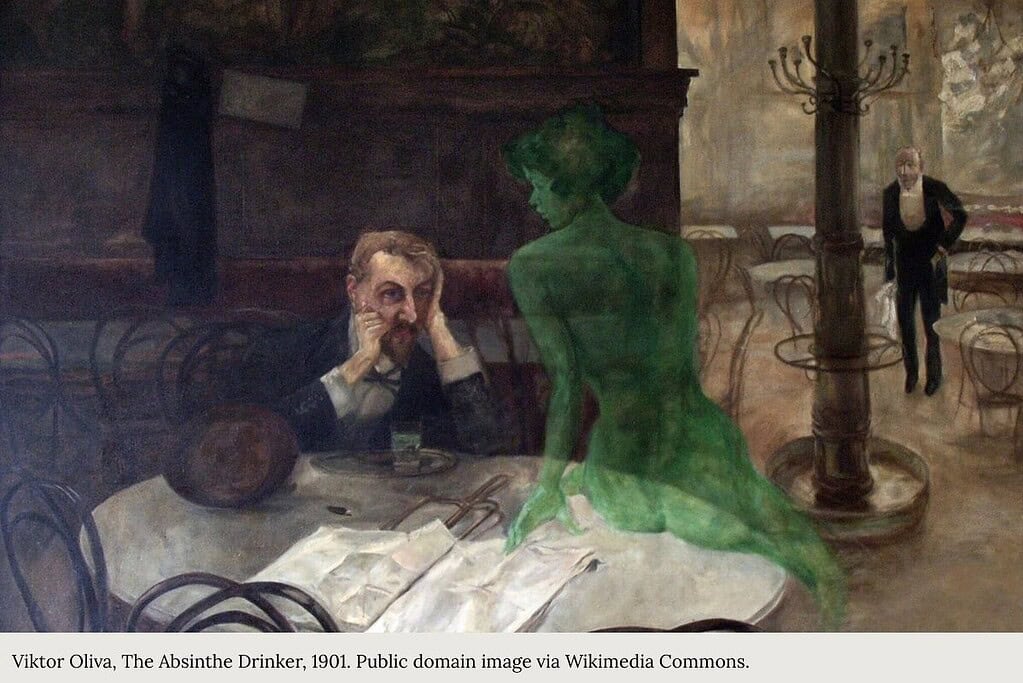
At the far end of the café and just around the corner hangs a historic copy of Viktor Oliva’s 1901 painting The Absinthe Drinker. The original resides in Prague’s Zlatá Husa Gallery, but the café’s copy has become part of Slavia’s identity.
Oliva was a member of the Parisian Bohemians, a group of Czech artists who lived in Paris during the late 19th and early 20th centuries. During his time in Paris, Oliva came to appreciate the joys of absinthe. His painting depicts a man sitting alone in a café, an absinthe-induced, green haze of a woman perched atop his table.
This notorious image provided a familiar backdrop for Václav Havel and his circle during the Communist era and dissident years, hanging above their perpetually reserved table—a testament to the café’s enduring role as a meeting place for Prague’s writers, artists, and thinkers.
DRINKING HABITS
Absinthe in Prague
Absinthe was never the defining drink of Prague’s cafés, but it was present as a cosmopolitan import during the late 19th and early 20th centuries.
Unlike France and Switzerland, where moral panic, temperance pressure, and economic lobbying from the wine industry helped drive early 20th-century bans, absent an equivalent social surge in demand, absinthe was never regulated in the Czech lands under the First Republic or Communist rule — and remained legal after the Velvet Revolution.
When it was served, absinthe followed the same ritual practiced elsewhere in Europe: a dose poured into a glass, a sugar cube resting on a slotted spoon, and ice-cold water slowly dripping from a carafe or fountain to dilute the spirit and create the classic louche effect.
The specialized glassware, fountains, and spoons that grew up around this practice became decorative and collectible, embodying the café’s role as a place of ritual, leisure, and shared public life.
Today, the abundance of absinthe paraphernalia in Prague reflects the city’s enduring fascination with Belle Époque café culture, rather than having been evidence of widespread historical consumption.
Source: Radio Prague International, “No Other Spirit Has So Much Mystery,” Evan Rail on absinthe’s Czech links and more (October 7, 2024).
What’s On Offer
Classic riverside café with coffee, cakes and full meals: breakfast, Czech cuisine with a modern twist (salads, fish and meat mains along with traditional dishes), plus wine, beer and cocktails.
Known For
Palacinky / crêpes, classic cakes and pastries, as well as Czech mains such as schnitzel and svíčková (marinated beef sirloin, slow-roasted, served with a vegetable-cream sauce and accompanied by knedlíky and a spoonful of lingonberry or cranberry sauce).
Service
Service is mostly smooth and efficient, but can slow down during peak times.
My Take
I like to pop into the Café Slavia at night when Prague Castle, the National Theater, and the panorama in between are illuminated. It’s an ideal place to rest if you’ve been walking around New Town and need a sugar and caffeine boost. If you’re attending a performance at the National Theater, it only makes sense to drop by.
VISITOR INFORMATION
Website: cafeslavia.cz
Address: Smetanovo nábřeží 1012/2, 110 00 Praha 1
Hours: Weekdays, 10:00 AM – 11:00 PM; Saturdays, 9:00 AM – 11:00 PM; Sundays, 9:00 AM – 10:00 PM
Nearby: National Theatre, Vltava River, and Charles Bridge within easy walking distance.
Note: The Café Slavia also now hosts a great new bar, Fobina, to the back of the entry foyer. I’ll be sharing my views on that space in the upcoming Pour Decisions: A Travel Designer’s Guide to Well-Appointed Bars in Prague.
Café Savoy
Ceiling Envy
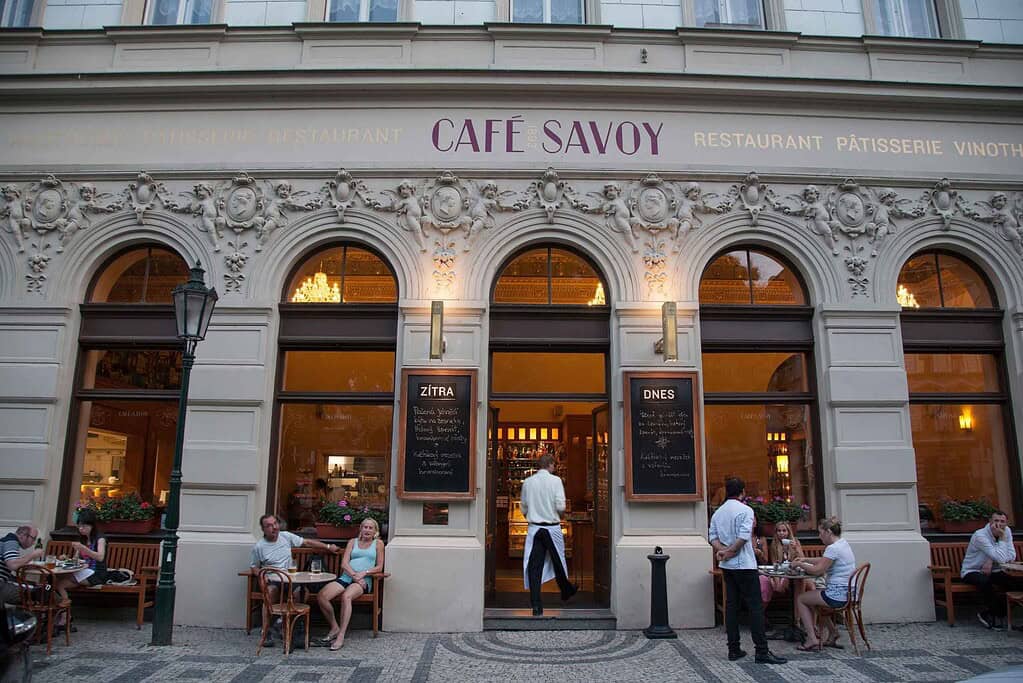
Photo: Kevin George/Alamy
The beautifully restored Café Savoy boasts an ornate Neo-Baroque ceiling that soars to a height of seven meters (23 feet). The café’s mix of historic and modern design evokes opulence, from its wood-and-marble décor to its wine wall and custom chandeliers. Czech artist Vernika Richerova, who specializes in recycled materials, including plastic bottles, specially designed the unique lighting for the Café Savoy.
The large arched windows, which match the room’s scale, flood the space with light during the day. An adjacent seat provides an excellent view of the goings on within and beyond the café. As the day progresses and the sun sets, the ambiance in the room shifts from bustling café to sophisticated dining spot.
If you’re in search of other fine dining options, including Michelin restaurants in Prague, read my post, Savoring Prague: A Travel Designer’s Guide to Fine Dining.
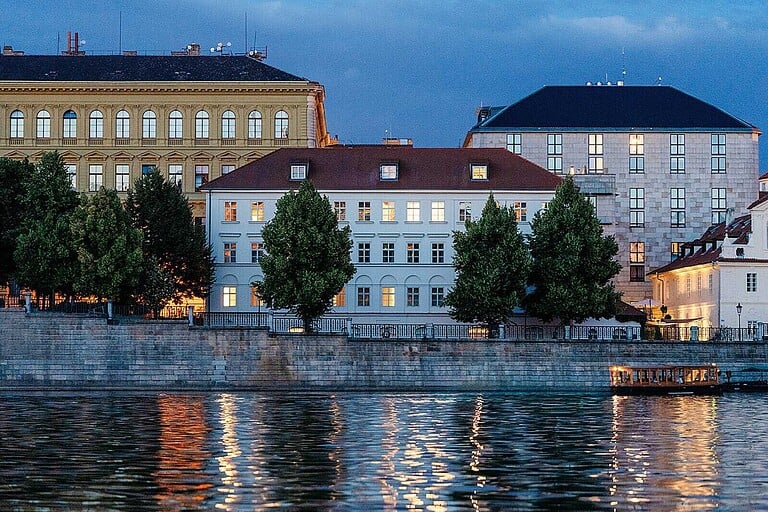
The Café Savoy has long occupied a liminal, very public corner between different social worlds. Opened in 1893 on the Malá Strana side of the Legion Bridge, it stood at the bridgehead between the industrial, working-class Smíchov neighborhood and the more “respectable” left bank. This embodiment of “location, location, location” contributed to a social space where classes intermingled rather than one of closed exclusivity.
Over the decades, the premises shifted functions. It closed during World War I. For a time thereafter, it housed various commercial establishments, including a butcher’s shop and a fish shop. During the drab Communist era, it served as a recruiting office for the security services.
During that time, and as with so much else, the beauty of the place was suppressed. Its ornate ceiling was plastered over, and the wall of the Blue Salon (a private dining space) was destroyed. In the years immediately following the Velvet Revolution, it became a smoky neighborhood haunt. The current owners undertook an extensive renovation and succeeded in recreating the Belle Époque style.
What’s On Offer
A refined restaurant–patisserie that sets a strong breakfast benchmark. In addition to breakfast and brunch, the Café Savoy offers an in-house bakery that prepares excellent pastries and cakes, Czech and French dishes for lunch and dinner, and a full bar with over 500 wine selections. Compared to the other cafes featured here, the space is a bit more formal and gives off a sophisticated air.
Known For
House pastries, including the Cake Savoy, breads, elaborate breakfast plates, and signature mains and bistro-style dishes, including roasted meats.
Service
Attentive, professional, and a bit formal. Reservations are recommended to avoid queues. In addition to crowds, you should also expect to pay higher prices compared to other cafes in the city.
My Take
Visit for coffee and a pastry or for weekend brunch. When there, be sure to venture downstairs for a view of the glass-walled pastry kitchen. The Café Savoy is a great spot to visit if you’re in the vicinity of Kampa Island. If it’s a sunny day, pair your visit with a stroll along the tree-lined Smetana Embankment with its beautiful townhomes and a view of the river.
The café is also right on the tram line in Prague. If you find yourself on lines 22, 23, or 12, the “Vítězné Náměstí” is the place to disembark and pop into the café. From Old Town or the Lesser Town, Savoy is often a one to two-stop tram ride. It’s also a short hop from major transit hubs like Karlovo náměstí and the tram network along Národní třída.
VISITOR INFORMATION
Website: cafesavoy.ambi.cz
Address: Vítězná 5 (or 124/5 depending on mapping), 150 00 Praha 5, Malá Strana
Hours: Weekdays, Monday – Friday, 8:00 AM – 10:00 PM; Weekends, 9:00 AM – 10:00 PM.
Nearby Attractions: Kampa Island, Vlatava River, Legion Bridge, Smetana Embankment, Victims of Communism Memorial, Petřín Hill.
Taken together, Café Louvre, Kavárna Slavia, and Café Savoy underscore the role of Prague’s cafes at the intersection of private and public life—from workplaces and information hubs to sites of dissent, ritual, and everyday sociability.
In the next installments of the Prague Pause series, we turn to cafés shaped by Art Nouveau and early modernist aesthetics, where architecture itself became a vehicle for cultural expression and national identity.