Prague Pause: A Travel Designer’s Guide to Early Modernist Cafés

Where the rituals of reading, conversation, and people-watching unfold over coffee and torte—inside Prague’s modernist cafés.
Learning About Prague Through Its Cafés
My graduate studies in Eastern European and Soviet political history eventually led me to a global career, one that inevitably returned me to Central Europe again and again. Prague was the site of my first business trip, and it quickly became a recurring chapter in my professional and personal life. When I lived there, I wandered the streets with purpose and curiosity, settling into cafes for hours at a time, nibbling, reading, writing, and people-watching.
Because I’m a visual thinker, I pay close attention to design, atmosphere, and vivid backstories. In my Prague Pause series, I help travelers discover the best cafes in Prague, places with meaningful histories, distinctive interiors, and worthwhile house specialties. Even when menus echo a shared Austro-Hungarian heritage, each café offers something unique.
This third post of the Prague Pause series explores how Prague’s cafés deviate from Imperial traditions, taking an imaginative turn through Orientalist, Cubist, and early Art Deco design.
For context on how Prague’s cafés fit within broader Central European café culture—and what distinguishes them architecturally and culturally—start with Prague Pause: A Travel Designer’s Guide to Cafés as Civic Spaces.
Four Cafés Where Prague Embraced Early Modernism
Jump to: Café Imperial | Kaverna Lucerna | Grand Café Orient | Cukrárna Myšák
We explore some of Prague’s most noted cafes featuring Orientalist and Cubist motifs. In this context, early modernist describes cafés designed at the turn of the 20th century, when historic styles began giving way to experimentation. Architects explored geometry, color, exotic motifs, and new spatial ideas—creating interiors that felt daring and forward-looking, without entirely abandoning the warmth or ornament that the public had come to expect.
DESIGN TERMINOLOGY
Orientalist Motifs in Early Modernist Cafés
In cafés such as Imperial and Lucerna, Orientalism refers to a historic European design trend, popular roughly between 1880 and 1920, that drew on abstracted motifs from North African and Middle Eastern art. At the time, these patterns were admired for their geometry, color, and surface richness, and were used to evoke luxury, exoticism, or a sense of worldliness.
Today, the term carries more complex associations. Modern scholarship recognizes that Orientalist design emerged from unequal cultural power dynamics and often reflected a stylized, Western-imagined vision of “the East.” In this guide, the term is used strictly in its architectural and decorative sense, to describe the visual vocabulary of the period.
Café Imperial
Embroidery Rendered in Clay
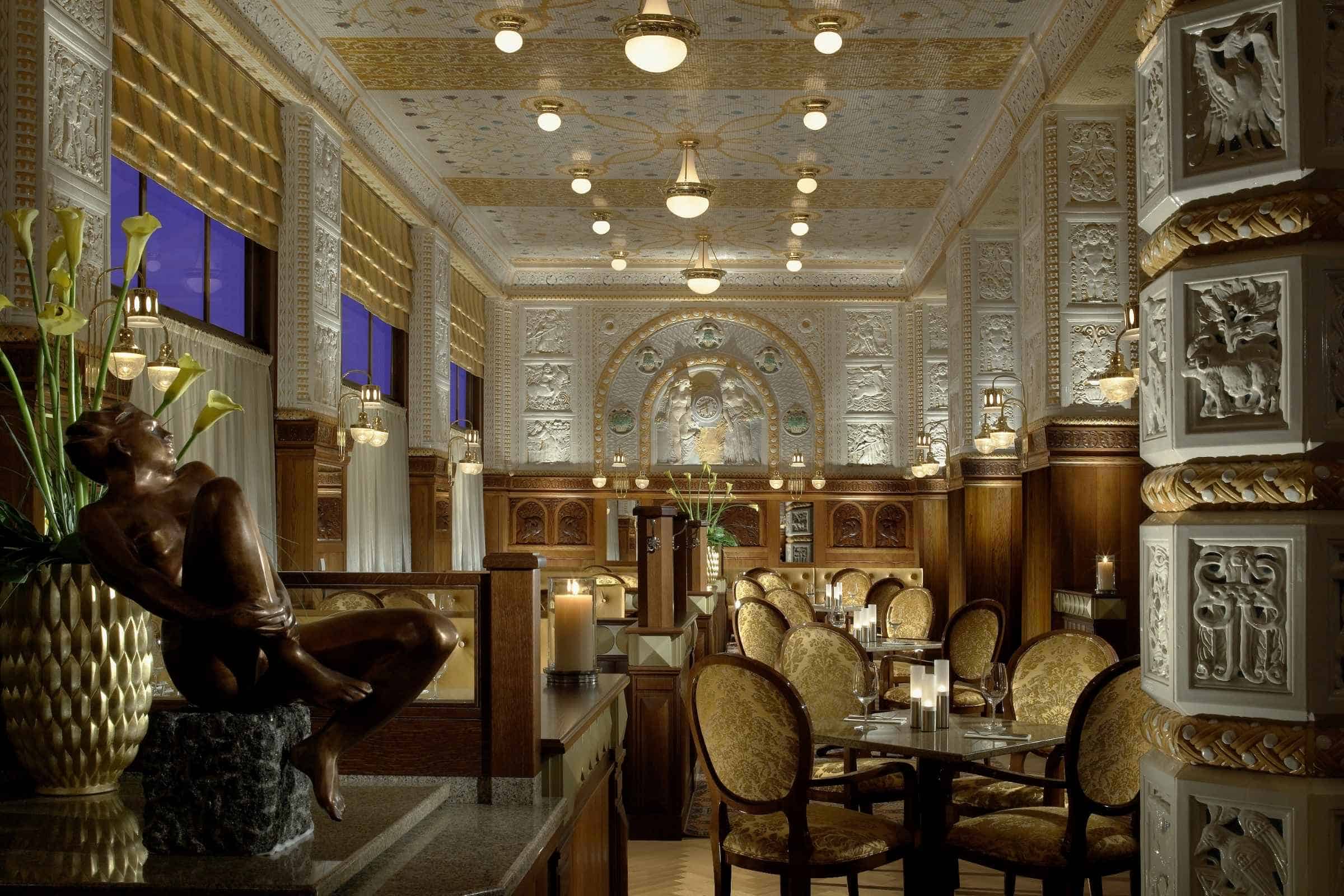
Photo: Courtesy of the Art Deco Imperial Hotel Prague
The Hotel Imperial’s muted Art Deco exterior, defined by cubist elements and gray-brown stone, hardly prepares you for what awaits inside. Beyond the entryway, the Café Imperial reveals one of Prague’s most spectacular surviving Art Nouveau interiors. A rare, original ceramic masterpiece, it’s one of the clearest examples of Orientalist influence in early-20th-century café design.
Step through the door and you’re wrapped in a jewel box of glossy, hand-made ceramic tiles adorned with geometric, animal, and hunting motifs drawn from Egyptian, Greek, and Moorish art.
Beneath the gleam, a band of dark, carved wood wainscoting grounds the room, its quietly intricate craftsmanship offering a warm counterpoint to the exuberance above. The upper walls rise in rhythmic friezes of sculpted relief panels in shades of ivory, ochre, and blue.
At the back of the room, a monumental, sculpted lunette of allegorical figures with a central clock creates one of the most elaborate decorative walls in any Prague café.
Tiled pillars carry the eye upward toward a shimmering mosaic ceiling, whose swirling floral and gold-flicked patterns are arranged like a vast, luminous tapestry, like embroidery rendered in clay.
POLITICAL RUPTURE
Café Imperial’s 20th Century Ordeal
From the 1939 Nazi occupation onward, Café Imperial’s story mirrors the upheavals of 20th-century Prague. During WWII, the café became a favored haunt of German officers, which drove away many of its regular Czech clientele. After the 1948 Communist coup, the building was nationalized, requisitioned for use by trade unionists and the Party.
Its elegant rooms were converted into a basic workers’ canteen. Residue of decades of heavy smoking dulled the once radiant room. Its damaged tiles were sloppily patched, if at all, with little regard for the original craftsmanship. By the 1980s, the building had slipped into deep decline. After 1989, and following a series of renovations, the Café Imperial has reacquired its former splendor and stands as a cherished national cultural monument.
Sources: hotelmperial.com, “What Story Behind Our Hotel”; Podnos.cz, “Café Imperial.”
What’s on Offer
A grand café–restaurant serving coffee, pastries, breakfast, lunch, dinner, dessert, and a full wine and beer list. Menus are overseen by celebrity chef Zdeněk Pohlreich and his team.
Known For
Hearty Czech classics including slow-roasted beef (svíčková), roast pork knuckle, goulash, schnitzel, dumpling dishes, and signature deserts, including the Imperial Cake and a stylish spread of patisserie.
Service
Typically polished and professional, though the café’s popularity means it can feel busy or slightly impersonal during peak hours.
My Take
The Café Imperial has long been one of my favorite weekend spots for breakfast or lunch. It’s an ideal spot for architecture lovers, design devotees, and anyone craving a formidable torte or a proper meal in a setting that feels lifted straight from Prague’s early modernist Golden Age. Reservations are strongly recommended on weekends and for dinner. Before you leave, wander through the adjoining sitting rooms and lobby area of the Hotel Imperial to see even more extraordinary Orientalist-inspired details.
VISITOR INFORMATION
Website: Café Imperial Website
Address: Na Poříčí 15, 110 00 Praha 1
Hours: Daily, 7:00 AM – 11:00 PM
Nearby: Republic Square (Náměstí Republiky), Palladium Shopping Center, historic Tenement House architecture on Na Poříčí
Visit the Hotel Imperial website
The Café Imperial is among the more formal and fancy cafés featured in this Prague Pause series. If you’re looking for more formal dining options, check out Savoring Prague: A Travel Designer’s Short List For Fine Dining.
Kaverna Lucerna
Coffee at the Cinema with Kafka
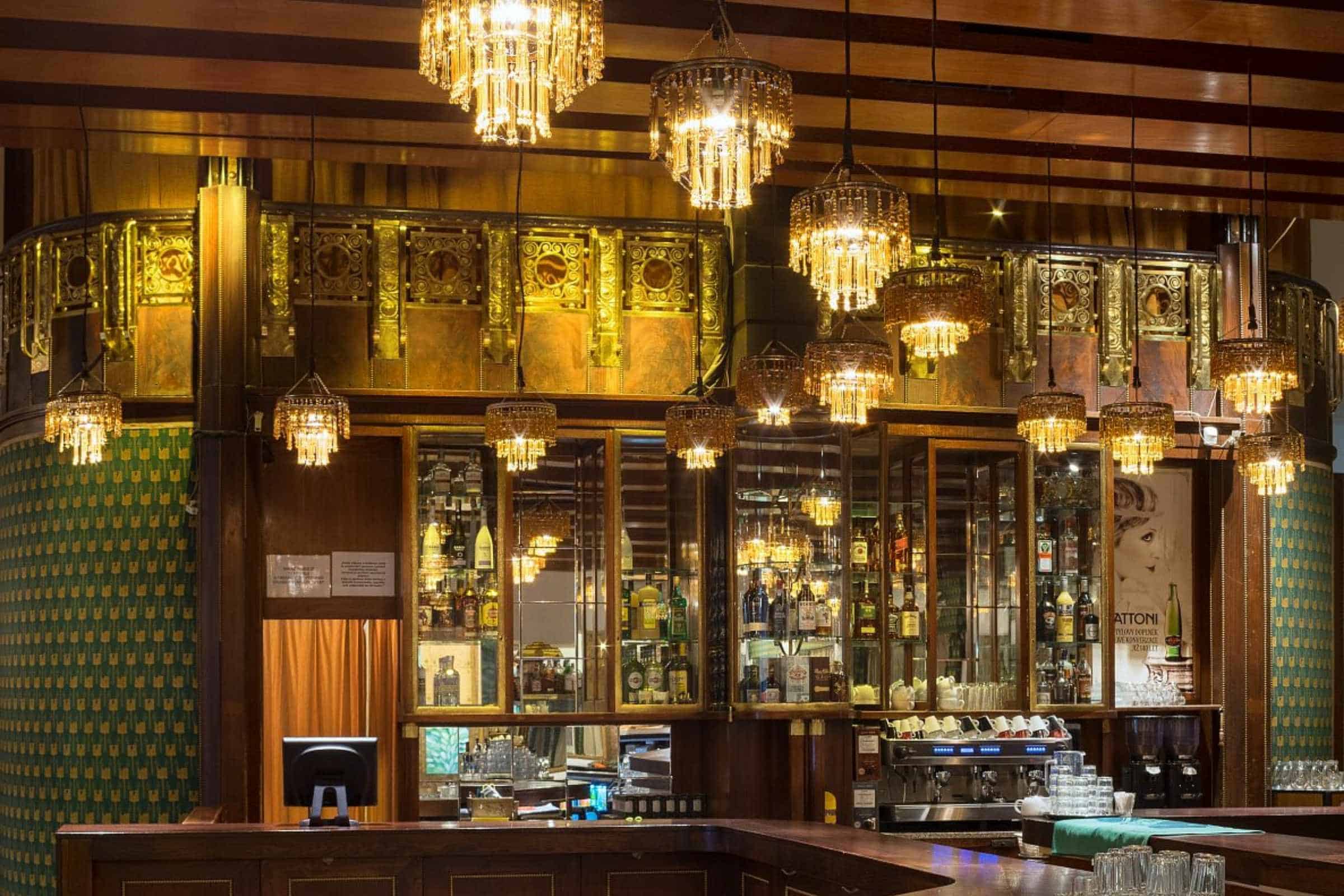
Photo: Courtesy of Lucerna Café
On Vodičkova Street, just off Wenceslas Square, stands a building that was, in many ways, ahead of its time. Built by the grandfather—and namesake—of playwright, dissident, and later president Václav Havel, the Lucerna (lantern) Palác was Czechoslovakia’s first genuinely multi-purpose arcade.
Clad in red marble and crowned with a frosted-glass skylight and a stunning central dome, the complex housed shops, eateries, and entertainment venues, including the country’s first cinema to screen sound films. It functioned as an early 20th-century social and commercial hub: a precursor to the modern shopping mall, albeit infinitely more elegant. In 1913, it became the first covered passage in Prague, running through from one street to another.
The Lucerna Palác is also a fascinating collision of early 20th-century architectural currents. Built between 1907 and 1911 with one of the city’s earliest reinforced-concrete frames, it technically falls into the late Art Nouveau period. Yet its geometric lines, monumental presence, and occasional Orientalist flourishes lean decisively into early modernism, foreshadowing the arrival of Art Deco in Central Europe.
Meanwhile, the Palac’s cinema inhabits an entirely different world. It’s a richly intimate neo-Baroque jewel box wrapped in warm gold tones, and adorned with ornamental plasterwork and scalloped balconies. The space is reminiscent of an opera house, if only slightly smaller in scale. The cinema was a favorite escape, a form of “unbridled entertainment,” for Franz Kafka, the eventual absurdist writer, who worked nearby at the considerably more mundane Workers’ Accident Insurance Office.
Off the first landing of the grand staircase leading to the cinema (kino), sits a nostalgic, slightly bohemian café, the Kaverna Lucerna. The focal point of the room is an expansive bar with café tables radiating outward across multiple sides. Dark wood, geometric brass friezes, and a green-and-gold palette create a warm ambience, further enriched by a constellation of small, tiered pencil-glass chandeliers.
On one side, a bank of tall, narrow arched windows framed in polished marble surrounds provides an incomparable view of David Cerný’s infamous sculpture of St. Wenceslas mounted on an upside-down horse. It’s also the best spot to watch people promenading through the passage below.
Like so many of Prague’s private landmarks, the Lucerna Palác fell victim to the upheavals of the mid- 20th Century. During the Nazi occupation, its glamorous halls were requisitioned for political meetings and propaganda-fueled cultural events. After WWII, Communists used the building to plot their takeover of the country.
Nationalized in 1952, the Lucerna Palác slowly deteriorated until it was returned to the Havel family in 1990, after which significant restoration work began. Today, the building is protected as a National Cultural Monument.
What’s On Offer
A hybrid daytime café/evening bar serving hot and cold drinks, snacks, and cakes. A limited, rotating, weekday business lunch menu with a daily soup and choice of two mains is offered. Cocktails, beer, and wine are also available.
Known For
Espresso drinks, cocktails, the vibe, and celebrity sightings (around movie premieres).
Service
During peak hours, service can slow down a bit. Go for the atmosphere and give yourself time to settle in.
My Take
I prefer Kavarna Lucerna in the evening, when the room leans into its moody, dramatic character. It’s an unforgettable place for a pre-movie drink or dessert. If possible, time your visit with an English-language or subtitled film in the Lucerna cinema. The space is breathtaking and, honestly, what history or literature enthusiast wouldn’t savor watching a movie in the very cinema where Kafka himself once sat?
Note: If you’ve never been to Prague and are looking for the Lucerna cafe online, prepare for a little confusion. Multiple venues share the Lucerna brand, and the marketing doesn’t always clearly distinguish them. This post refers only to Kavárna Lucerna, the historic café located up the grand stairway beside the entrance to the Lucerna cinema (“Kino”). Other venues in the complex include: Lucerna Music Bar, a basement club and live-music venue; Lucerna Café Bar, a trendy ground-floor space offering modern cuisine, cocktails, and longer hours; and Hospoda Lucerna, a pub-style spot adjacent to the music bar downstairs.
VISITOR INFORMATION
Website: Kavárna Lucerna
Address: Vodičkova 36, 110 00 Praha 1
Hours: Mon – Fri, 11:00 AM – 11:00 PM; weekends, 12:00 noon – 11:00 PM
Nearby: Lucerna Palác, Wenceslas Square, National Museum
Grand Café Orient
A Café On Edge
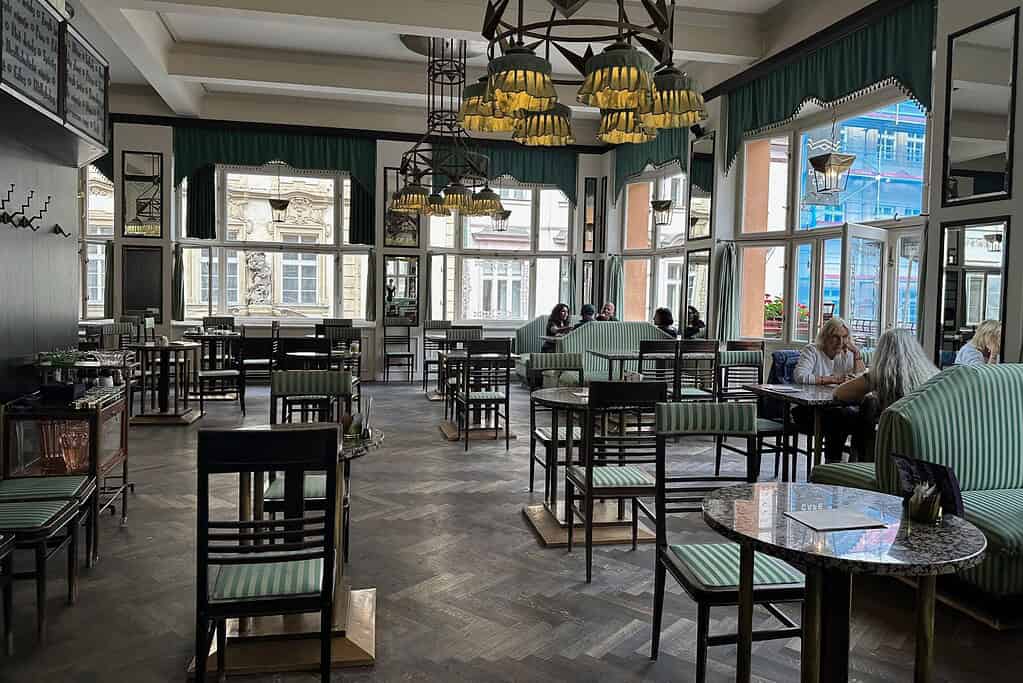
Photo: Catherine Barnes
Between 1912 and 1924, Czechoslovakia embarked on an avant-garde rebellion against Art Nouveau in favor of a distinctive Czech style of Cubism.
The Grant Café Orient occupies the first floor of what was a Cubist department store, designed in 1911-1912 by Josef Gočár, a 31-year-old architect. The building’s faceted façade, zig-zag central staircase, and prismatic detailing mark it as one of the purest surviving works of Czech Cubist architecture.
At the time, municipal authorities worried about the construction of a modern building in the heart of the Old Town. To assuage their concerns, Gočár incorporated a corner statue niche on the right side of the building to house a statue of the building that had previously occupied the same spot. This is how a Cubist masterpiece came to feature a Baroque statue of a Black Madonna (and thus carried on the name, “House of the Black Madonna”).
The café itself boasts an unusual footprint that wraps around two sides of the building’s interior. Within the room, Cubist elements are everywhere, from the seating arrangements, furniture profiles, and lights featuring a faceted metal cage with multi-planar shades, all the way down to the coat hooks, serving pieces, and even some of the pastries.
By the 1920s, Czech Cubism was passé. The designs bore certain Oriental undertones that harkened to the Empire’s alliance with Turkey, which was wholly incompatible with the new Czechoslovak leadership’s vision for the First Republic. Barely a decade from opening its doors, the café went out of business until well after the Velvet Revolution in 1990.
In 2000, the city government bought the historic site to house a dedicated Czech Cubism Museum. Four years later, the newly named Grand Café Orient reopened after a painstaking restoration, during which the furnishings and decor were recreated solely from old black-and-white photos of the era.
What’s on Offer
An iconic cubist café with coffee, tea, desserts, breakfast items, and a small selection of hot dishes. Swing music from the 1930s and 1940s, lectures, readings, and other cultural events are also on offer as per the website calendar.
Known For
Excellent pastries and cakes. On the savory side, breakfast is better than the hot mains.
Service
The space is beautiful, but the service can be inconsistent when the restaurant is full.
My Take
The main attraction here is really the building and the space itself. The restoration is very well done and just the kind of thing that speeds the pulse of historic design enthusiasts. During warm months, a small balcony provides an excellent vantage point for people-watching. My advice is to indulge in some coffee and cake (rather than a meal) before or after visiting the Cubist museum on the upper floors (be sure to buy a museum ticket on the ground floor before ascending the circular staircase). Afterwards, pop around the corner to Kubitsa, one of my favorite shops in the city.
Note: Be sure you’re at the right café. For Americans, be advised that the “first floor” means one level up from the ground floor. It’s easy to get diverted by the Black Madonna café, to the right side of the building (if facing it), right under the statue. It does a good job of mimicking the cubist design, but there’s no backstory there. The Kubitsa shop, on the left side of the building (when facing it), has a separate entrance outside the building (don’t confuse it with the museum shop on the ground floor, which offers comparatively little).
VISITOR INFORMATION
Website: Grand Café Orient
Address: Ovocný trh 19, 110 00 Praha 1, Staré Město
Hours: Monday – Friday, 9:00 AM – 10:00 PM; Saturday and Sunday, 10:00 AM – 10:00 PM
Nearby Attractions: Museum of Cubism (upstairs), Kubitsa shop, Old Town Square
Cukrárna Myšák
Dual Identity
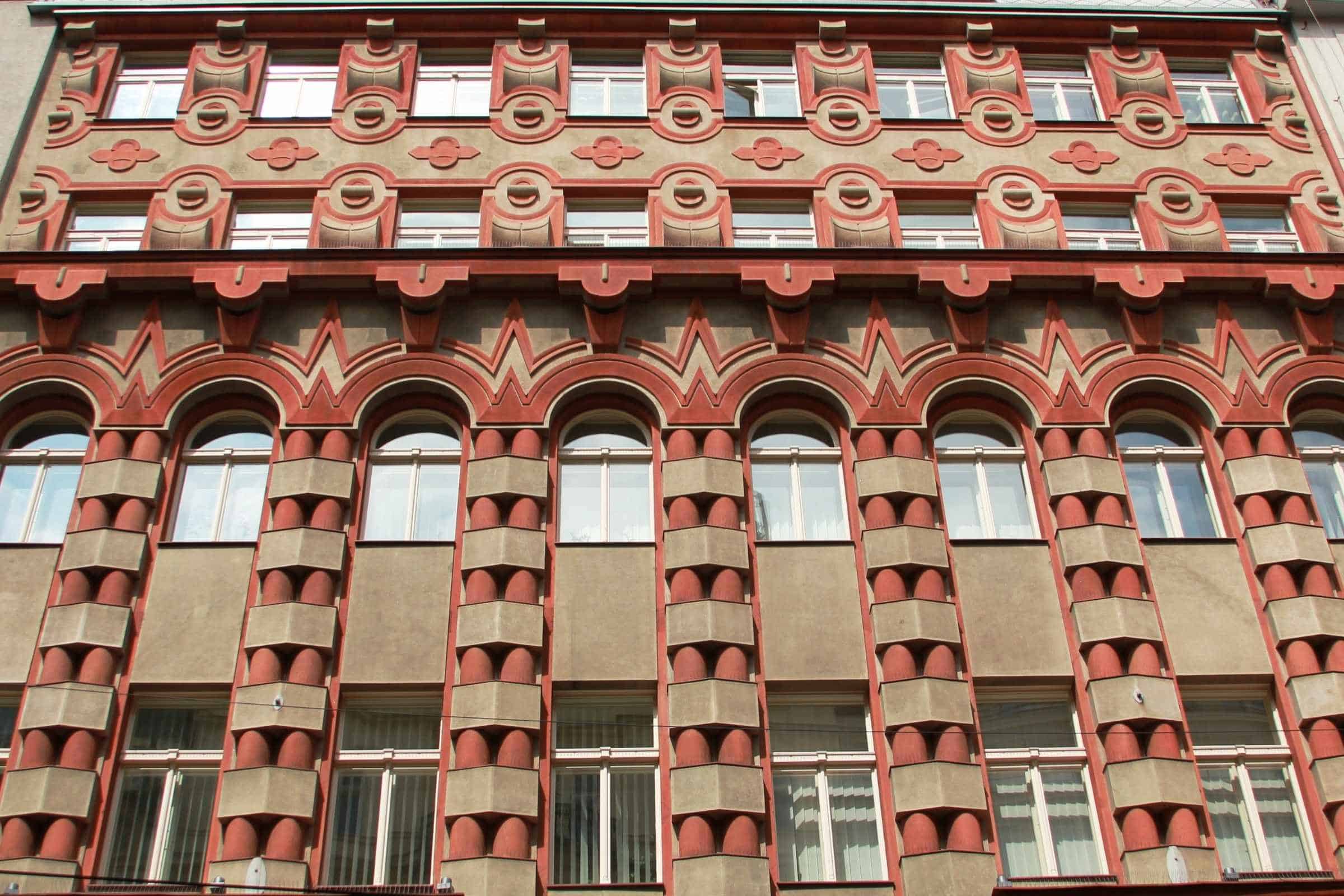
Photo: © Øyvind Holmstad/ Wikipedia Commons (CC BY-SA 3.0)
Without knowing where to look, you might walk straight past historic Cukrárna Myšák without even noticing it. Or you might be distracted by the sleek modern arcade next door. Either would be a mistake. This revived Prague pastry institution rewards visitors who slow down, step inside, and pay attention—offering some of the city’s most thoughtfully executed Czech patisserie alongside a quietly fascinating architectural story.
The confectioner occupies a terra-cotta-red and stone-gray building whose exterior is defined by Rondocubism, a short-lived Czech architectural style that emerged shortly after the formation of Czechoslovakia. The movement softened the sharp geometry of Czech Cubism with rounded, ornamental forms. Refaced in 1922, the structure at Vodičkova 710/31 was originally built in 1883 in a Neo-Renaissance style, with the Rondocubist layer later applied as a symbolic expression of national identity.
That curvaceous exterior effectively masks what lies within. Step through the front door and the mood shifts immediately. Prague often feels like a ready-made Wes Anderson set, and Myšák’s ground floor fits that aesthetic perfectly. This is the café’s most explicitly historic space, offering a richly atmospheric glimpse into interwar Prague café culture.
Drawing on archival research and close collaboration with preservation authorities, architect Tereza Froňková and her team reconstructed the ground-floor interior to evoke the confectioner’s appearance in the 1920s, when Myšák was at the height of its fame. Period references extend beyond architecture to include server uniforms, hand-drawn typography, and custom glasswork, all reinforcing the café’s heritage identity. The color palette—drawn from baking essentials like vanilla and chocolate—reinforces the space’s confectionery DNA.
When Cukrárna Myšák reopened under the Ambiente Group, the design team faced a familiar Prague dilemma: how to honor history when so much of the original interior had already been lost. Above the ground floor, only the façade survived after a partial collapse decades earlier. With little remaining to preserve, the upper level offered a rare opportunity for a more interpretive approach.
DESIGN DETAILS
Whimsical Glass!
While the restored façade and ground floor clearly establish Myšák’s dual identity, once you head upstairs, it becomes more accurate to speak of this property’s multiple personalities. Each level reflects a different chapter in the café’s evolution. The upper floor adopts a contemporary, minimalist language—lighter, calmer, and more interpretive in tone.
Look up, and you’ll spot a surprising element: custom crystal chandeliers composed of stylized glass fruit, mushrooms, and animals. Crafted by Czech glassmakers using traditional techniques, these whimsical fixtures quietly bridge historical reference and modern design sensibility. The result is neither nostalgic nor starkly modern, but something in between—a thoughtful continuation.
For a deeper look at the interior restoration, Mediar’s photo essay captures details not immediately visible to the casual observer.
Sources: Mediar.cz, reporting on the reopening and redesign of Cukrárna Myšák (2017); Archilovers.com, explaining Rondocubism and the use of arches and national colors.
Redevelopment of the adjacent Myšák Gallery could easily have erased the historic confectioner altogether. Instead, the older structure has been absorbed into a layered whole. Today, its Neo-Renaissance origins, interwar modernism, and contemporary urban retail coexist—distinct identities folded together rather than flattened.
What’s on Offer
A historic Czech pastry shop and café spread across two floors, offering classic and seasonal cakes, pastries, croissants, ice cream, and a solid selection of breakfast and brunch dishes. Expect simple egg plates, light savory options, and well-made coffee alongside the sweets.
Known For
Traditional Czech patisserie, historic house cakes, and seasonal specialties executed with consistency and care. Větrník is one of the most beloved Czech cakes, made from airy choux pastry sliced horizontally and filled with generous layers of vanilla and caramel cream. Finished with a glossy caramel fondant, it’s the benchmark by which many locals judge pastry shops. Harlekýn is a visually striking cake of alternating light and dark sponge layers filled with chocolate or cocoa-inflected cream, typically finished with chocolate glaze or decorative striping.
Service
Most orders are placed at the counter. Staff are generally friendly and efficient, but the café’s popularity—combined with its counter-ordering system—can make service feel hectic during peak hours. Remain calm. Your patience will be rewarded.
My Take
Come for the pastry, stay for the architecture. Between its layered design history, consistently strong patisserie, and classic coffee-and-cake atmosphere, Cukrárna Myšák is among the most rewarding café stops in Prague.
VISITOR INFORMATION
Website: mysak.ambi.cz
Address: Vodičkova 31 (710/31), 110 00 Praha 1
Hours: Mon–Fri 08:00–19:00; Sat–Sun 09:00–19:00
Nearby: Wenceslas Square, New Town shopping streets, historic Nové Město
Prague’s early modernist cafés mark a moment when tradition gave way to experimentation—when design, politics, and cosmopolitan ambition converged at the café table. These rooms invite not just a pause for coffee, but a closer look at how Prague imagined itself on the cusp of the modern age.
Café visits and observations reflect conditions as of August 2025.
Explore more posts in the Prague Pause series on Prague’s café culture: Civic Spaces | Art Nouveau Gems