
Europe’s New Entry/Exit System and Airport Security: What Travelers Need to Know for 2026–2027

UPDATED: August 6, 2026
Your itinerary hasn’t changed, but how you get in and out of Europe has. The EU’s new Entry/Exit System (EES) became fully operational in April 2026. The European Travel Information and Authorisation System (ETIAS) is expected to follow, although its previously anticipated late-2026 launch has been delayed and no revised start date has been officially announced. Meanwhile, the United Kingdom is now enforcing its Electronic Travel Authorisation (ETA) requirement. Airport security rules and screening procedures are also being revised.
This practical guide examines how the EES is handling its first peak summer travel season, where serious operational problems have emerged alongside more routine experiences, and what travelers should expect through the fall, the Christmas holiday season, and into 2027. It also explains changes in airport security procedures and offers travelers strategies for managing longer queues, inconsistent processes, and tighter connections en route to Vienna, Budapest, Prague, and Berlin.
Expanded Use of Biometrics In Travel: Shifting Public Attitudes
The public continues to ease into the use of biometrics — unique physical characteristics, such as facial features and fingerprints, used to verify identity — in everyday life. From unlocking our phones and laptops to accessing bank and investment accounts and authorizing payments through services such as Apple Pay and Google Wallet, many of us are becoming accustomed to using our faces and fingerprints for authentication. In many consumer applications, though, the biometric data is stored and compared on the device rather than transmitted to the service provider.
Perhaps it isn’t surprising, then, that many travelers are receptive to biometric processing despite lingering concerns about privacy and data security, particularly how their biometric data may be retained, shared, and used by governments and private companies. SITA, a leading aviation technology provider, in its 2025 Passenger IT Insights, found growing acceptance of biometric travel technology: nearly seven in ten surveyed passengers were comfortable with biometric scanning at airports, while 62 percent preferred biometric checkpoints to traditional staffed border counters.
For visitors entering and leaving much of Europe, the most consequential development in biometric border control is the EU’s new Entry/Exit System (EES), which launched in October 2025 and was deployed at scale in spring 2026. But government border control is only one part of the broader shift toward biometric travel.
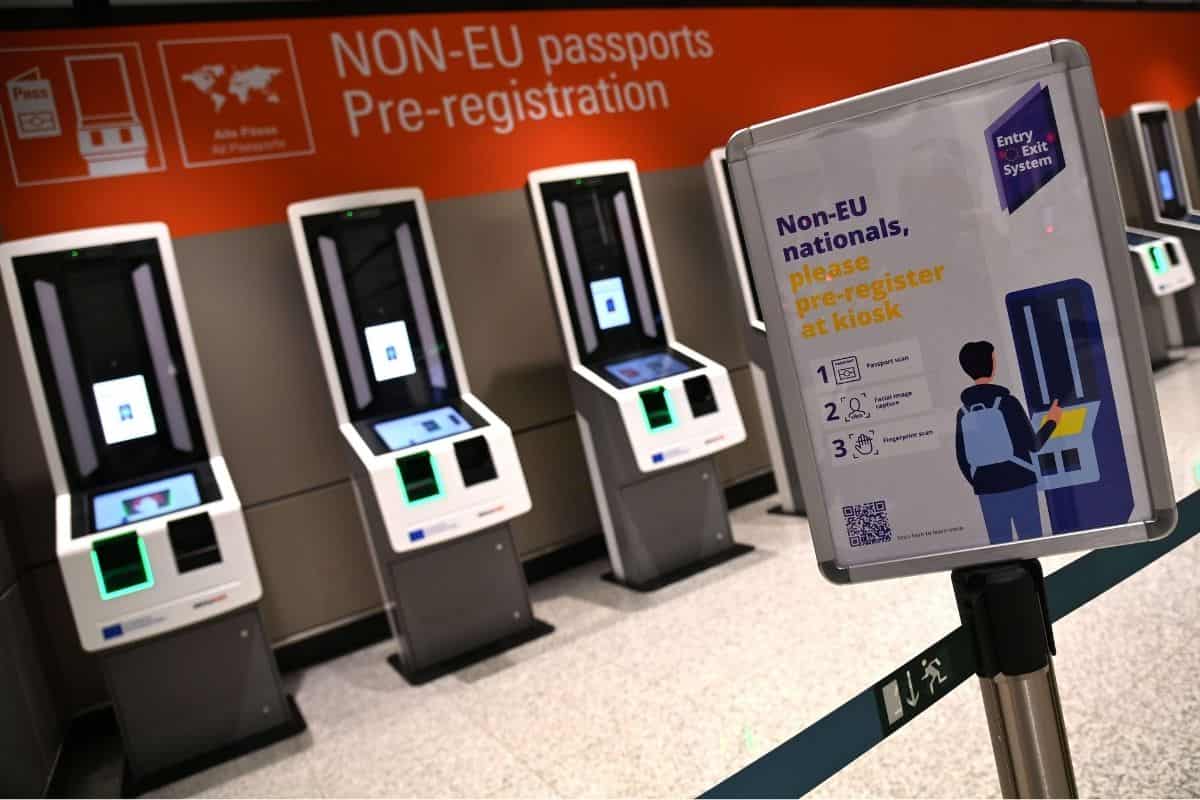
Entry/Exit System kiosks for non-EU travelers at Munich Airport’s Terminal 1 Pier following its opening on April 13, 2026. Photo: IMAGO/Frank Hoermann/SVEN SIMON/Alamy
Airports and airlines have also been investing heavily in biometric identity systems for passenger processing, including check-in, bag drop, access to security checkpoints, and boarding. These systems serve a different purpose from border control. Rather than determining whether a traveler may enter or leave a country, they generally verify that the person moving through the airport is the passenger associated with a particular passport, reservation, or boarding pass.
SITA’s 2025 data captured just how quickly the technology is spreading. It found that some form of biometric border control was already operating at 54% of surveyed airports and was expected to reach 83% by 2028.
Such figures don’t mean that every traveler will encounter facial recognition at every stage of a trip. Implementation varies by country, airport, airline, route, and checkpoint. At airports with more integrated passenger-processing systems, travelers may be able to enroll once and then use a facial scan instead of repeatedly presenting a passport or boarding pass at participating checkpoints. Even where the underlying systems and responsible authorities remain distinct, the process may appear increasingly seamless to passengers.
From AI trip planning and travel apps to biometric screening and contactless technology, digital tools are reshaping every stage of the travel experience. Read our guide to using travel technology mindfully while staying present, curious, and connected to the places you visit.
EU Snapshot: EES, ETIAS, and ETA Explained

A traveler uses an Entry/Exit System biometric kiosk at Franjo Tuđman Airport in Zagreb following the full EES launch on April 10, 2026. Photo: Igor Soban/PIXSELL/Alamy
EES: At-a-Glance
The EU’s digital border record, the EES, went fully operational in April 2026. EES uses biometric technology to electronically record travelers’ passport details, facial images, fingerprints, and the dates and locations of their entries and exits. The first time you enter the EU after the system’s introduction, expect a kiosk or border officer to capture your biometric data.
EES applies to non-EU/Schengen nationals, including both visa-exempt travelers (including U.S. citizens) and short-term visa holders. Those with long-stay visas and residence permits are outside of the system’s scope, as are certain diplomatic or special-status travelers. Fingerprinting is currently waived for children under the age of 12.
According to the EU, EES records are generally retained for several years, but travelers may still be asked to provide biometric data again if a record cannot be retrieved, identity verification fails, equipment malfunctions, or border authorities require new capture. Because an EES file is linked to the traveler’s passport details, obtaining a new passport requires a new or updated EES registration.
Although the system is intended to strengthen border security and automate immigration controls, its first peak travel season has exposed substantial inconsistencies in staffing, equipment, registration procedures, and processing times. More on that in a bit.
Jump to: How EES Is Working So Far | What to Expect in the Months Ahead | Strategies for Navigating Changes and Delays
ETIAS Status and Scope
The long-awaited European Travel Information and Authorisation System (ETIAS) will not launch in the final quarter of 2026 as previously anticipated. In July 2026, The Financial Times reported that the EU agency responsible for developing and operating the underlying border technology had acknowledged that a late 2026 launch was no longer feasible. Technical work and testing must be completed before the European Commission can set the system’s formal start date.
As of August 2026, the European Commission has not publicly announced a revised timetable, although some official EU webpages still retain references to the earlier late-2026 projection. The EU says it will announce the specific launch date several months before applications open.
ETIAS is not a visa. It’s an electronic pre-travel authorization for travelers from visa-exempt countries, including the United States, who plan short stays in 30 participating European countries. Like the United States’ ESTA system, it permits a traveler to request entry but does not guarantee admission; border officials will still determine whether the traveler meets the conditions for entry.
Once operational, ETIAS will require eligible travelers to apply online before departure. Applicant information will be checked against security, immigration, and public-health databases. Travelers who require a visa will continue to follow the existing visa process.
While ETIAS is not accepting applications in advance of the system’s launch, fraudulent and misleading third-party services have already emerged, including websites that offer assistance with ETIAS applications, charge excessive fees, or collect travelers’ personal and financial information. Travelers should therefore rely on the official ETIAS portal for current information and should not apply or pay any third-party service.
Travelers will need to meet the applicable passport-validity rules: the passport generally must have been issued within the previous 10 years and remain valid for at least three months after the intended departure from the participating countries. Applications will be submitted through the official ETIAS website or mobile app. Most are expected to be processed within minutes, but additional review may extend the process, so travelers should apply well before departure.
An approved ETIAS will generally remain valid for three years or until the passport used in the application expires, whichever comes first. During that period, it may be used for multiple short visits, subject to the usual 90-day-in-any-180-day-period limit. Because the authorization is electronically linked to the passport, travelers must use the same passport for both the application and the trip. Obtaining a new passport will require a new ETIAS authorization.
|
Why EES? |
Why ETIAS? |
|---|---|
|
Replace manual passport stamps with digital records. |
Screen visa-exempt travelers before arrival. |
|
Enforce 90/180-day limits. |
Identify security, irregular-migration, and public-health risks. |
|
Reduce identity fraud. |
Maintain visa-free travel while strengthening oversight. |
|
Modernize border controls. |
Reduce avoidable refusals at the border. |
UK: ETA At-a-Glance
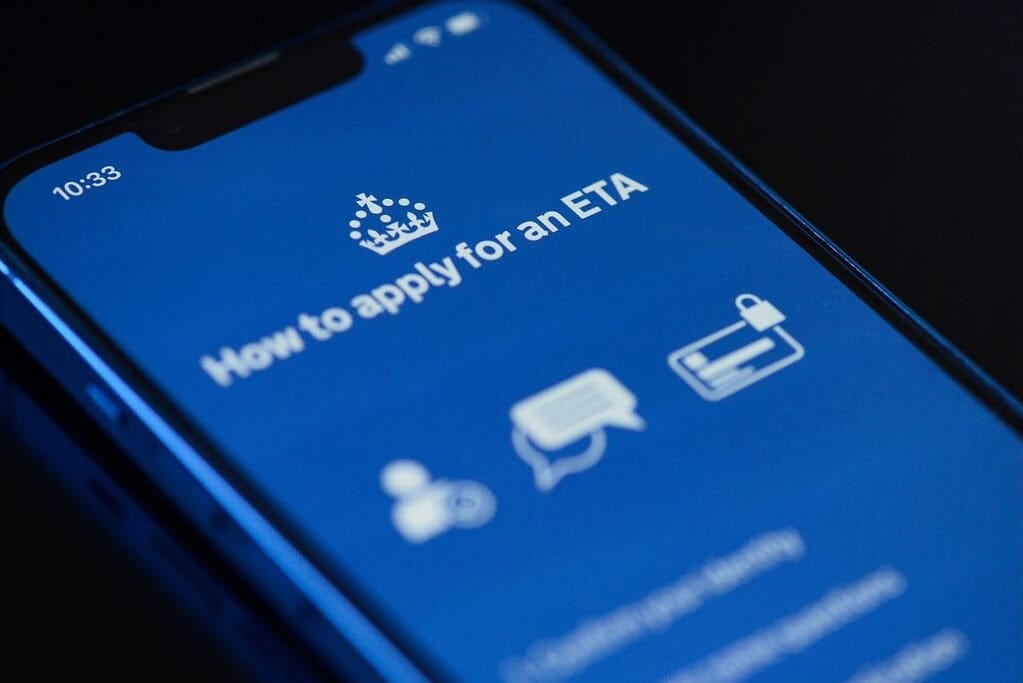
The UK Electronic Travel Authorisation application is completed online before travel. Photo: Ognyan Trifonov/Alamy
The UK’s ETA requirement is now in force for eligible visa-exempt travelers. Most visitors need an ETA or a visa, depending on their nationality and the reason for their visit to the UK. Travelers from Europe, the USA, Canada, and Australia will usually need an ETA rather than a visa. To be sure, you can check GOV.UK’s ETA webpage.
Travelers making a true airside connection, i.e., remaining behind security and not passing through UK border control, don’t currently need a UK ETA. The exemption is temporary and primarily affects connections through Heathrow and Manchester. By contrast, an ETA is required for landside transit, including itineraries that involve passing through UK border control to collect baggage, change airports, stay overnight, or continue by train or road.
Travel by Eurostar or through the Channel Tunnel is not airside transit. At London St Pancras, French officials conduct Schengen entry checks before passengers board under the system known as “juxtaposed controls.” EES procedures are being introduced gradually for Eurostar journeys, and eligible travelers may complete EES registration in the UK before departure. Travelers taking Eurostar from London therefore need permission to travel to and enter the UK, including an ETA when applicable — even if London is only an intermediate stop on a longer journey to continental Europe.
Here’s how the EES, ETIAS, and ETA compare:
|
EES |
ETIAS |
ETA |
|
|---|---|---|---|
|
What is it? |
An automated border system that electronically records the entries and exits of short-stay-non-EU travelers. It uses passport information, facial images, and fingerprints, replacing routine passport stamping. |
Online pre-travel authorization for visa-exempt visitors to 30 participating European countries. It is not a visa and is separate from the EES. |
Online pre-travel authorization for eligible visa-exempt visitors to the UK. |
|
When does it start? |
Fully operational since April 2026. |
Delayed beyond 2026; no revised official launch date has been announced. |
In effect for eligible travelers. |
|
Who does it affect? |
Most non-EU nationals visiting participating European countries for up to 90 days in any 180-day period, whether visa-exempt or traveling on a short-stay visa. |
Visa-exempt travelers, subject to specified exemptions. |
Eligible visa-exempt travelers who do not already hold UK immigration status, subject to specified exemptions. |
|
Where is it checked? |
At the external border of a participating European country (kiosk/counter). |
Before boarding when traveling by air or sea and by border authorities upon entry. |
By the carrier before travel and by UK Border Force when the traveler passes through UK border control. |
Planning a trip to Europe? Use our practical EES and airport-security checklist to prepare for biometric border registration, ETIAS and UK ETA requirements, changing carry-on liquid rules, and varying airport procedures.
How Europe’s EES is Working So Far
As of summer 2026, the fully operational EES is colliding with peak travel demand, and its shortcomings are no longer confined to early anecdotes. Some travelers continue to clear immigration without serious difficulty, but airports and airlines have now documented severe and widespread operational problems during peak periods, including hours-long queues (between three and five hours in some cases), missed connections, repeated biometric capture attempts, equipment failures, and inconsistent procedures.
In a July 2026 letter to the European Commission, Europe’s leading airport and airline associations described the system as being at a critical point. They attributed the disruption to longer biometric processing times, inadequate staffing, unreliable or insufficient automated equipment, limited pre-registration capacity, and airport facilities not designed for prolonged border checks.
The European Commission didn’t grant the aviation industry’s request for broader authority to suspend EES during the peak summer period. The dispute now centers less on whether the system should exist than on whether airports and border authorities have the means to implement it without undermining Europe’s transport network.
During exceptional traffic peaks, national border authorities do have a temporary legal option to suspend the collection of biometric data at a particular crossing point for up to six hours. The measure is intended to relieve excessive queues. This option is controlled by the authorities, not the airport, airline, or traveler.
As of mid-summer 2026, the measure is already being used frequently at some major airports, but aviation officials argue that six-hour partial suspensions don’t provide enough flexibility to resolve the underlying capacity problems. And, under existing rules, this flexibility is only temporary through September 2026.
Reliable, comparable wait-time data remain difficult to obtain for individual airports, and no single reported queue should be treated as predictive. The broader disruption, however, is now well documented. An Airports Council International survey of 85 airports in 20 countries found that peak waits in June reached as long as five hours, even as conditions vary significantly, making connection planning unusually difficult for travelers.
Jump to: Changes to Security Screening | Strategies for Navigating Changes and Delays
How will EES Impact Travel In the Months Ahead?
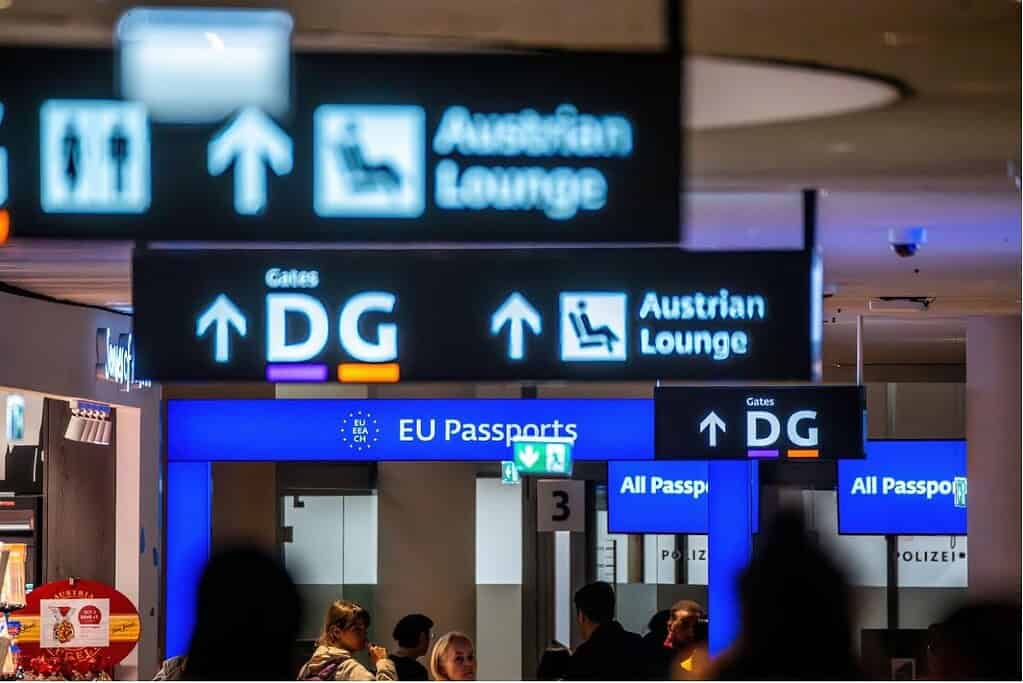
Passengers heading toward passport-control lanes at Vienna International Airport. Procedures and wait times may continue to vary as EES settles into full operation throughout 2026. Photo: Alexandre Rotenberg/Alamy
The bumpy experience of summer peak won’t provide a definitive picture of how EES performs over time. Lower passenger volumes may ease pressure in the fall, and repeat travelers should generally require less initial enrollment work. But the aviation industry’s July 2026 appeal suggests that reduced traffic alone won’t resolve underlying problems with staffing, automation, and limited pre-registration capacity.
Fall 2026: Some Relief but not yet a Reliable Pattern
Passenger volumes typically decline after summer, which may shorten queues at some border crossings. Even so, travelers connecting through their first Schengen entry point should continue to allow generous margins. Quieter airports may perform better, but lower traffic shouldn’t be mistaken for proof that EES is operating consistently.
Christmas and New Year: the Next Major Stress Test
The holiday period will test whether airports have improved staffing and processing since summer. Concentrated arrival schedules and large numbers of occasional travelers encountering EES for the first time could again produce significant delays. Travelers should plan conservatively rather than assume that any autumn improvement will continue through the year-end peak.
What To Expect of EES in 2027
By 2027, more returning visitors should already have EES records, which may make some subsequent checks faster. But any gains could eventually be accompanied by the introduction of ETIAS.
Because ETIAS is obtained before travel, it shouldn’t create the same biometric registration bottleneck at the border. Even so, its rollout may introduce new complications for travelers, airlines, and border authorities as authorization checks are added to an already changing system.
The larger question is whether airports and border authorities improve the operation of EES itself. More reliable equipment, adequate staffing, clearer procedures, and wider use of automated and pre-registration tools will matter more than simply moving beyond the peak travel season.
To stay abreast of changing travel rules and security technologies, among other topical information, sign up for our newsletter.
What’s New: U.S. and European Airport Security
Borders are only one part of the changing airport experience. Security screening is evolving as well, driven by new scanning technology, revised rules for liquids and electronics, and the expanding use of biometric identity checks. Because implementation remains uneven, travelers may encounter different procedures not only from country to country, but from one airport or terminal to another.
Jump to: Strategies for Navigating Changes and Delays

Airport security procedures continue to evolve, with variations by airport, terminal, and available screening technology. Photo: Wavebreakmedia Ltd UC24/Alamy
United States (TSA)
Some familiar checkpoint rituals are beginning to change, but not all of them. The 3-1-1 liquids rule remains in place: liquids, gels, aerosols, creams, and pastes must still be in containers of 3.4 ounces/100 ml or less and packed inside one clear, quart-size resealable bag per traveler. Depending on the checkpoint and its screening equipment, you may still be instructed to remove that bag from your carry-on.
One notable change came in July 2025, when TSA ended the general shoes-off requirement at standard screening lanes. Most travelers may now keep their shoes on, although officers can still request removal during additional screening.
Passengers should also be aware that cordless curling irons and similar hair tools powered by lithium batteries or butane are permitted only in carry-on baggage. They must also be protected against accidental activation and fitted with a safety cover. Spare gas cartridges are prohibited, and spare lithium batteries must be protected against short-circuit.
For the most up-to-date and complete information, always check the TSA website prior to your trip.
European Union
Airport security across Europe is becoming more technologically advanced but less predictable. New CT scanners can allow travelers to leave electronics and liquids inside their carry-on bags and, at some airports or checkpoints, carry liquid containers of up to 2 liters. But the rollout remains uneven. Rules may differ not only from one airport to another, but between terminals, transfer checkpoints, and even individual security lanes.
That inconsistency makes packing harder than the technology itself. Travelers should pack according to the strictest security rules they are likely to encounter at any airport where they will pass through screening en route to their final destination. Unless every relevant airport explicitly permits otherwise, the safest approach is still to follow the 100 ml liquids rule. Check the latest guidance for each departure and connecting airport, particularly if your itinerary requires you to clear security more than once.
Key Airports in Central Europe
Across Central Europe, airport security rules remain inconsistent as CT scanners are introduced at different rates.
Vienna
Vienna International Airport has introduced CT scanners at all central security controls. From July 2026, departing passengers may carry liquids in containers of up to 2,000 ml in their carry-on bags. Liquids and electronic devices (laptops, tablets, phones) can also remain inside hand luggage during screening. These rules aren’t yet universal, though. Salzburg and Innsbruck still apply the standard 100 ml/1 liter transparent bag rule; Salzburg also requires liquids and electronic devices to be presented separately for screening.
Prague
Václav Havel Airport Prague has deployed CT X scanners in Terminal 2 and now allows passengers to bring one container of liquid over 100 ml (up to 2 liters total per person) in addition to the standard 1-liter bag of ≤100 ml containers. Electronics can remain in bags at these CT-equipped checkpoints. However, non-Schengen departures from Terminal 1 continue under the traditional 100 ml/1 liter bag restriction until CT scanners there finish calibration and full rollout.
Budapest
As of summer 2026, Budapest Ferenc Liszt International Airport continues to limit carry-on liquids to 100 ml per container, all placed in a single 1-liter transparent, resealable bag presented separately at security; larger liquid items must go into checked baggage or be confiscated. There remains no formal indication of when a switch to CT scanner-enabled 2-liter allowances will come into effect.
Airports in Germany
German airports are rolling out CT security scanners at different rates, so liquids rules still vary by airport and checkpoint. Frankfurt am Main Airport continues to apply the 100 ml/one-liter-bag limit at all security lanes. At Munich Airport Franz Josef Strauss and Berlin Brandenburg Airport Willy Brandt, some CT-equipped lanes permit liquid containers of up to two liters, while conventional lanes retain the 100 ml rule. Because travelers may not know in advance which checkpoint they will use, the safest approach is to pack according to the stricter 100 ml limit.
Because procedures are still evolving, check the official website of each departure and connecting airport shortly before travel. Links to official resources are provided at the end of this article.
Navigating Airport Delays and Security Changes
New border and security systems introduce variables travelers can’t fully control, from biometric enrollment and uneven airport procedures to unpredictable queues. A few practical choices — made when booking travel, preparing for your trip, and moving through the airport — can reduce the risk of missed connections and help manage delays.

Preparation, realistic time margins, and a few practical coping strategies can make an uncertain airport experience feel more manageable. Photo: Rawpixel Ltd/Alamy
Before You Book
- Choose a generous connection rather than the shortest legal one. Peak EES waits have reached several hours at some airports in summer 2026 and have contributed to missed flights. When your first Schengen entry occurs during a connection, allow substantially more time than you would have before the EES was introduced, particularly if separate tickets would leave you responsible for rebooking.
- Don’t assume a previous smooth crossing predicts the next one. EES conditions can vary by airport, terminal, arrival window, staffing level, and equipment status. Enrolled repeat travelers should continue to allow a generous margin even if an earlier trip involved little delay.
- Plan a gentle arrival. Avoid placing a nonrefundable tour, timed museum admission, important dinner reservation, or musical performance too soon after landing. A flexible hotel check-in, private transfer, or quiet first evening gives you room for border delays without allowing them to derail the start of the trip.
- Check your travel insurance as soon as you book. Standard missed-connection coverage often applies only to specified events, such as airline delays, severe weather, or mechanical problems. An EES or passport-control queue may not qualify, so review the policy wording and ask the insurer for written clarification.
Before You Travel
- Allow extra time for your first EES registration. Your first crossing involves more than a passport check: you may need to scan your passport, provide fingerprints and a facial image, answer entry questions, and complete the process with a border officer. Future crossings should generally be faster because your biometric record will already exist. Review the EU’s step-by-step explanation of the EES process before departure so the procedure doesn’t come as a surprise.
- Travel with an undamaged biometric passport. A valid non-biometric passport may still be accepted, but a biometric passport gives you access to self-service systems where available. Those with biometric passports should follow signs for EES kiosks or automated lanes rather than assuming that the staffed queue will be quicker.
- Use official pre-registration where it’s supported. The EU’s Travel to Europe mobile app can capture passport data, a facial image, and some entry information before travel, but only at border crossings and in countries that have enabled it. Check the official app before departure rather than assuming it will be available at your destination.
- Pack for the strictest security rules on your route. CT scanners may let you keep electronics and liquids inside your bag, but procedures still vary by airport, terminal, and lane. Review the official guidance for every airport where you expect to pass through security, and follow the strictest liquids and electronics rules unless each airport expressly says otherwise.
- Arrange mobility assistance in advance if you can’t stand or walk for long periods. Request a wheelchair or airport assistance through your airline well before departure, and confirm the arrangement again before travel.
At the Airport
- Know the sequence before you reach the kiosk. Expect some variation, but the basic pattern is passport scan, biometric capture, entry questions where required, and final verification by an officer. Having your passport ready, removing glasses or hats when instructed, and calmly following the prompts can make the process smoother.
- Prepare for the queue rather than trying to predict it. Keep essential medication, permitted water, and necessary travel documents accessible in your personal item. Use the restroom before joining the line when possible, and assume that phone use or photography may be restricted in the border-control area.
- Check official alerts before entering border control. Review your airline app and the official websites or apps of your arrival, departure, and connecting airports before landing or before joining the queue. Once inside the passport-control area, follow posted instructions and don’t assume that phone use or photography is permitted.
If Delays Threaten Your Connection
- Speak to airport staff as soon as your connection is at risk. Ask whether there’s a priority route for imminent departures and contact the operating airline through its app or service desk.
- Keep receipts for meals, transport, or accommodation that you may later submit to your insurer, while remembering that border-control or security delays do not automatically create a right to compensation.
- Rely on official alerts, not isolated queue reports. Unofficial trackers and social-media accounts may provide context, but they often can’t distinguish among terminals, passenger categories, equipment failures, or temporary surges.
Official Resources
The information provided herein is based on EES, ETIAS, UK ETA, and TSA rules as of July 2026. Be sure to check the latest travel rules and screening procedures on official websites a week or two prior to your departure to ensure you have accurate and up-to-date information:
Preparing for a trip to Europe? Sort through the changing requirements and prepare with confidence using our companion EES, ETIAS, UK ETA, and airport security checklist.