Prague Pause: A Travel Designer’s Guide to Art Nouveau Cafés

Where the rituals of reading, conversation, and people-watching unfold over coffee and torte—inside Prague’s most decorative Art Nouveau cafés.
Finding My Bearings in Prague’s Cafés
Prague entered my life through archives and footnotes, when graduate work on Eastern European and Soviet political history led me here for research and then at the very start of my career. By the time I moved to the city, its cafés had become my anchors: corners, whether quiet or animated, to write, think, and understand the city’s rhythms from the inside out. In this “Prague Pause” series, I spotlight the cafés where narrative, design, history, and gastronomy intersect.
This second installment of the Prague Pause series starts with a subtle clarification before exploring two of the city’s Art Nouveau masterpieces, the Kavárna Obecní dům and the Fantova Kavárna in the main train station.
For context on how Prague’s cafés fit within broader Central European café culture—and what distinguishes them architecturally and culturally—start with Prague Pause: A Travel Designer’s Guide to Cafés as Civic Spaces.
Understanding Prague’s Café Vocabulary
As you explore Prague’s café scene, you’ll encounter some useful terminology that signals subtle distinctions. A classic kavárna (café/coffeehouse) is a social room offering coffee, light meals, newspapers, and sometimes wine or beer; a place to read or write, debate current events, or simply observe the “goings-on.” Some offer a full menu with heartier fare.
By contrast, a cukrárna is first and foremost a confectioner: a pastry shop anchored by cakes, tortes, and ice creams. You’ll still get good coffee, but the primary ritual is choosing something from the glass case and indulging a sweet tooth.
In practice, the categories overlap. Many of Prague’s best cafés have serious pastry offerings, and a few confectioners now feel as polished as hotel lounges. For the purposes of this guide, “café” primarily refers to old-style coffeehouses where time slows down, if only for a while.
Explore other posts in the Prague Pause series: Civic Spaces | Early Modernist Cafés
Where Art Nouveau Takes Center Stage
Kavárna Obecní dům (Municipal House)
Gilded Optimism Before the Fall
The Building
On Republic Square, just steps from Prague’s Powder Tower, stands one of the great monuments of Czech Art Nouveau: the Municipal House. Completed between 1905 and 1912 by Antonín Balšánek and Osvald Polívka after a major public design competition, the building was conceived from the outset as a civic gathering place rather than an administrative one. Its grand halls and intimate salons were designed for exhibitions, concerts, balls, dining, and spirited public life; a showcase of modern Czech culture at the dawn of the 20th century.
Every surface inside the Municipal House contributes to a single, unified decorative vision (“Gesamtkunstwerk”). Murals, stucco reliefs, carved wood paneling, mosaic floors, stained glass, ornamental railings, and custom lighting were all meticulously designed. Today, the building remains one of Europe’s most fully realized and impeccably executed Art Nouveau interiors.
Its splendor reflects the constellation of artists who worked on it. Alfons Mucha, the iconic graphic artist and muralist, created some of the building’s most celebrated spaces. He was joined by leading Symbolist and Czech National Revival painters Jan Preisler, Max Švabinský, and František Ženíšek.
Sculptors such as Ladislav Šaloun, master metalworkers like Franta Anýž, and renowned craft ateliers, including the Hora brothers’ stucco workshop, contributed to the building’s rich layers of decorative detail.
Though often described simply as Czech Art Nouveau, the building fuses Secessionist, Neo-Baroque, Neo-Renaissance, and subtle Oriental elements with a distinctly Bohemian artistic sensibility rooted in national revival and local craft traditions.
For lovers of architecture, decorative arts, and early 20th-century design, the Municipal House is an essential stop, a showcase of refined grandeur and meticulous craftsmanship.
The Café
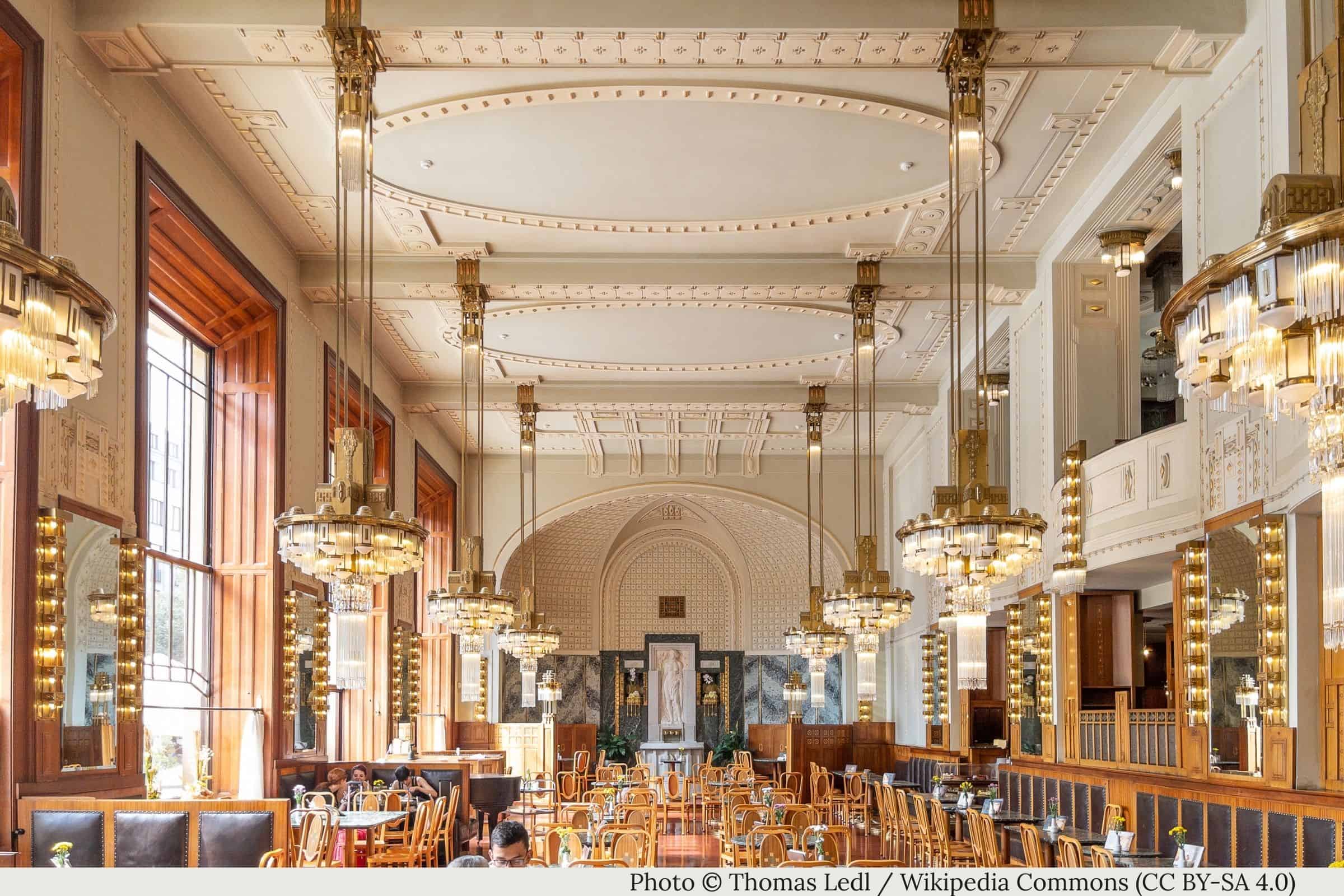
Conveniently, it’s also home to the elegant Kavárna Obecní dům (Municipal House Café). While the café itself doesn’t bear any of Mucha’s original works (those appear in other parts of the building), the Municipal House Café feels like stepping into one of the artist’s famed illustrations.
This mahogany-paneled salon is defined by muted tones, high ceilings supported by marble columns, and an interplay of light across tall windows, gilded mirrors, stained-glass, ceramic tiles, and crystal prisms. At the far end, an elevated dining nook features a nymph fountain, whose gentle drops and sculptural grace pull the room’s decorative details into a single, shimmering focal point.
It’s hard to miss the massive Art Nouveau chandeliers by František Křižík’s lighting workshop. Towering “columns of light,” they descend dramatically from the ceiling almost to the tables. Each fitting hangs from a long brass stem that flares out into a faceted, polygonal crown. From this gilded frame flows a dense fringe of glass rods and prisms, giving the café its unmistakable theatrical ambience.
What’s On Offer
A classic European café menu with espresso drinks, tea, hot chocolate, and cold beverages (including wine and spirits), desserts, sandwiches, and light Czech and international dishes from breakfast through dinner.
Known For
Beyond the room itself, the café has a strong focus on house-made pastries, with trolley service for cakes and tarts, as well as ice-cream sundaes. Afternoon tea is served with a classic three-tiered stand of mixed sweets and savories.
Service
Old-world and generally pleasant. Attentive during off-hours; slower and occasionally brusque during busy periods (a standard Prague café experience).
My Take
Book a tour of the Municipal House, it’s essential. Then slip into the café for breakfast before your tour (8:00 – 11:00 AM) or return afterward for coffee and dessert. Settle in, exhale, and take in all of the magnificence around you. Although there’s outdoor seating in summer, the real draw is the interior. It’s one of the most beautiful historic cafes in Prague.
Arrange a tour of the Municipal House
Options
The café isn’t the only amazing dining space in the building. In fact, it’s not even the most breathtaking. That distinction belongs to the Restaurace Obecní dům (Municipal House Restaurant), right across the foyer. The restaurant is modeled after the legendary Le Train Bleu in Paris’s Gare de Lyon, one of Europe’s most opulent Belle Époque dining rooms. It’s all soaring ceilings, gilded stucco, monumental murals, and glittering chandeliers; ideal for a more formal lunch and dinner.
Downstairs, you’ll find the Plzeňská Restaurace (The Pilsner Restaurant / Municipal House Pub). This folkloric, Czech beer hall serves hearty plates: roast meats, dumplings, and goulash, paired with Pilsner on tap. It’s rustic, lively, and relaxed.
Also downstairs is Tretter’s Municipal House (also known as the Americký bar /American Bar), one of the oldest surviving American-style cocktail bars in Europe. This stylistic gem offers classic cocktails, intimate lighting, a refined fin-de-siècle atmosphere, and a moodier vibe. Perfect before or after a performance in Smetana Hall.
TECHNOLOGICAL SHOWCASE
Engineering a Modern Public Palace
When it opened in 1912, Municipal House wasn’t just an architectural gem; it was also a technological marvel.
A pioneering climate-control system drew on two basement wells to ventilate and temper the air throughout the building. The system is still in use today to temper the air in the café and concert halls.
The building also featured a continuously circulating “paternoster” lift, a hop-on-hop-off elevator once considered the pinnacle of modern engineering. Although the Municipal House’s original lift no longer operates, you can see one at the Nova Radnice (New City Hall), which offers brief guided “Paternoster Tours.”
Other innovations included the pneumatic post system that used pressurized air tubes to whisk messages between offices in seconds, and a central vacuum system that allowed staff to plug long hoses into wall inlets connected to a powerful suction plant in the basement.
Sources: Municipal House technology overview, Prague.eu (Obecní dům official visitor site).
VISITOR INFORMATION
Website: Municipal House Café
Address: Náměstí Republiky 5, 110 00 Praha 1
Café Hours: Daily, 8:00 AM – 10:00 PM
Restaurant Hours: Daily, 11:30 AM – 3:00 PM, 5:30 PM – 11:00 PM
Pub Hours: Daily, 11:30 AM – 11:00 PM
Bar Hours: Tuesday – Saturday, 7:00 PM – 2:00 AM (reservations recommended)
Nearby: Republik Square, Prašná Brána (Powder Tower), Palladium shopping center, and Old Town Square
The Obecní dům (Municipal House Restaurant) is among the more formal spaces featured in this “Prague Pause” series. If you’re looking for other formal dining options, check out Savoring Prague: A Travel Designer’s Short List to Fine Dining.
Fantova Kavárna
Art Nouveau In Motion
The Station
The other leading Art Nouveau structure in Prague, and the largest in the city, is the main train station. Originally opened in 1871, the station underwent expansion and modernization in 1901, when the building adopted its Art Nouveau style.
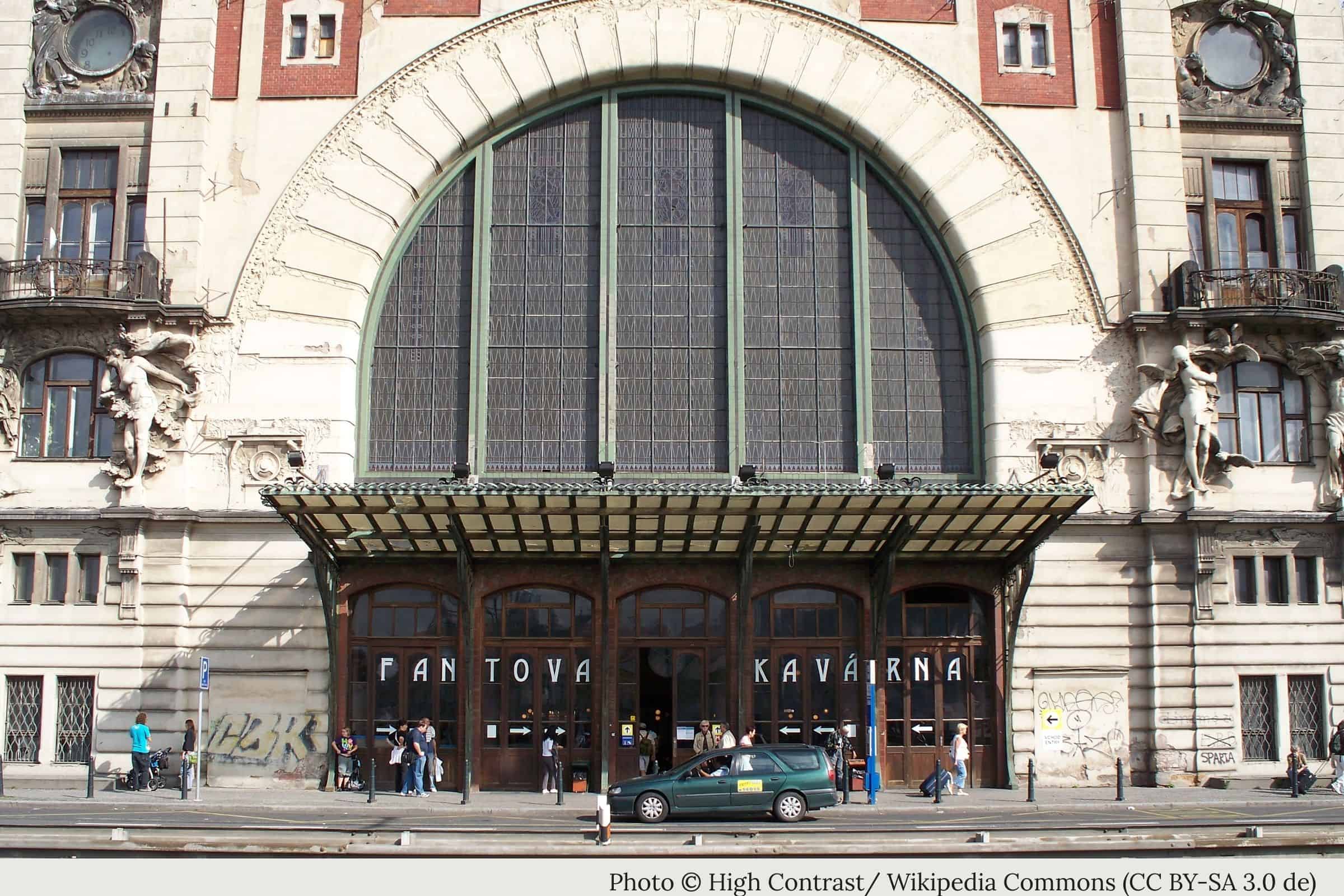
Designed by Czech architect Josef Fanta and completed in 1919, the station’s grand interior — anchored by a semi-circular central pavilion with painted stucco sculptures and coats of arms — featured ceilings approaching seven neters (23 feet). The pavilion, part of the main entrance into the railway station, also housed a café that served travelers and locals alike.
Originally known as the Franz Josef Station, it was one of the last great infrastructure projects of the Austro-Hungarian Empire before WWI. As extraordinary as its Art Nouveau heritage was, the main station fell victim of competing priorities and incoherent visions. Soon after it opened, successive political regimes, transport planners, and architects imposed their own ideas. Rarely were they in harmony with the original design.
The most drastic change came in the 1970s. Under Communist rule. The building’s historical interior was neglected, and plans were floated to demolish it entirely. Instead, the regime prioritized the construction of a massive brutalist terminal hall directly in front of the historic station.
A tangle of elevated highways, ramps, and sunken access roads effectively severed the landmark Art Nouveau building from the street grid. As a result, the old station, along with its breathtaking café, the Fantova Kavárna, effectively lost natural footfall and civic prominence. Decades of underfunding left its ornate interior faded, its future uncertain.
The Cafe
Ongoing restoration since 1989, involving a painstaking review of available photos and documentation from the era, as well as interviews with surviving relatives, has revived much of the original building’s beauty, including the café.
The Fantova Kavárna isn’t just a dramatically revived interior, it’s a reclaimed civic space that invites you to pause inside Prague’s railway architecture rather than merely passing through it. Sadly, many travelers pass it by entirely, unaware of its existence, as they take their modern-day coffee on the go, milling about the soulless modern-day addition to the station.
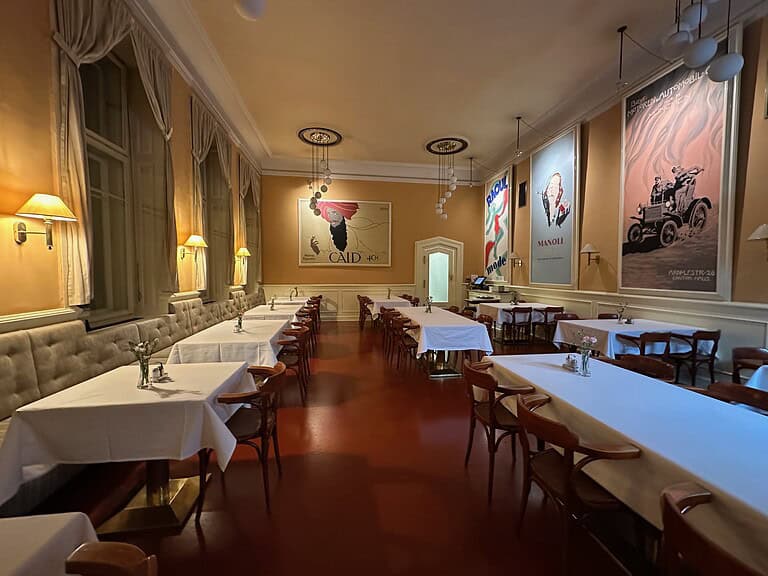
The updated café balances historic touches with contemporary restraint. Massive arched windows on the exterior and interior walls flood the room with light and, combined with the high ceilings, showcase the room’s scale. A color palette of warm creams, soft yellows, and deep greens creates a welcoming and calm atmosphere, while wood floors and dark metal accents ground the room.
The fit-out is light-touch. Simple wooden tables and dark bentwood-style chairs allow the architecture to lead, while richly upholstered banquettes and armchairs invite you to settle in for a while. The softly curved bar acts as a visual and social anchor, while offering playful seating. Overhead, exposed Edison-style pendant bulbs hang from the high ceiling, providing a soft glow. Art Nouveau references appear throughout the space, including period photos, a portrait of Josef Fanta, stylized murals, curved lines, and decorative detailing
The café also boasts seating set along the balustrade of the historic entrance pavilion. From here, tables overlook the station’s main hall, offering a privileged vantage point onto the flow of travelers beneath the grand arches. It’s a rare position: suspended between movement and stillness, where you can comfortably watch the rhythms of the station unfold from above.
DESIGN RESTORATION
Reimagining Prague’s Hlavní Nádraží
Prague’s main railway station, long a bustling but fractured transit hub, is now undergoing a thoughtful transformation that foregrounds both its Art Nouveau heritage and the needs of contemporary travelers. Under the Nový / Šťastný Hlavák design scheme led by Henning Larsen architects, the station precinct is being reconfigured to feel lighter, more civic, and more welcoming, as Fanta intended.
Historic elements of the original terminal hall, including its striped flooring, curved geometries, and expansive sightlines, are being preserved and reintegrated into the new scheme. Warm timber, abundant natural light, and native plantings are being introduced to soften the hard edges and structural additions of the 1970s.
The result will be a more human-scaled, park-oriented gateway that honors the station’s layered architectural history while undoing decades of neglect from the Communist period. Which is to say that in the future, the overall experience of visiting the café will be easier, whether you’ve got a train to catch or not.
Sources: Nový / Šťastný Hlavák project overview, Henning Larsen Architects; Prague Train Station Hlavní Nádraží redevelopment, Prague.eu; “Henning Larsen wins competition to redesign Prague’s main railway station,” Architects’ Journal.
Known For
A proper sit-down café and inspiring space in the station with coffee, tea, cakes and desserts, plus light meals (breakfast dishes, salads, simple main courses).
Service
Polite, professional, and reasonably quick. Efficiency falls off a bit during commuter rushes.
My Take
This dramatically revived Art Nouveau café inside Prague’s historic main train station is ideal for architecture buffs, train lovers, and travelers seeking a hidden gem with a touch of cinematic grandeur. Await your departure in style with a good cup of coffee and cake.
VISITOR INFORMATION
Website: fantova-kavarna.cz
Address: Wilsonova 300/8, 110 00 Praha 2 – Vinohrady
Hours: Daily, 8:00 AM – 8:00 PM
Nearby Attractions: Prague Main Railway Station (Hlavní nádraží), Jerusalem Synagogue, Wenceslas Square (lower end)
Directions (once inside the station): Fantova kavárna is located near the original Art Nouveau terminal hall; look for heritage signage, curved forms, and ornamental detailing that distinguish this restored space from the newer concourse. Upon entering the station’s main hall, follow the signs for Platform 1 / Nádražní restaurace / Kavárny. To reach the café, take the stairs or elevator up to the upper level, which leads into the historic section of the station.
MORAL COURAGE
Nicholas Winton
Once you’ve finished your coffee, but before you hop on your train or head out of the station, there’s one more bit of history to discover.
From Platform 1 of Prague’s main railway station, Nicholas Winton organized the departure of hundreds of Jewish children in 1939, arranging their escape to Britain as Nazi occupation loomed. Acting with extraordinary urgency, Winton helped secure visas, transport, and foster homes—saving 669 children from almost certain death.
Today, a bronze statue depicting Winton with two children stands on Platform 1, marking the precise place where those trains once departed and giving quiet, physical form to an act of moral clarity carried out against the tide of history.
Sources: Radio Prague International (Czech Radio); Nicholas Winton Memorial Trust; Prague City Tourism.
Together, these cafés offer a lens on Prague at the turn of the 20th century, when optimism, ornament, and innovation converged in public space. In the next chapters of Prague Pause, we move beyond Art Nouveau to explore how café culture evolved as the city—and the century—grew more complicated.
Café visits and observations reflect conditions as of August 2025.
Explore more posts in the Prague Pause series on Prague’s café culture: Civic Spaces | Early Modernist Cafés