Viennese Pause: A Travel Designer’s Guide to Imperial Cafés

Where the rituals of reading, conversation, and people-watching unfold over coffee and a torte.
Vienna’s Ritual of Rest and Reflection
To truly appreciate Vienna, you need to sit down—for a while. Vienna’s coffeehouses, often called cafés or Kaffeehäuser, serve as the city’s social salons. Imagine marble-topped tables, newspapers hanging over wooden rods, and drinks served on silver trays. Here, time seems to stand still.
Konditoreien, a distinct category from Kaffeehäuser, are pastry shops specializing in indulgent desserts and confections. Skilled confectioners turn sugar and sponge into beautiful ornaments displayed like jewels in glass cases. Konditoreien tend to focus on artistry and sweet treats rather than the broader café menu.
Between them and the new generation of third-wave coffee bars lies an entire spectrum of mood and ritual. Each spot has its own identity, shaped by a distinct history, rhythm, and clientele. These are places intended for lingering.
What’s the Difference?
Vienna’s Coffeehouses, Cafes, and Konditoreien
|
TYPE |
IDENTITY |
OFFERINGS |
ATMOSPHERE |
TIME |
|---|---|---|---|---|
|
Café/ Kaffeehaus |
Intellectual salon |
Coffee, meals, pastries |
Historic, grand or cozy |
Hours |
|
Konditorei (pastry shop) |
Pastry boutique |
Cakes, sweets, tea |
Elegant, aesthetic |
Moderate |
|
Third Wave Coffee House |
Everyday stop |
Coffee drinks, light bites |
Contemporary, casual |
Quick visit |
Note: A few of Vienna’s historic cafes are now legendary. In a couple of instances where demand runs high or service feels brisker, this is noted so that readers can plan their visit accordingly.
Drawing on three decades of visits to Vienna and countless hours enjoying café culture, I created this series to help travelers find spots suited to their style and pace. While I highlight some house specialties, my main focus isn’t food (the fare from café to café is consistently traditional). Instead, I explore Kaffeehäuser through their history, design, and atmosphere. From imperial salons to bohemian hideouts, each offers a unique glimpse of Viennese life and appeals to a different mood.
This is the first installment in a series of posts on Vienna’s cafe culture.
Explore the series:
Old Town Institutions | Bohemian Hideaways | Culinary Detours
Imperial and Cultural Axis: The Grand Ring Cafés
The Ringstraße cafés are elegant institutions that encircle Vienna’s cultural heart, making them perfect stops before or after an opera, museum visit, or evening stroll through the city center. As you enter, expect the sparkle of mirrors, gilt, and crystal, waiters in waistcoats, and tables dressed in white linen.
If your sense of indulgence extends beyond the menu and the service, to include history and aesthetics, include at least one of these Imperial Cafés on your itinerary. Each offers its own variation on tradition, shaped by location, clientele, and history. Consider them invitations rather than obligations. Let yourself linger longer than planned; the setting will do the rest.
Jump to cafés:
Café Sacher | Gerstner Café | Café Imperial | Café Schwarzenberg | Café Landtmann
Café Sacher
Upper Crust
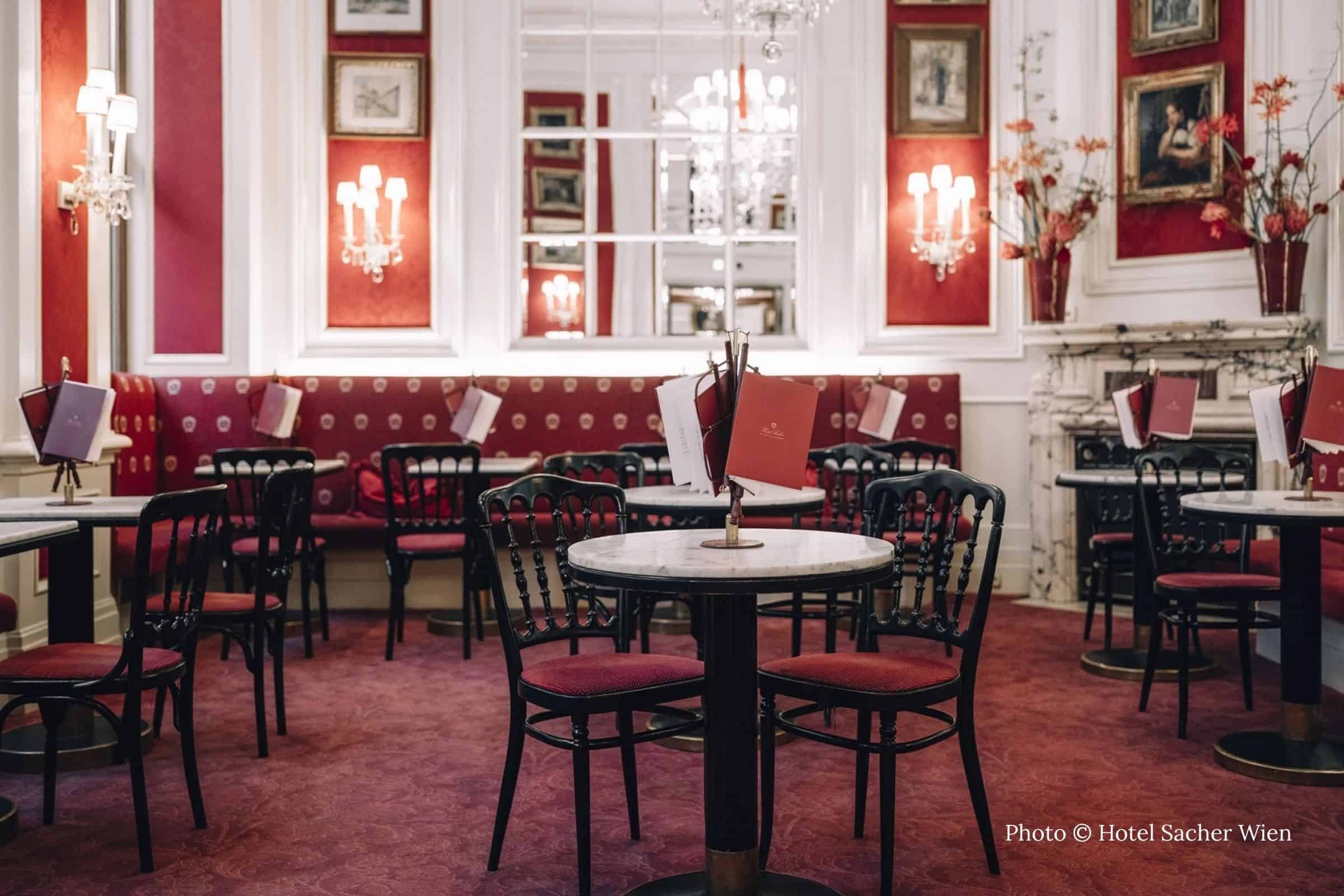
Plush, polished, and perpetually photographed, Café Sacher is one of the most famous addresses in town. Across from the Vienna State Opera on Philharmonikerstraße, it’s a pocket of 19th-century elegance. Enveloped by vanilla walls with crimson fabric panels, the room is grounded by similarly hued seats and marble-topped tables. Mirrors, framed pictures of imperial life, and bright chandeliers complete the room’s sophisticated ambience as servers in black waistcoats balance silver trays laden with coffee, torte, and cream. The atmosphere is refined but bustling.
The main draw here is the Original Sacher-Torte, created in 1832 for Prince Metternich of Austria. According to the origin story, the chef took ill and his 16-year-old apprentice, Franz Sacher, was left to fulfill the prince’s request for a special dessert. Today, his confection is iconic. Apricot jam is layered between dense chocolate cake and topped with a glossy dark chocolate glaze. The torte is served with unsweetened whipped cream.
Variations are available throughout town, but for authenticity, it’s best enjoyed at Café Sacher. Otherwise, you might want to avoid the tourist lines and comparatively brisk service.
VISITOR INFORMATION
Website: Café Sacher
Address: Philharmonikerstraße 4, 1010 Wien
Hours: Daily, 8:00 AM – 10:00 PM
Nearby: Vienna State Opera, Albertina, Kärntner Straße (short walk), Haus der Musik
Visit the Hotel Sacher website
If the Café Sacher is Vienna’s most photographed stage set, the Gerstner Café offers a quieter but no less dramatic encore just around the corner.
Gerstner Café
Ascending Opulence
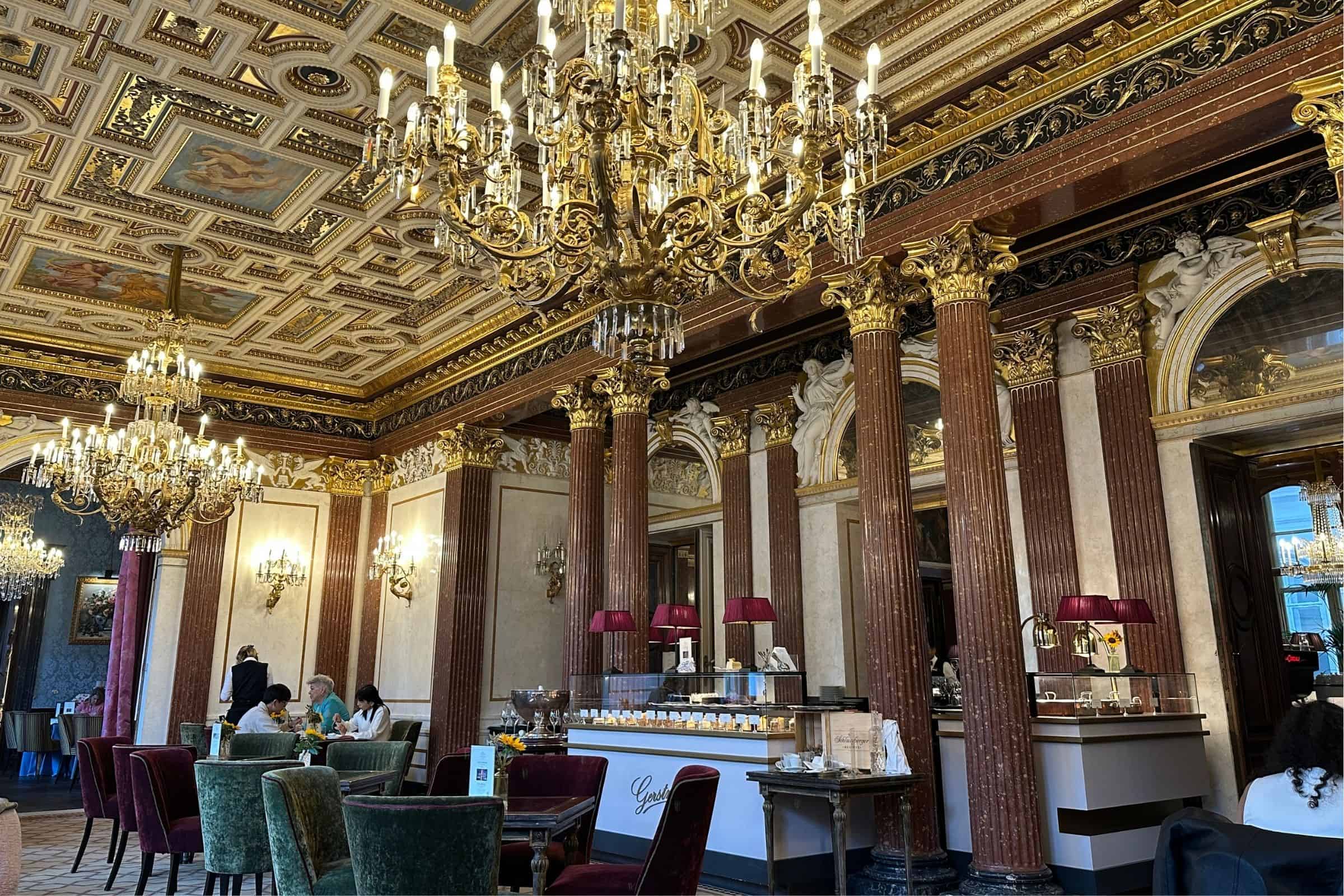
Photo: Catherine Barnes
Across from the Opera on the Kärntner Straße side, Gerstner offers all the opulence (if not more) of the Sacher Café with fewer crowds. The Gerstners’ three-tiered salon becomes more sumptuous as you ascend. Located in the 19th-century Palais Todesco. The façade and entry-level confectionery shop look like they came straight from a Wes Anderson film. Here you can purchase candied violets, a favorite of the Empress Sisi.
The first-floor café-bar has a spectacular view of the Opera and offers aromatic coffee and freshly baked cakes. Like the Sacher, Gerstner was an official confectioner to the Imperial Court, and offers a lighter, moister, and more pâtisserie-like version of the chocolate-and-apricot torte.
On the top floor restaurant, you’ll find one of Vienna’s most breathtaking ceilings. Architect Theophil Hansen and painter Christian Griepenkerl (with earlier work by Carl Rahl) created coffered panels and allegorical frescoes, framed by gilt stucco, marble columns, and opulent chandeliers. Wherever you happen to be seated, be sure to stroll through the interconnected salons before departing. Each is rich in architectural design elements, evoking distinct moods. Order champagne with your torte or settle in for a complete meal.
VISITOR INFORMATION
Website: Gerstner
Address: Palais Todesco, Kärntner Straße 51, 1010 Wien
Confectionery / Store (ground floor) Hours: Daily, 8:00 AM – 10:00 PM
Café-Bar (1st floor) Hours: Daily, 11:30 AM – 10:00 PM
Restaurant (2nd floor) Hours: Daily, 8:00 AM – 11:00 PM
Nearby: Vienna State Opera, Albertina, Burggarten, Kapuzinergruft (Imperial Crypt)
For a closer look at Vienna’s fine-dining scene, see Savoring Vienna: A Travel Designer’s Short List to Fine Dining.
For a closer look at Vienna’s fine-dining scene, see Savoring Vienna: A Travel Designer’s Shortlist to Fine Dining.
From the bustle of the Opera quarter, the mood changes, from confectionery charm to gilded restraint, as you move down the Ring towards the Hotel Imperial.
Café Imperial
Cosmopolitan Heritage
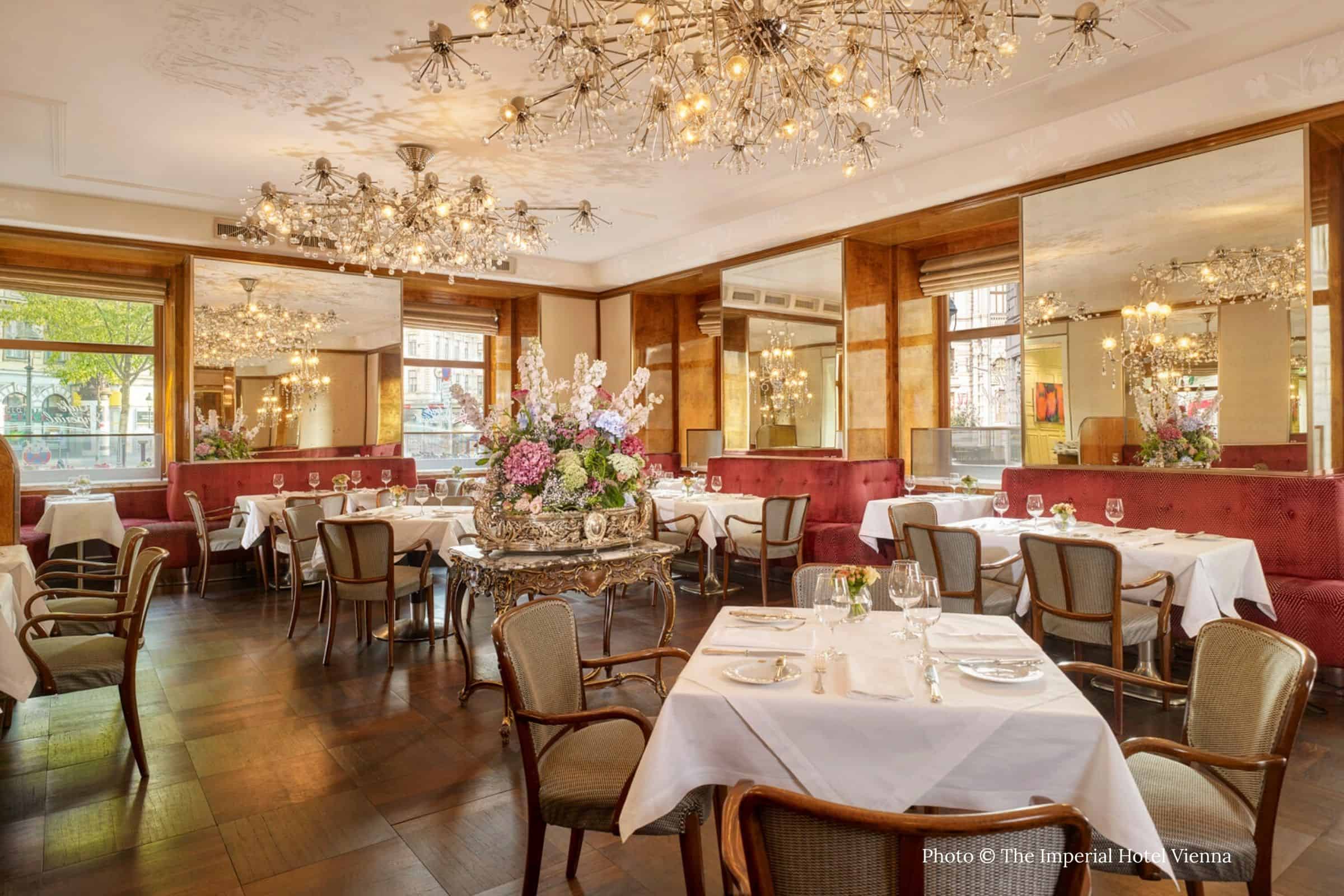
Step through the gilded doors of the Hotel Imperial and enter a time capsule of late-Habsburg elegance. While the café has its own street entrance, I recommend passing through the hotel lobby to experience the full grandeur of the palais. Originally a private residence, this building opened as a hotel for the 1873 World’s Fair in Vienna, and its café quickly won favor among the city’s high society.
HISTORICAL CONTEXT
Vienna Becomes a Cosmopolitan City: The 1873 World’s Fair
In the lead-up to the 1873 World’s Fair, which also marked the 25th anniversary of Franz Joseph I’s reign, a construction boom dramatically changed the city’s appearance. About 20 million visitors were expected, along with 53,000 exhibitors from 35 countries.
The fairgrounds featured a central rotunda and 194 pavilions. Six railway stations were built, and a wave of new cafes, restaurants, and hotels appeared. Existing buildings were also repurposed, ushering in the era of palace hotels.
One of the first was Duke Philipp von Württemberg’s Palais (1865), which became the Imperial Hotel and served as a hub for diplomats and royal guests.
Sources: Vienna Tourist Board (vienna.info)
“Fun Facts on the Vienna World’s Fair”
“Hotels a la 1873: Stately Home from Home”
Café Imperial features stucco ceilings, starburst chandeliers, and gilded mirrors: silver, crystal, and fine porcelain grace starched white linens. Service is formal yet relaxed, reminiscent of an era when time itself was meant to be savored. Alternatively, you can also visit the Imperial Bar, a luxurious seating area off the main lobby. Enjoy a glass of champagne or a “Golden Martini” along with light snacks. Ease into your leather chair and enjoy some jazz under the massive chandelier, whose 7,749 crystals reflect 240 lights, casting a warm glow over the room.
The house specialty, the Imperial Torte, was created to honor Emperor Franz Joseph. It has layers of crisp almond meringue, chocolate buttercream, and marzipan glazed in dark chocolate. The cake is presented in a signature hexagonal box. It’s silky, nutty, and richly aromatic. Pair it with a glass of Champagne or a mélange and watch the carriages roll past the Musikverein across the Ring.
COFFEE NOTE
Wiener Mélange
A Viennese coffee specialty, the Wiener Mélange is traditionally made with a shot of espresso topped with steamed milk and a soft layer of milk foam. Unlike its cousin, the cappuccino, Mélange usually has a thinner layer of foam and a gentler flavor. It’s typically served in a glass or small cup on a silver tray, accompanied by a glass of water. This is part of the ritual of Viennese coffee culture. The term has also come to describe Vienna’s special mix of coffeehouse visitors.
VISITOR INFORMATION
Website: Café Imperial
Address: Kärntner Straße 16, 1010 Wien
Café Hours: Daily, 7:00 AM – 11:00 PM
Bar Hours: Daily, 9:00 AM – 1:00 AM
Imperial High Tea: 12:00 PM – 4:30 PM
Nearby: Vienna State Opera, Musikverein, Albertina, Karlsplatz, Karlskirche, Secession Building
Book your stay at the Hotel Imperial
If the Café Imperial embodies courtly splendor, Café Schwarzenberg reflects its counterpoint in a space built more for conversation than ceremony.
Café Schwarzenberg
Timeworn Conversations
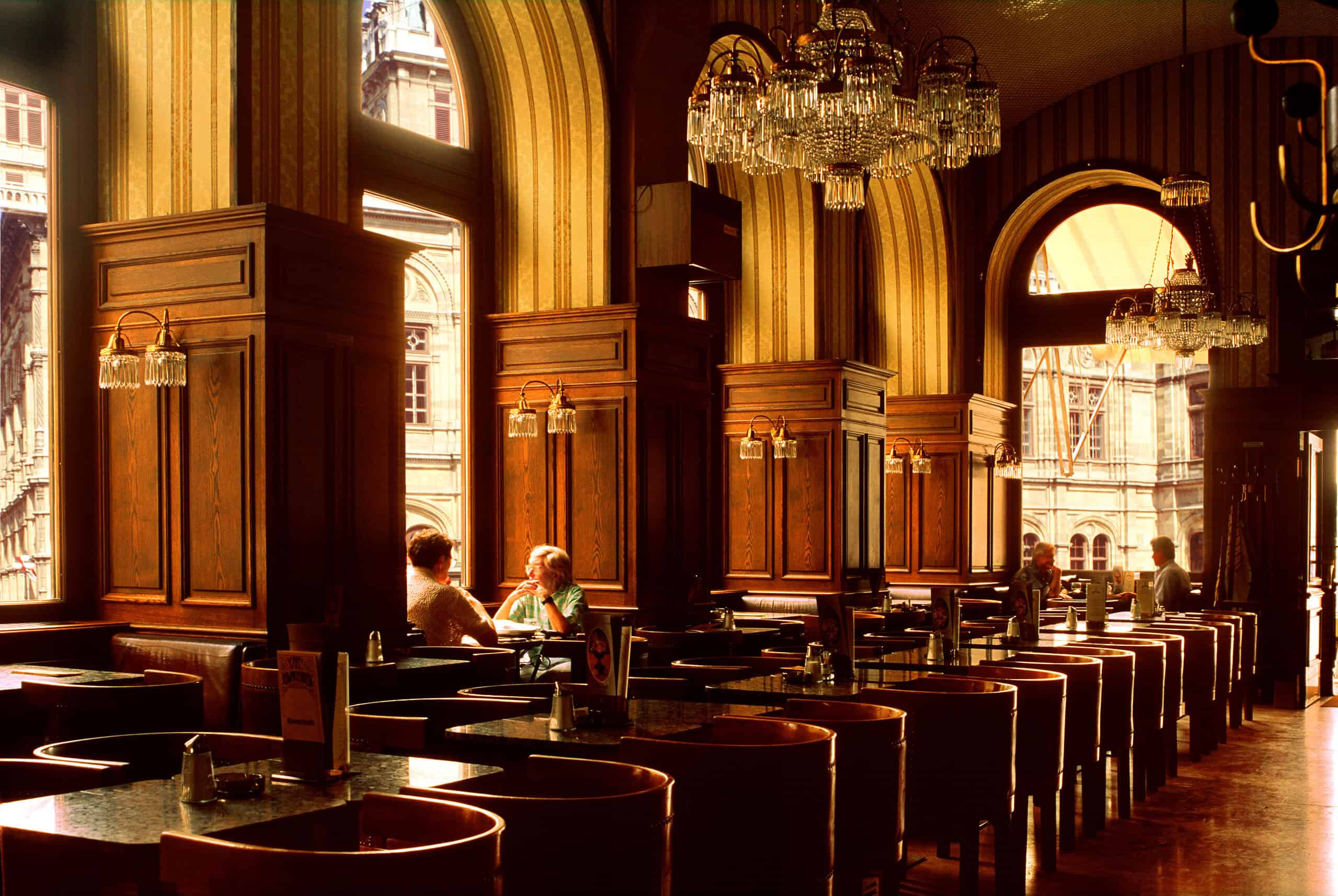
Photo: Art Kowalsky/ Alamy
Dating back to 1861, Café Schwarzenberg underwent various name changes, owners, and refurbishments before adopting its current name in 1902. Further instability followed during WW2, when it was known as Café Deutschland, and subsequently, when Soviet officers occupied the space to use for their events.
Some elements of the café’s design reflect the interwar period, particularly the influence of the architect Adolf Loos. The corner room to the left of the entrance features hammered brass tables, black-and-white marble-clad walls, and a mosaic-paneled ceiling of frosted glass and gold plating. Compared to its peers, Café Schwarzenberg’s interior has a darker, moodier, and more masculine feel.
Among the café’s most famous and loyal customers was another of the city’s renowned architects, Josef Hoffmann. A co-founder of the Wiener Werkstätte, he is said to have conceived many of his designs here. It remains an ideal setting for a civilized breakfast, a leisurely lunch, a game of billiards, or a nightcap after a concert at the nearby Musikverein.
VISITOR INFORMATION
Website: Café Schwarzenberg
Address: Kärntner Straße 17, 1010 Wien
Hours: Monday–Friday, 7:30 AM – 10:00 PM; Saturday–Sunday, 8:30 AM – 10:00 PM
Nearby: Musikverein, Konzerthaus, Stadtpark (Johann Strauss Monument), Karlsplatz, Karlskirche
HISTORICAL FIGURE
Helmut Zilk (1927 – 2008)
Journalist, educator, and long-serving Viennese politician, Helmut Zilk served as Vienna’s Councillor for Cultural Affairs before becoming mayor in 1984. During the 1970s, modernization threatened many of the city’s historic coffeehouses.
Zilk used his post to champion their preservation. He blocked commercial conversions and encouraged careful restorations, treating the Kaffeehaus as a civic and cultural asset rather than a disposable relic. His advocacy helped save institutions such as Café Schwarzenberg and Café Landtmann. Zilk ensured that the marble tables, Thonet chairs, and chandeliers that once hosted figures like Freud and Zweig would continue to define Vienna’s urban identity.
While an ardent patron of Vienna’s café culture, Zilk was a man with a complicated history. In later life, he was alleged to have been an informant for the Czechoslovak secret police (StB), and possibly other intelligence services, during the 1960s. He reportedly provided information on Austria’s political scene and fellow politicians. In 1993, Zilk was seriously injured in a letter-bomb attack carried out by Franz Fuchs, a far-right extremist who targeted public figures associated with minority rights and multicultural values.
Sources: histouring.com, “Café Schwarzenberg”; Café Landtmann (landtmann.at), “The Landtmann Story”; iDNES.cz (in Czech, free registration required), Jiří Šťastný, “Helmut Zilk may have worked for StB and CIA, file suggests” (March 12, 2009); The New York Times (paywalled), “Mayor of Vienna Wounded by Bomb,” Associated Press (December 6, 1993).
Follow the curve of the Ring northward, and we arrive at the Café Landtmann, where politics, the arts, and philosophical debate mingle.
Café Landtmann
Polished Debate
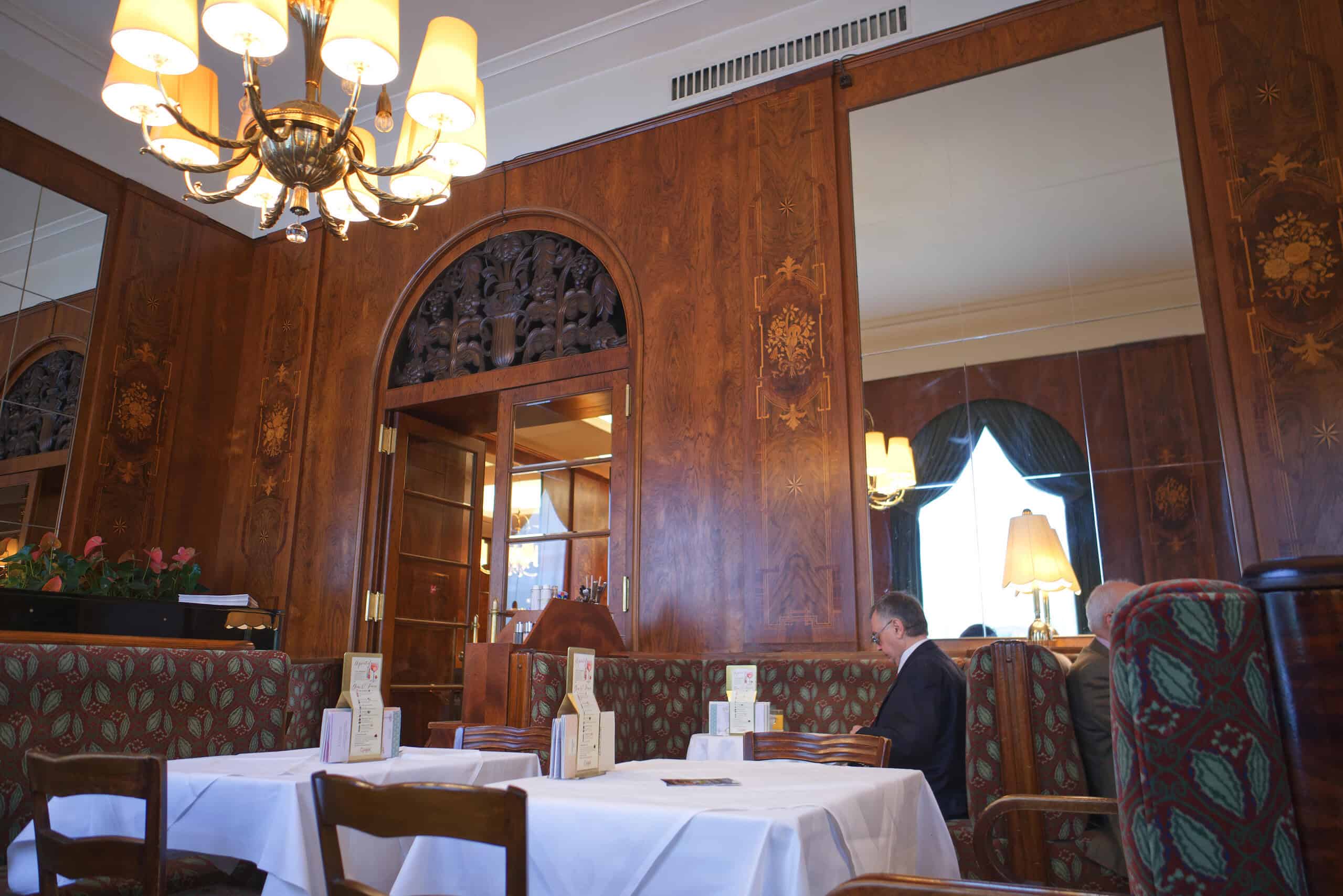
Photo: Newstock 2019/Alamy
As hard as it is to imagine sitting on the outdoor terrace, taking in the nearby landmarks along with one’s coffee, when the Café Landtmann first opened in 1873, it was surrounded by nothing but a massive building site. The Ringstrasse and the Burgtheater did not yet exist, while the Rathaus (City Hall) and the University were under construction.
Freud’s café of choice, Café Landtmann, is today frequented by politicians, actors, and other cultural and intellectual elites. In the main room, the mirrors and historical inlay work on the dark, wood-paneled walls date to the 1929 renovation overseen by famous architect Ernst Meller. Along with the rest of the interior of the main room, the built-in booth seating is heritage protected (and, in a sign of earlier times, a bit of a snug fit), while the Thornet chairs are from the imperial age.
Go mid-morning or late afternoon when the pace slows and service shines. Ask for seating beyond the modern glass conservatory, either in the main room (for the whole heritage experience) or, weather permitting, on the Ring-facing side terrace (for the complete Viennese tableau).
VISITOR INFORMATION
Website: Café Landtmann
Address: Universitätsring 4, 1010 Wien
Hours: Daily, 7:30 AM – 11:00 PM
Nearby: Rathaus (Vienna City Hall), Burgtheater, University of Vienna, Volksgarten
Whether for a morning coffee or an evening pause between performances, these cafés offer more than refreshment. They offer a way into the rhythm of the city itself.
Explore the series:
Old Town Institutions | Bohemian Classics | Culinary Detours
If you’d like to explore Vienna’s local cuisine and café culture with an expert guide, Context offers a thoughtfully designed, food-focused private walking tour.