Grand Addresses: A Travel Designer’s Guide to Luxury Hotels in Prague

Best Luxury Hotels in Prague: How to Use This Curated Guide
Context, Not Rankings
Prague’s best luxury hotels are not interchangeable, and that’s precisely what makes the city interesting. Some occupy former monasteries, Belle Époque landmarks, or urban palaces that have survived war, occupation, and nationalization, and have since undergone post-communist reinvention. Others translate Czech folklore, riverfront grandeur, or early 20th-century design into a contemporary five-star stay.
This guide is designed for travelers who care not only about star ratings and amenities, but also about atmosphere, architectural integrity, neighborhood fit, and the kind of experience a hotel makes possible.
Rather than ranking properties from best to worst, I’ve organized Prague’s leading luxury hotels by character and traveler fit.
The real question is less which hotel is objectively superior than which one most closely aligns with how you want to inhabit the city: cloistered calm in Malá Strana, polished cosmopolitanism in Old Town, or design-led drama in New Town and on Wenceslas Square.
This guide draws on more than three decades of travel to Prague and my time living and working in the city. Some hotels I know as a guest and through their bars, restaurants, and salons. Some of Vienna’s newer luxury properties I’ve come to know during staff-guided walk-throughs. Here, I assesses each property through a consistent editorial lens:
Sustainability information reflects publicly available disclosures at the time of publication.
Taken together, these criteria are meant to help sophisticated travelers think beyond luxury as polish alone. A hotel can be visually beautiful yet culturally thin; impeccably serviced yet spatially generic; historically impressive yet poorly matched to a guest’s desired rhythm in the city.
The hotels below stand out precisely because they offer not just comfort, but a distinct relationship to Prague.
Prioritizing sustainability and social responsibility in your travels? Explore my guide to responsible luxury stays, from eco‑certified hotels to properties with strong community and cultural commitments (coming soon).
Best Luxury Hotels in Prague at a Glance
Which Prague Luxury Hotel Fits You Best?
Before diving into the individual reviews, use the comparison table below to scan the essentials: neighborhood, size, atmosphere, signature features, dining, wellness, accessibility, and price point.
Jump to:
Quiet Sanctuaries: Augustine Prague | Aria Prague
Urban Institutions: Andaz Prague | Four Seasons Prague
Modernist Landmarks: W Prague | The Imperial Prague
Quiet Sanctuaries Reclaimed
Intimate scale, inward calm, quiet luxury
Prague’s quiet luxury hotels tend to cluster in the Lesser Town (“Malá Strana”), where the city softens into sloped streets, church domes, walled courtyards, and sculptured gardens. The five-star Augustine and Aria hotels offer access to major sights while preserving a more contemplative rhythm.
They’re especially strong choices for travelers who want elegance, cultural depth, and a genuinely restorative experience.
Augustine, a Luxury Collection Hotel
Cloistered Luxury
Set within a former monastery in Prague’s Lesser Town, the Augustine offers five-star seclusion, historic depth, architectural atmosphere, and an unusually tranquil base between Prague Castle and Charles Bridge.
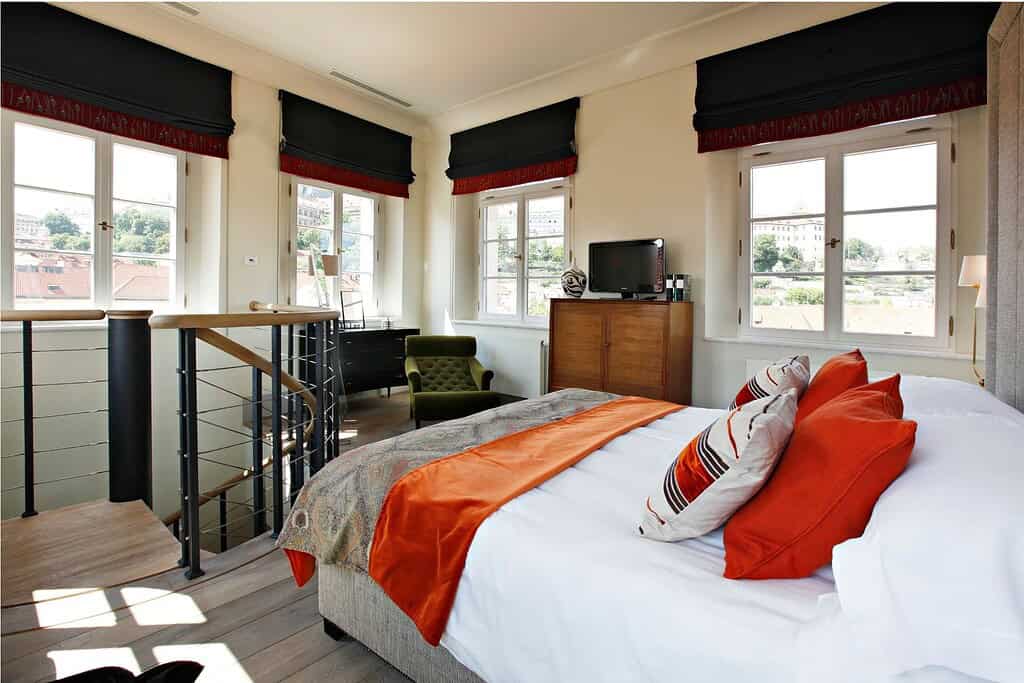
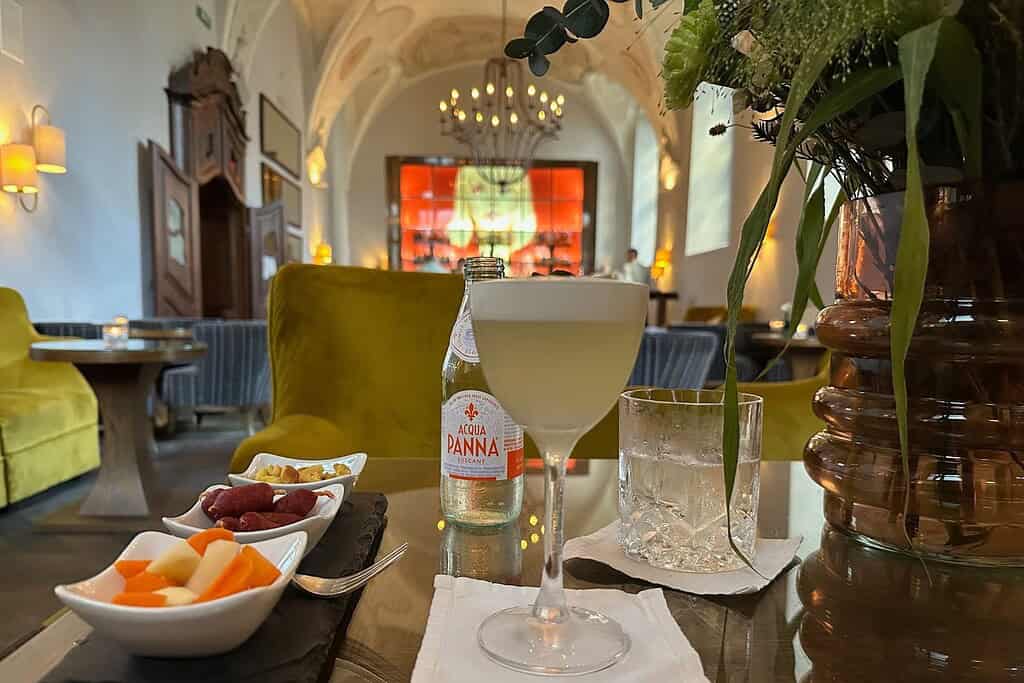
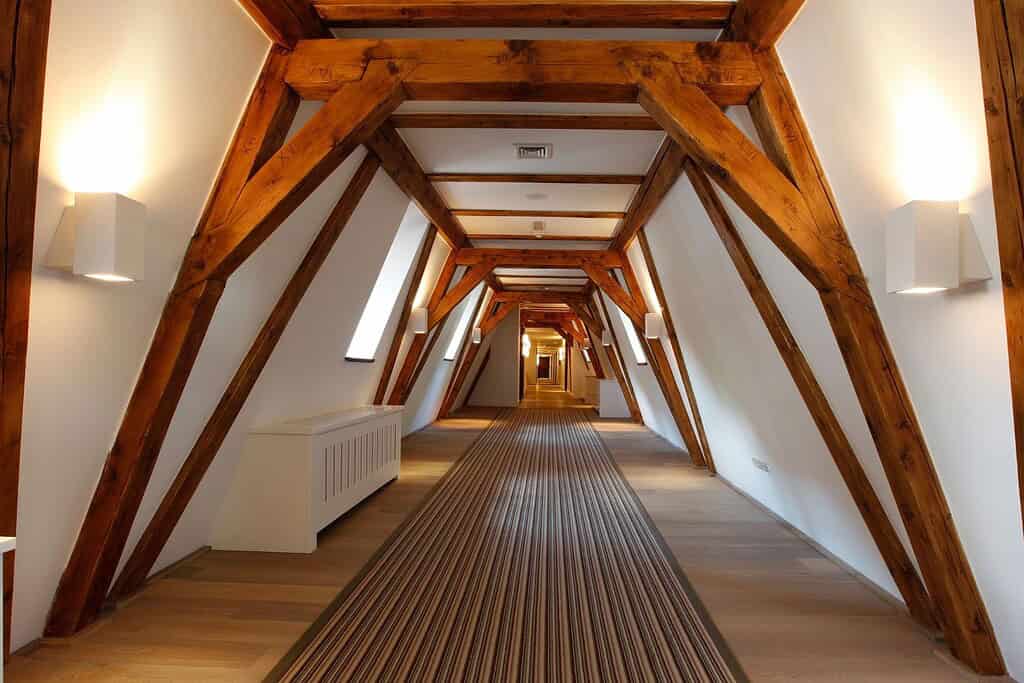
Suite and hallway photos: Josef Horazny / Alamy
Refectory Bar photo: Catherine Barnes
Relationship to History
Few hotels can rival the Augustine Prague for historic pedigree. The hotel occupies a labyrinth of seven linked buildings associated with the Augustinian monastery of St. Thomas, founded on this site in 1285. For centuries, the complex supported religious life, brewing, and communal activities.
Today, surrounded by Baroque palaces and winding lanes, the hotel feels embedded in that older urban fabric rather than being imposed upon it. The hotel’s slightly recessed position gives it a sense of remove without sacrificing convenience. The walk toward Prague Castle, Wallenstein Garden, or Charles Bridge unfolds through one of the city’s most historic and atmospheric districts.
Architectural Intelligence
The conversion succeeds because it doesn’t overcorrect. Vaulted ceilings, stone walls, exposed timber beams, baroque frescos, and religious motifs remain visible, allowing the property’s long life to register visually. Gothic, Renaissance, and Baroque layers coexist within the hotel’s footprint, while Czech cubist artworks, contemporary furnishings, modern textiles, and pops of color keep the interior from lapsing into solemnity.
The result is character without gimmickry, a design that exudes restraint. The Augustine doesn’t try to erase irregular floor plans or polish the building into uniformity. A former monastery shouldn’t be forced into a generic box, and here it is not.
Social Posture
The Augustine suits travelers who value heritage, discretion, and relative quiet over scene. It’s close enough to Prague Castle, Charles Bridge, and Kampa to remain highly convenient, yet just removed enough from Old Town’s density to feel restorative at day’s end. For historically minded travelers, that balance is one of the hotel’s principal strengths.
Ritual and Rhythm
Originally designed for monastic life, The Augustine occupies a distinct niche within Prague’s luxury hotel scene. Here, setting, architecture, and wellness reinforce each other convincingly. The quiet is structural, not staged.
The hotel provides a slightly secluded and peaceful sanctuary, replete with enclosed courtyards and serene gardens. Here, you can unwind at the spa (you can thank me later for recommending the “St. Thomas Beer Body Ritual”). Later stop by the Refectory Bar for a thoroughly modern cocktail program under a barrel-vaulted ceiling featuring 19th-century pink frescos and refined, attentive service.
Looking for well‑appointed bars in Prague? Check out the Prague edition of Pour Decisions (coming soon) for a curated review of the best cocktail bars and wine bars in the city, from atmosphere to mixology.
Cultural Fluency
What makes the Augustine Prague especially persuasive is that it draws on the site’s own history rather than layering generic luxury onto a picturesque shell.
The active monastery next door offers friar-guided tours of the historic chapel, library, and other restricted areas. Revival of St. Thomas’s historic brewing traditions link the hotel to a specifically Czech monastic and beer-making heritage, relying on centuries-old recipes and techniques. This is one of Prague’s clearest examples of luxury hospitality rooted in place.
Sustainable Stay
Augustine’s sustainability profile benefits from Marriott’s Serve 360 framework, portfolio‑wide reporting, and verified, property‑level credentials. Publicly available information points to monitoring of the energy, water, waste and carbon against science‑based reduction targets.
The Prague property itself holds the Green Key international eco‑label, based on independent audits, and publishes carbon and water “footprint” metrics per room night.
VISITOR INFORMATION
Website: Augustine, a Luxury Collection Hotel Prague
Address: Letenská 12/33, 118 00 Praha 1 – Malá Strana, Czech Republic
Location highlights: St. Thomas Church and Monastery, Wallenstein Garden and Palace, Prague Castle complex, Malostranské náměstí (Lesser Town Square), Charles Bridge, and Kampa Island
The Aria Prague
Music as Atmosphere
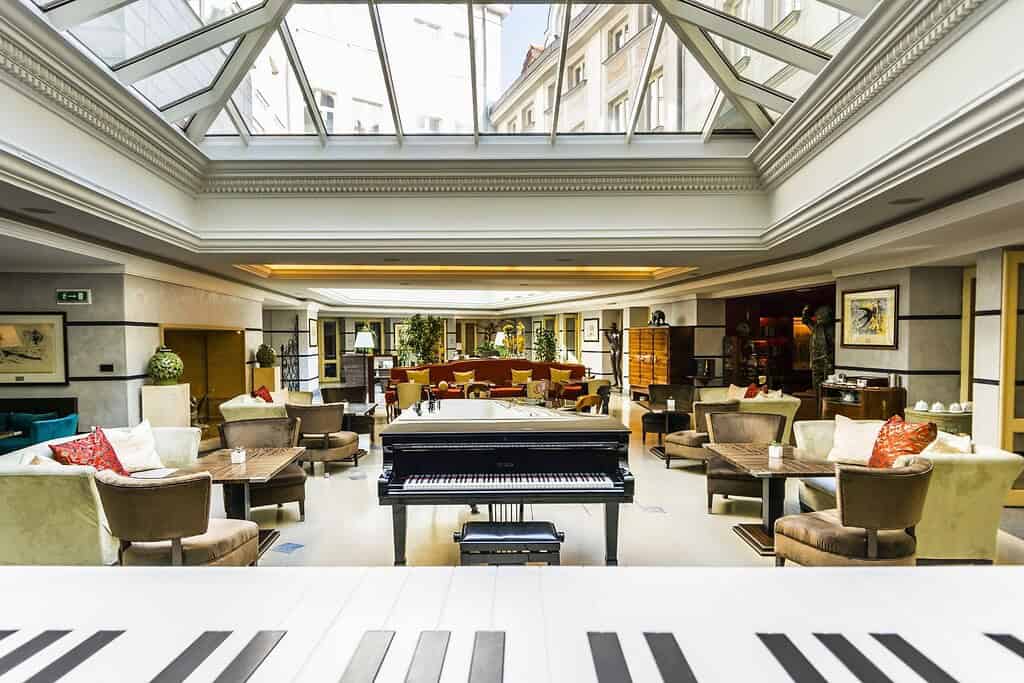
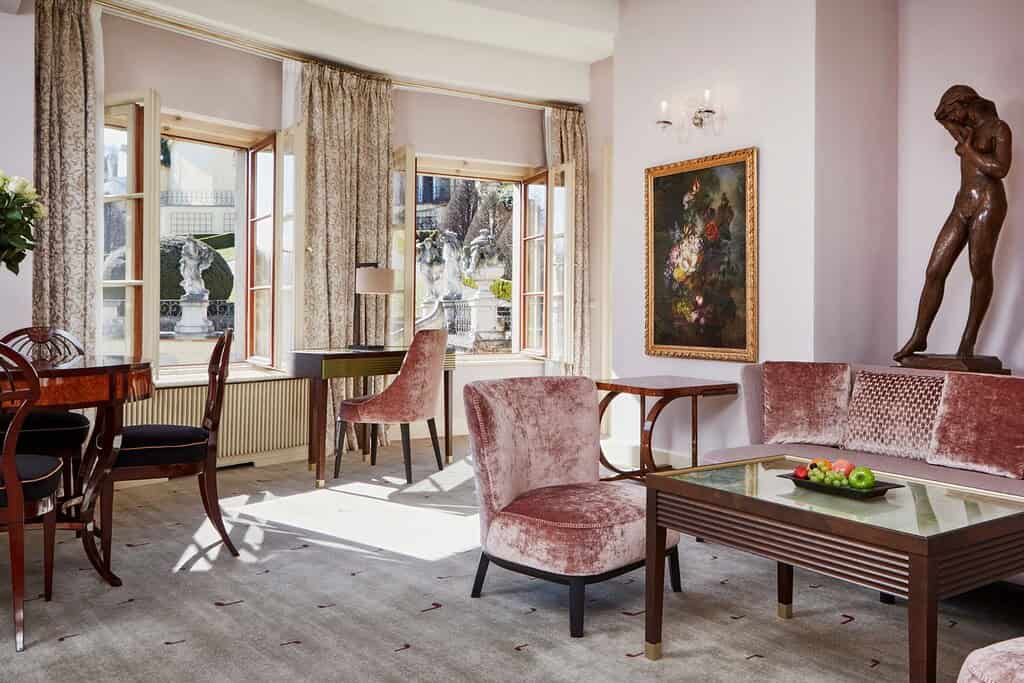
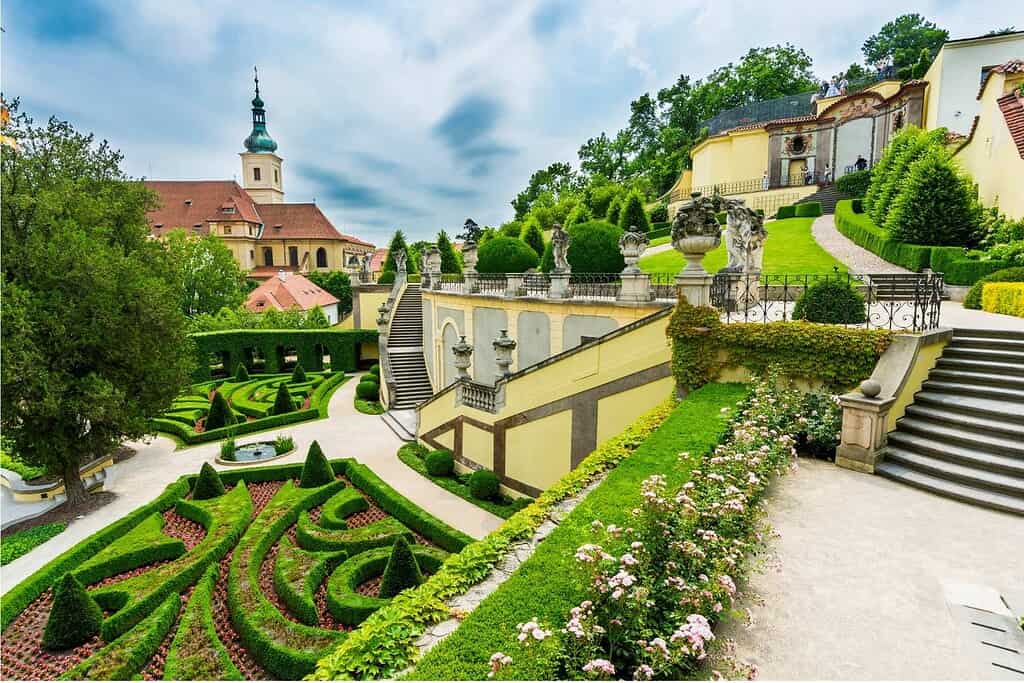
If you’re contemplating where to stay in Prague, the luxury Aria Hotel Prague uplifts guests through the resonance of music, the symmetry of the Vrtba Garden, and open vista views across the Malá Strana.
Photos: Courtesy of Aria Hotel Prague
Relationship to History
The Aria occupies a cluster of historic townhouses on Tržiště Street in Malá Strana, part of a district shaped by aristocratic, ecclesiastical, and diplomatic life. Its immediate setting matters as much as the property itself.
Just beyond lies the Vrtba Garden, one of Prague’s most beautiful Baroque landscapes. Created in the early eighteenth century for Count Jan Josef of Vrtba, the terraced garden climbs the sloping Petřín Hill below Prague Castle, unfolding into a series of ascending outdoor rooms adorned with sculptures, frescoes, and formal plantings.
Architectural Intelligence
Converted into a hotel in the early 2000s, the Aria’s current interiors were designed by Rocco Magnoli and Lorenzo Carmellini. Longtime collaborators of Gianni Versace, the architects brought a subtle fashion-world flourish to the hotel’s music-inspired design.
The hotel’s music theme could have tipped easily into novelty, yet the property is anchored by strong interiors, an eclectic art collection (see the original Chagalls), and a glass-roofed courtyard lounge that draws light into the center of the building.
The hotel’s design intelligence lies in composition rather than grandeur. It layers antiques, modern furnishings, decorative objects, and a mix of fine and pop art in a way that feels cultivated and intentional.
Social Posture
With only 51 rooms, the Aria Prague is one of the most intimate luxury hotels in Prague. It will especially appeal to travelers who want boutique scale, thoughtful service, and an environment that’s cultured without being grand. Music enthusiasts and lovers of sculpted gardens will likely be drawn to the hotel, as will visitors in search of the combination of tranquility, beauty, and location.
Ritual and Rhythm
Situated in the shadow of St. Nicholas Church, the hotel places you in one of Malá Strana’s most atmospheric quarters. Yet the experience here is quieter and lighter than at some of Prague’s larger luxury properties. As you pass through the arched entry, the cadence shifts and calm descends.
That sense of sanctuary extends into the Vrtba Garden, a place where contemplation and aesthetic pleasure converge, and to which the Aria enjoys private access during the warmer months. When the weather allows, one can enjoy the CODA’s rooftop terrace, where the ceramic-tiled roofs of the Lesser Town and the spires of Prague unfold in every direction.
Cultural Fluency
Not merely decoration, music is an organizing principle at the Aria Prague. Guest floors are grouped by musical traditions — classical, opera, jazz, and contemporary.
Individual rooms are dedicated to composers and performers from Mozart and Beethoven, to Dvořák, and Smetana, and Armstrong and Ellington. Each features images of the musician alongside design elements referencing their era or style and a curated in-room music library.
The concierge can assist with recommendations for live music, whether opera performances, philharmonic concerts, or jazz clubs. Or you might wander outside to catch a few notes hanging in the air.
Just uphill on Malostranské náměstí stands Liechtenstein Palace, home to the faculty of the Academy of Performing Arts, with its classrooms, rehearsal studios, practice rooms, and small performance spaces.
CULTURAL SIGNIFICANCE
A Prague Tradition: Caricature and Satire
Caricature has long been part of Prague’s cultural life. In the late 19th and early 20th-centuries, illustrated journals and café culture fostered a lively tradition of satirical drawings. The humorous portraits, a form of cultural and political commentary, distilled the essence of public figures into a recognizable visual shorthand.
The stylized portraits of composers that appear throughout the Aria Hotel Prague continue that tradition. Created by Czech caricaturist Josef Blecha, the minimalist line drawings reduce each composer to a handful of defining features, while giving the hotel a visual identity that feels distinctly local.
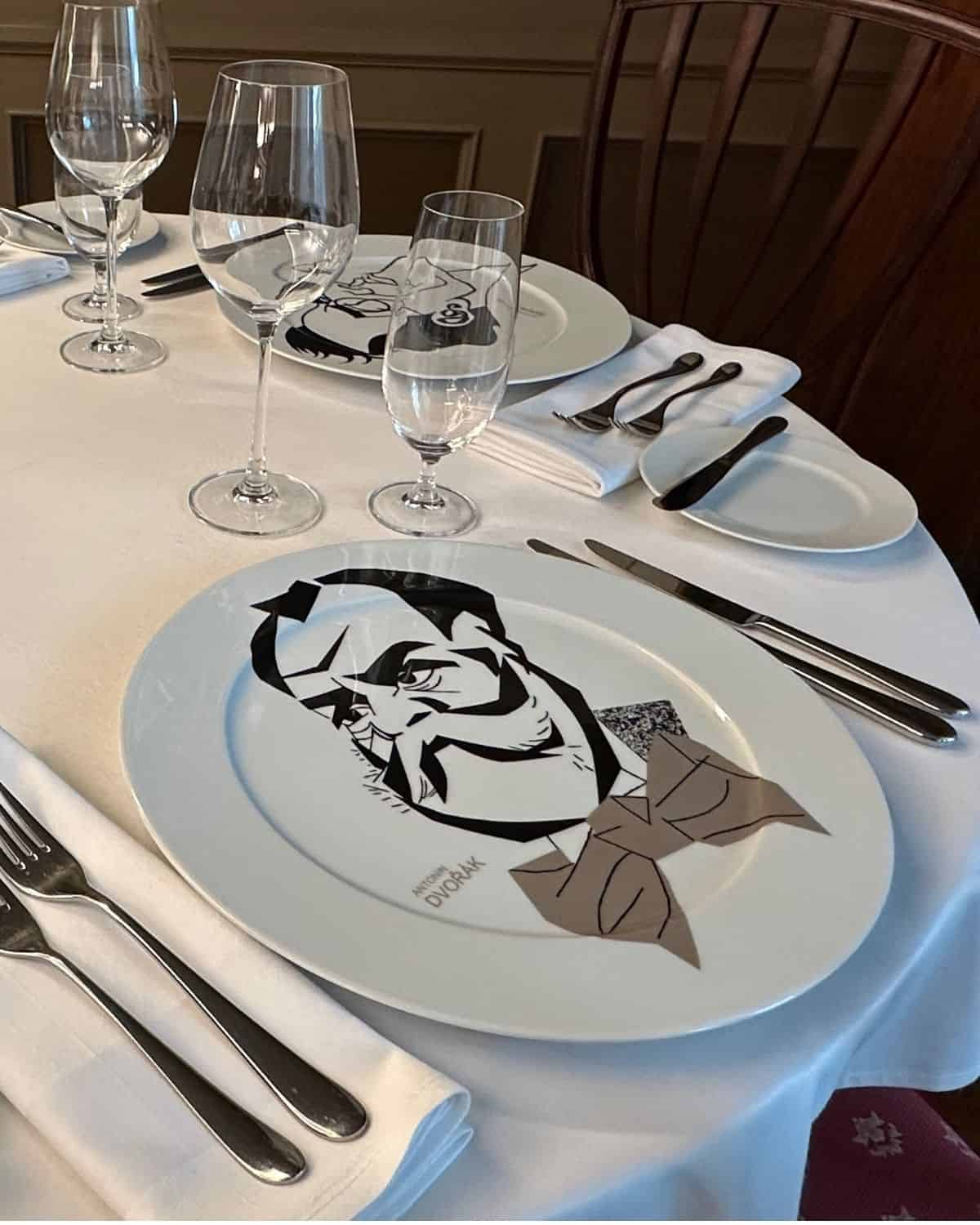
Josef Blecha’s caricatures appear on room signage, the Rosenthal porcelain, in-room art, and the painted friezes in the hotel’s courtyard. Photo: Catherine Barnes
Sustainable Stay
Public sustainability disclosure is limited. The hotel does not publish a dedicated sustainability or ESG section on its official website, nor reference environmental targets, eco-certifications, or formal monitoring systems.
VISITOR INFORMATION
Website: Aria Hotel Prague
Address: Tržiště 9, 118 00 Praha 1 – Malá Strana, Czech Republic
Location highlights: Vrtba Garden, St. Nicholas Church (Malá Strana), Malostranské náměstí (Lesser Town Square), Liechtenstein Palace (Music and Dance Faculty of the Academy of Performing Arts in Prague), Vrtba Palace, and the Church of Our Lady Victorious (Infant Jesus of Prague)
Jump to: Andaz Prague | Four Seasons Prague | W Prague | The Imperial Prague
Urban Institutions Reimagined
Legends, artistic inspiration, and refined luxury
In these centrally located Prague luxury hotels, the city serves as both backdrop and muse. At the Andaz Prague, folklore, legend, and Czech artistic traditions fuse into a sophisticated design language, while at the Four Seasons Hotel, the city itself — the Vltava River, Charles Bridge, and Prague Castle — provides a stunning panorama.
The Andaz Prague
Where Myth Meets Modern Design
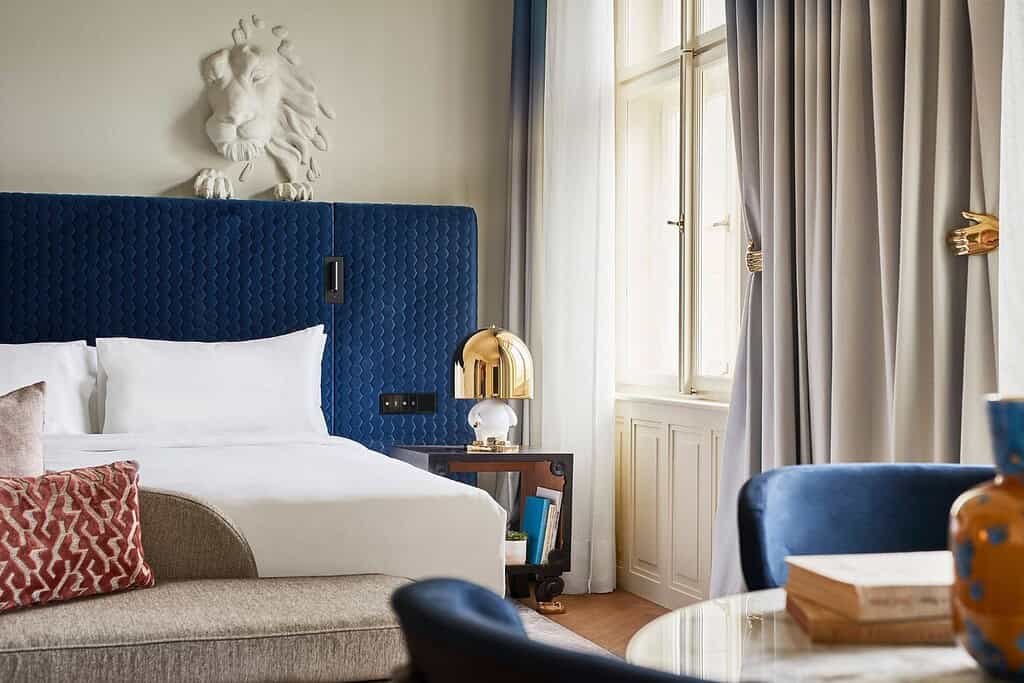
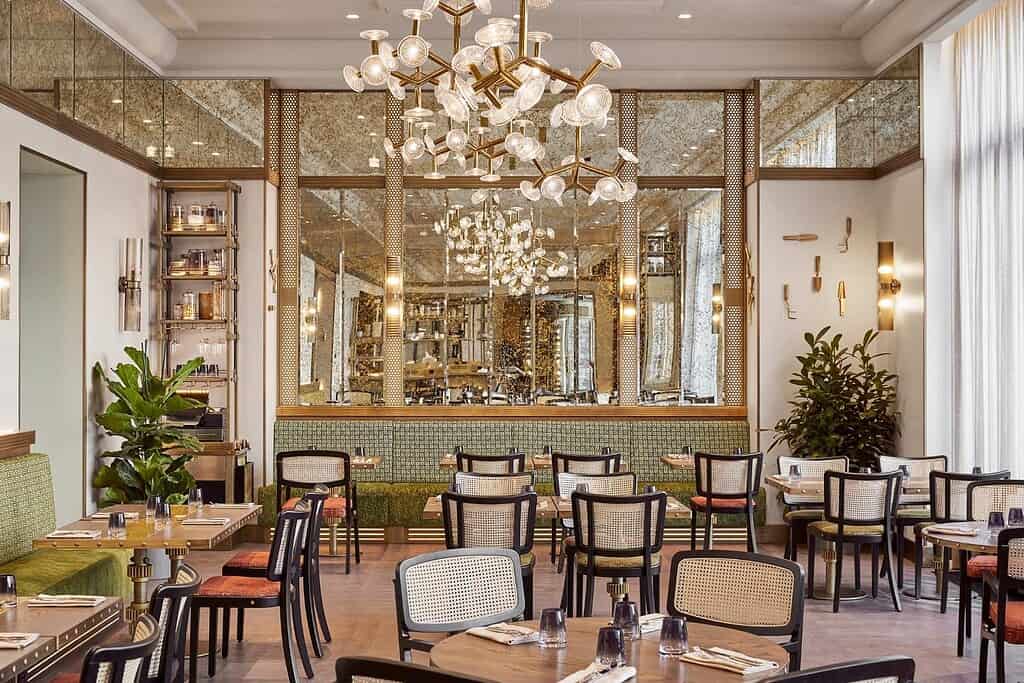
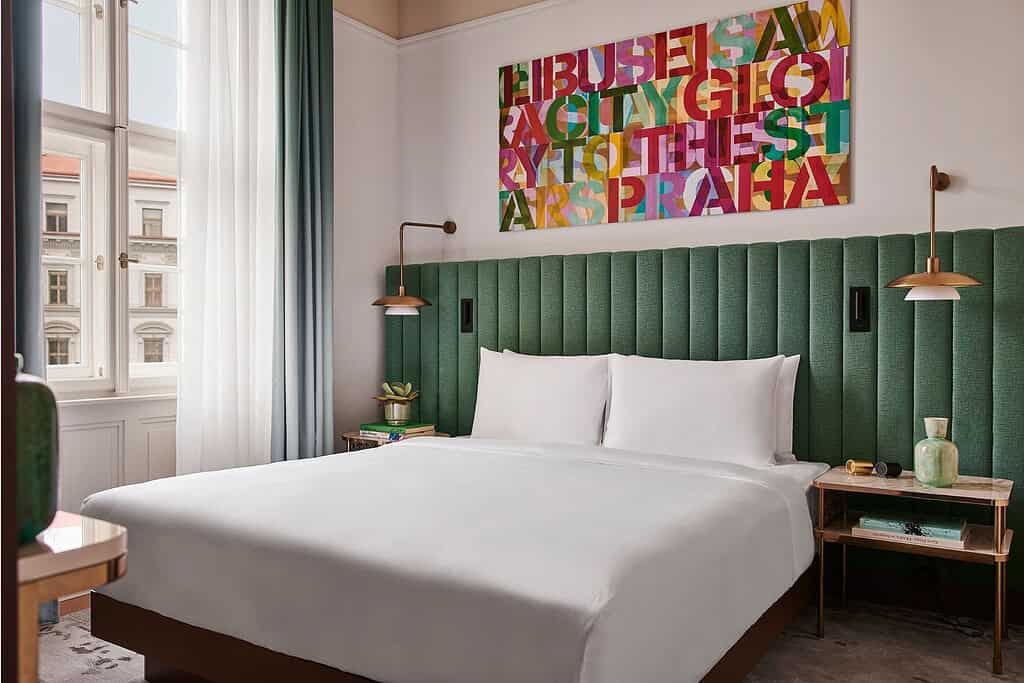
Housed in the historic Sugar Palace, the Andaz Prague is one of the city’s most design-conscious five-star hotels, pairing a contemporary luxury experience with a deeply considered Czech visual narrative that includes commissioned artworks and rotating exhibits featuring emerging Czech artists.
Photos: Courtesy of Andaz Prague
Relationship To History
The neo-Classical Sugar Palace (“Cukrovarnický palác”) was completed in 1916 for the Prague Sugar Industry Company. The palatial headquarters reflected the wealth and influence of the sugar-beet industry in Bohemia, which helped finance banks, insurance associations, and export networks across the Austro-Hungarian Empire.
After World War II, the building was nationalized under communist rule, housed government ministries, and served as a provisional meeting space for the parliament during the Warsaw Pact invasion in 1968.
Only after the Velvet Revolution in 1989 did the palace return to commercial use, including as a banking and insurance headquarters, before a comprehensive restoration and subsequent reopening as the Andaz Prague.
Architectural Intelligence
Architects Josef Zasche and Theodor Fischer originally designed this industrial palace in a neo-Classical Style with Baroque Revival influences. Franz Metzner was responsible for the sculptural motifs on the façade, which celebrated agriculture, productivity, and prosperity. Clearly visible today, these allegories were preserved as part of the building’s protected status.
The building’s history as a commercial rather than an aristocratic palace gives it a different kind of urban authority: less romantic, perhaps, but more monumental. The recent renovation was careful to adapt the grand proportions — soaring ceilings, ornate halls, and structural elements — into spaces suited to contemporary luxury hospitality and special events.
Objects uncovered during the restoration, including agricultural implements and historic banking fixtures, were thoughtfully repurposed and incorporated into the design.
Throughout the hotel’s public spaces and the hotel’s 245 guest rooms, artistic references to Czech folklore and legend abound, while the furniture, lighting, and decorative elements draw inspiration from Prague’s modernist design heritage.
Social Posture
Andaz Prague is a hotel for travelers who appreciate design, comfort, and a stylish urban base that retains a relaxed feel. Situated on Haymarket Square (“Senovážné náměstí”) at the crossroads of Old Town (“Staré Město”) and New Town (“Nové Město”), it draws a cosmopolitan mix of international travelers, expatriates, and locals reflecting the energy of the surrounding neighborhood.
Ritual and Rhythm
At Andaz Prague, daily life unfolds across a series of interconnected salons, where the traditional hotel lobby is replaced by relaxed living-room spaces. Staff handle check-in informally as you sit by the fire, admire the latest art exhibit, or enjoy a drink.
After a day exploring the city, guests might retreat to the spa or linger over coffee, cocktails, or dinner at ZEM, the hotel’s contemporary Czech bistro. By evening’s end, inward-facing rooms overlooking the courtyard or winter garden suites provide a quiet sleep in the midst of the city.
Cultural Fluency
Andaz Prague is unmistakably contemporary, yet its interior language is deeply rooted in local culture. Brime Robbins, working with the curatorial team at VELENOIR, was the driving force behind the design concept, a layered visual narrative expressed through art and embedded design.
Whether prominently displayed or subtly integrated, the commissioned artworks and decorative motifs draw on the symbols and stories that helped shape Czech identity: mystical forests and creatures, heroic battles and figures, and coveted elixirs and treasures.
This unusually cohesive environment, where architecture, design, and narrative converge, evokes the Central European idea of a total work of art (“Gesamtkunstwerk”). Yet, the space never overwhelms; instead, it leaves room for curiosity and inspiration.
Sustainable Stay
Andaz Prague is LEED Gold certified by the U.S. Green Building Council, adding a robust, third‑party‑verified layer to the hotel’s operational initiatives and the brand’s broader World of CARE reporting. Property‑level measures include LED lighting with automated dimming, smart building systems to reduce carbon emissions, low‑flow water fixtures, and active monitoring of water consumption, alongside efforts to minimize food waste and prioritize local, seasonal sourcing.
VISITOR INFORMATION
Website: Andaz Prague
Address: Senovážné náměstí 31, 110 00 Praha 1 – Staré Město, Czech Republic
Location highlights: Senovážné náměstí (Hay Market Square), Powder Tower (Prašná brána), Municipal House (Obecní dům), Hybernia Theatre, Na Příkopě shopping boulevard, and Wenceslas Square (Václavské náměstí)
The Four Seasons Prague
A Room with a View
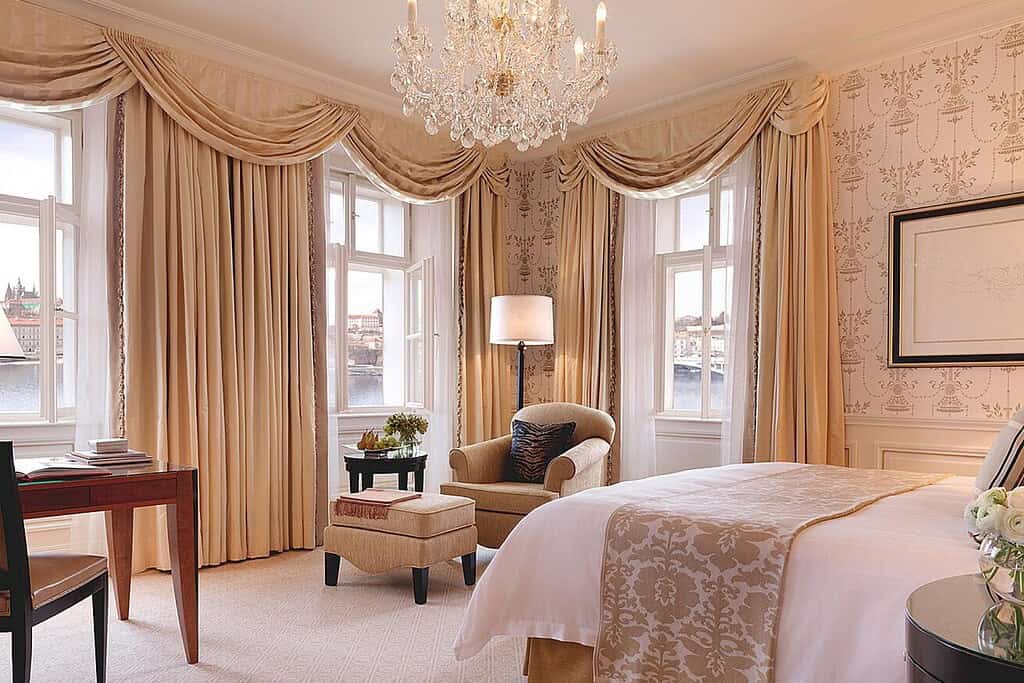
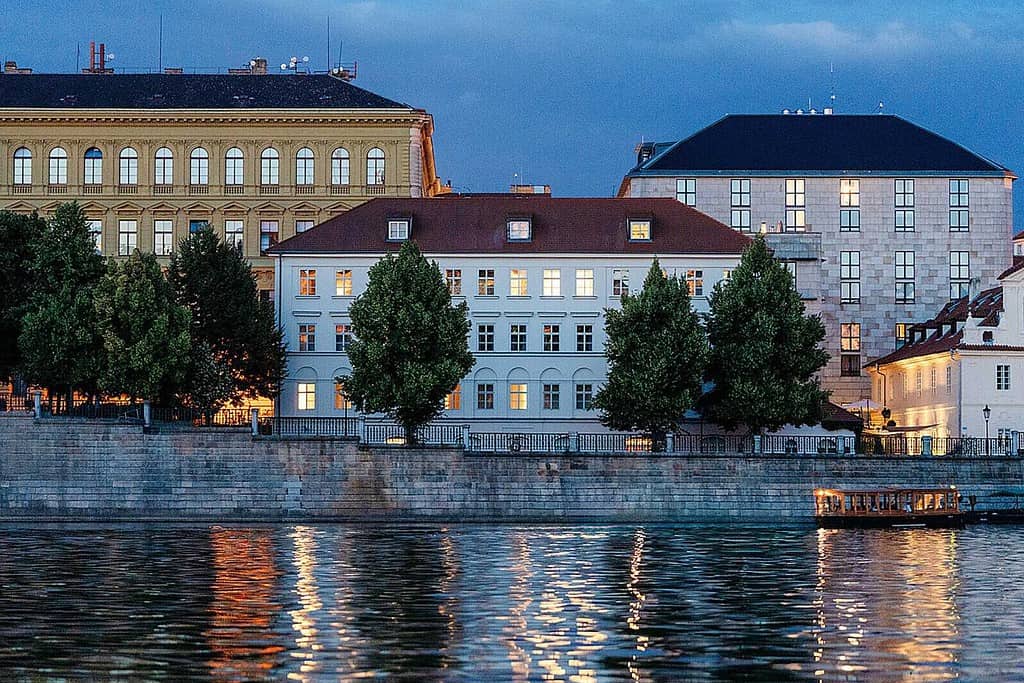
There are hotels with river views, and then there is the Four Seasons Prague. At this five-star luxury hotel on the Vltava River, water is not merely a backdrop but the defining presence with sweeping views of Charles Bridge, Prague Castle, and the rooftops of Malá Strana.
Room with a view photo: Paul Thuysbaert / Four Seasons Prague
Riverfront photo: Courtesy of the Four Seasons Prague
Lounge photo: Catherine Barnes
Relationship To History
The Four Seasons Prague occupies a riverfront ensemble of Baroque, neo-Classical, neo-Renaissance, and modern buildings, the oldest of which dates to 1568. The property sits just behind the historic Knights of the Cross monastery. Over the centuries, this monastic backdrop was layered with buildings purpose built for industry, trade, and bourgeois housing, typical of riverfront streets.
Today, they still shape how the hotel faces the city: guestrooms and suites look directly onto Prague Castle and the rooftops of Malá Strana, while the ground plane continues to read as part of Old Town’s lived experience rather than an isolated enclave.
Architectural Intelligence
Four Seasons Prague’s interconnected buildings underpin its reputation for “four centuries of style,” inviting guests to inhabit Prague’s architectural timeline rather than observe it from afar.
Historic façades and period interiors, from paneling and moldings to stone and plasterwork, were retained under close monument‑authority supervision, while the modern wing seamlessly knits the ensemble together.
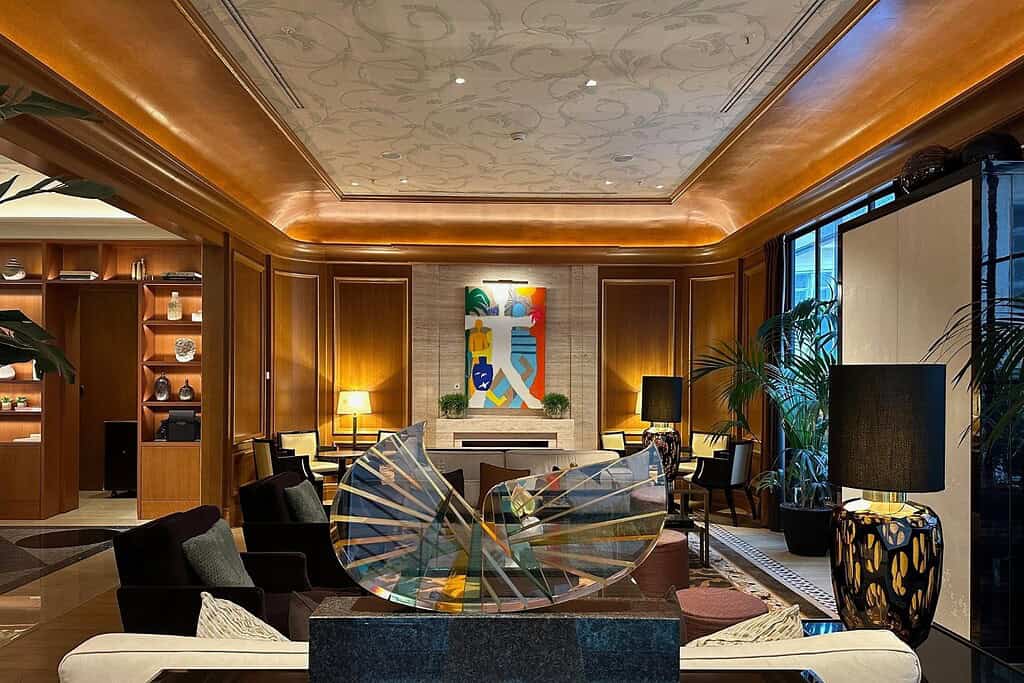
Interior design leans into Bohemian crystal, traditional textiles, and classically scaled rooms, positioning the hotel as a steward of Old Town grandeur.
Social Posture
The Four Seasons Prague is the most conventionally polished hotel in this guide. Its formal service, classic dress codes, and elegant decor signal quiet luxury and proper etiquette.
It will appeal to affluent leisure travelers, C-suite business guests, and high-net-worth families in search of a prestigious address, polished service, and refined experiences. Ultimately, the view will be the deciding factor.
In the hotel’s public spaces, expect to find a cosmopolitan crowd of guests, expats, and locals.
Ritual and Rhythm
What shapes daily life here is the river. Guests can take in its steady rhythm while enjoying an aperitif on the terrace, dining at CottoCrudo, unwinding in the spa, or settling into guest rooms facing the Malá Strana. The hotel’s riverside setting places visitors at the center of Prague’s cultural landmarks while offering a degree of remove from the crush of tourists around the nearby Charles Bridge.
Cultural Fluency
Beyond its location, The Four Seasons Prague engages the city through curated artistic and cultural programming, featuring paintings, drawings, photography, sculpture and glass by contemporary Czech artists.
The Gallery and lobby lounges prominently display custom lighting and works by Lasvit, Pavel Roučka, and Rony Plesl, whose bespoke “Four Seasons” vases and glass installations were commissioned specifically for the hotel.
Recent storytelling collaborations, including the Dan Brown package that ties his novel, The Secret of Secrets, to real city sites, engage Prague as a living narrative landscape rather than a mere postcard backdrop.
Sustainable Stay
Framed within the global Four Seasons for Good platform, the Four Seasons Prague’s property‑specific “Commitment to Sustainability” outlines initiatives such as resource conservation, waste reduction, sustainable sourcing, and community engagement.
The brand’s environmental policy and annual targets for energy, carbon and water are set and monitored across the portfolio. Publicly available, property-specific reporting remains lighter than at some competitors with no indication of third-party eco-certification.
VISITOR INFORMATION
Website: Four Seasons Hotel Prague
Address: Veleslavínova 1098/2a, 110 00 Praha 1 – Staré Město, Czech Republic
Location highlights: Charles Bridge, Old Town Bridge Tower, Old Town Square (Staroměstské náměstí), Smetana Museum, and Pařížská Street (luxury shopping boulevard)
LITERATURE
Following Robert Langdon (and the Golem) Through Prague
In The Secret of Secrets (2025), Dan Brown drops Professor Robert Langdon straight into Prague’s architectural drama, opening with his stay at the Four Seasons Hotel Prague, gazing across the Vltava toward Charles Bridge and Prague Castle.
As readers of the book will remember, that privileged vantage point quickly turns perilous, sending Langdon out a hotel window and into the river for an unplanned swim under decidedly threatening circumstances.
The Four Seasons has leaned into the connection with a “Live Like Langdon” guide that spotlights the Royal Suite as his fictional base, turning its riverfront ensemble of buildings into a ready‑made stage set for conspiracy and escape.
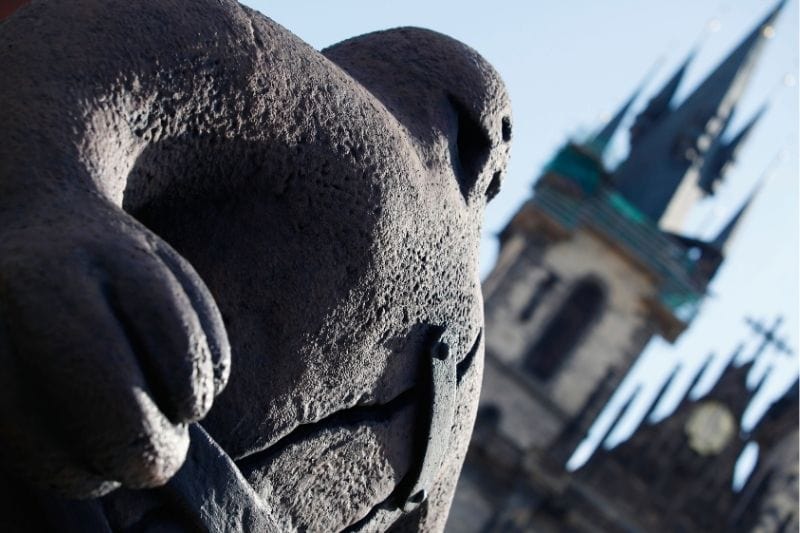
Photo: Rene Fluger/CTK/Alamy
Brown’s official materials also nod to a meal at CODA at the Aria Prague, a neat play on “code.” The rooftop terrace frames Prague’s domes and spires in the kind of cinematic sequence his plots thrive on.
And if you’re chasing the novel’s undercurrent of esoteric Prague — the golem, alchemy, and folklore — the Andaz Prague’s curated Scavenger Hunt and its integrated art program, with contemporary takes on Czech myths (including golem‑like sculpture) offer a complementary, more playful lens on the same city of symbols.
Sources: Dan Brown, The Secret of Secrets and “Live Like Langdon: Travel Guide to The Secret of Secrets”; Four Seasons Prague, “Prague by Dan Brown”; Andaz Prague, “Walk of Myths” and “Interactive Scavenger Hunt Inspired by the Myths and Legends of Prague.”
Jump to: W Prague | The Imperial Prague
Modernist Landmarks Preserved
Design legacy, visual drama, city-stage energy
The W Prague and the Art Deco Imperial Hotel occupy very different positions within Prague’s luxury landscape, but each is anchored by high architectural drama and a powerful historic identity. Both modernist landmarks, one hotel harkens back to heritage, while the other leans into lifestyle. These luxury stays reflect the centrality of design, modernity, and metropolitan aspiration to the city’s identity.
W Prague
Grand Evropa Reborn
A restored Art Nouveau landmark on Wenceslas Square, W Prague reimagines the former Grand Hotel Evropa as a bold lifestyle hotel with a serious architectural pedigree and a distinctly social pulse.
Photos: Courtesy of W Prague
Relationship To History
Originally built on Wenceslas Square in 1872 and transformed half a century later to the celebrated Grand Hotel Šroubek, and later to the Grand Hotel Evropa, this property has long been tied to the square’s role as one of Prague’s principal civic stages.
By the early 20th century, it had evolved from a medieval horse market into a stately urban promenade lined with trees, streetlights, and multi-story buildings, and anchored by the imposing National Museum at the street’s elevation.
Nationalized in 1951 and later renamed the Grand Hotel Evropa, it endured the communist decades as a fading icon, the hotel’s Art Nouveau splendor slowly slipping into neglect. Its latest incarnation as W Prague brings the story full circle: a return to five-star life on a square that has witnessed imperial display, national celebration, and some of the defining political dramas of modern Czech history.
To stay here is, in a sense, to stay on one of the city’s most symbolically charged boulevards.
Architectural Intelligence
The restoration preserves a much-loved Secession façade with its ornamental curves, decorative flourishes, and floral motifs, while adding a contemporary wing behind it.
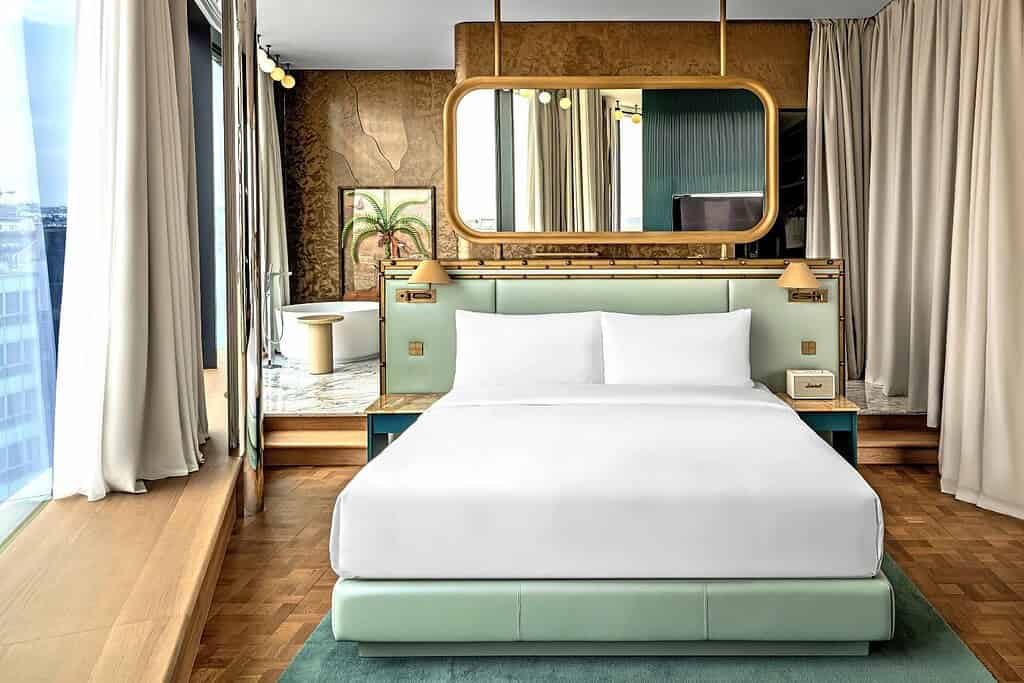
The design narrative leans into Prague’s turn-of-the-century modernity, using contrast to great effect. Historic stucco, plasterwork, moldings, metalwork, and mosaics are juxtaposed with dramatic lighting, art installations, mirrored surfaces, and modern furnishings. The heritage building inspired the palette of earthy yellow, terracotta, dark grey, beige, and a distinctive green.
Social Posture
The W Prague is explicitly social. It targets style-driven leisure travelers, younger luxury guests, and those who want glamour, nightlife, music programming, and visible energy as part of the hotel experience. Being seen is part of the proposition. That will either be a draw or a deterrent depending upon your travel style.
Beyond the public spaces, guest rooms will appeal to maximalists who want bold, theatrical design (see the “WOW” suites among others on offer).
Ritual and Rhythm
This is not a hushed hotel. The property draws energy from the bustling Wenceslas Square and amplifies it through bars, rooftop spaces, music, and late-day momentum. Guests seeking quiet can still retreat to the spa, pool, café, or a well-designed room, but the prevailing rhythm is outward-facing and performative.
Cultural Fluency
The question hovering over the project was whether a global lifestyle brand could successfully inhabit one of Prague’s most significant Art Nouveau buildings. My answer is a qualified yes –– qualified only because it depends upon your tolerance for visionary design bordering on brashness.
Having lived and worked in Prague when Evropa was perpetually boarded up, I dreamed about (and genuinely feared for) what would become of it.
Upon W Prague’s grand opening, I sighed with relief and excitement at the brand’s coup in honoring the building’s history, while reimagining it for contemporary luxury hospitality.
Conceptually, the hotel’s designers drew inspiration from Prague’s imagery of gold, myth, and Mucha-esque dream worlds. Whimsical design elements integrate the heritage building with the new wing.
Sustainable Stay
W Prague operates within the Marriott’s Serve 360 ESG framework, which tracks all hotel’s energy, water, waste and emissions, rather than publicly disclosing property‑specific metrics. There is no public indication the hotel holds third‑party eco‑certification (such as Green Key or LEED) or publishes its own sustainability report.
VISITOR INFORMATION
Website: W Prague
Address: Václavské náměstí 826/25, 110 00 Praha 1, Czech Republic
Location highlights: Wenceslas Square, National Museum, Lucerna Passage, Jubilee Synagogue, and the Prague State Opera.
The Art Deco Imperial Hotel Prague
Exotic Deco Design
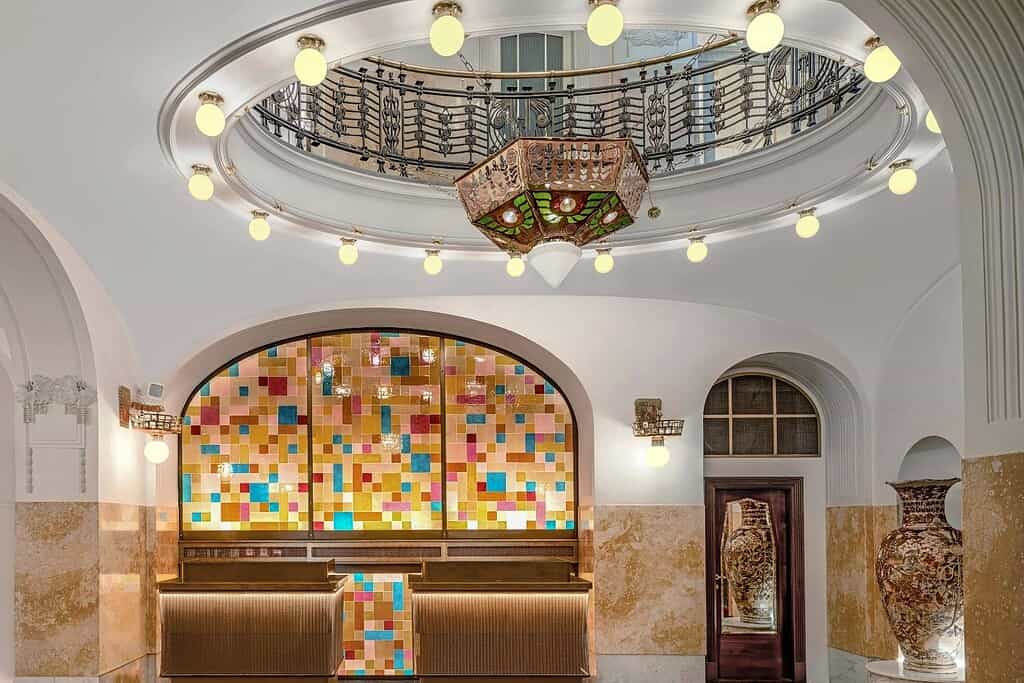
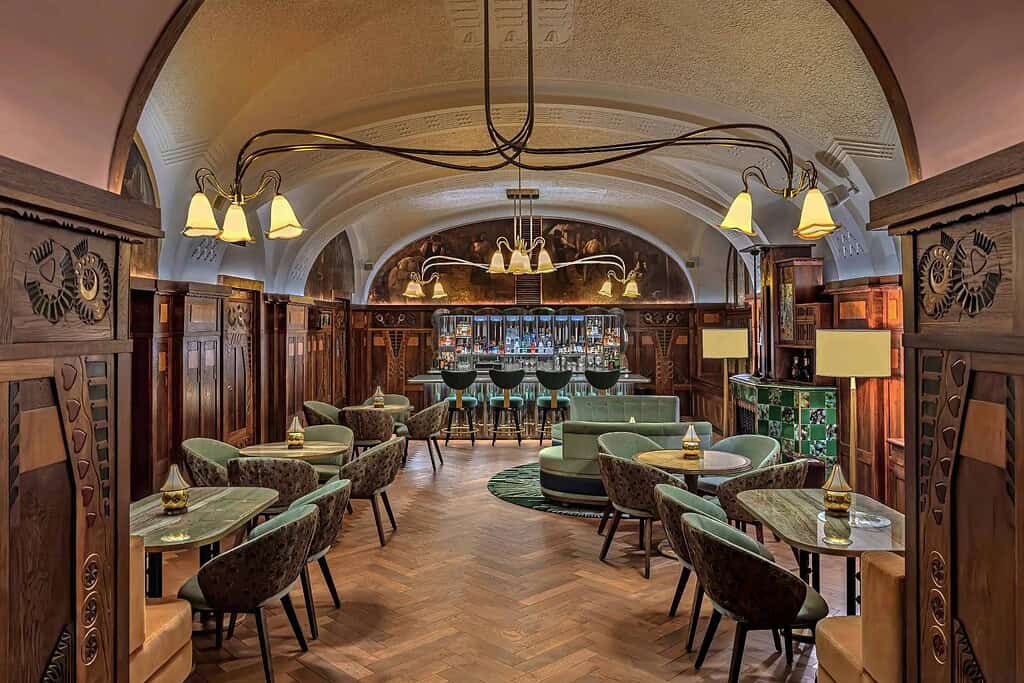
Opened in 1914, the Art Deco Imperial Hotel Prague in New Town offers one of the city’s most distinctive heritage stays, pairing historic Art Deco grandeur with the enduring magnetism of the Café Imperial.
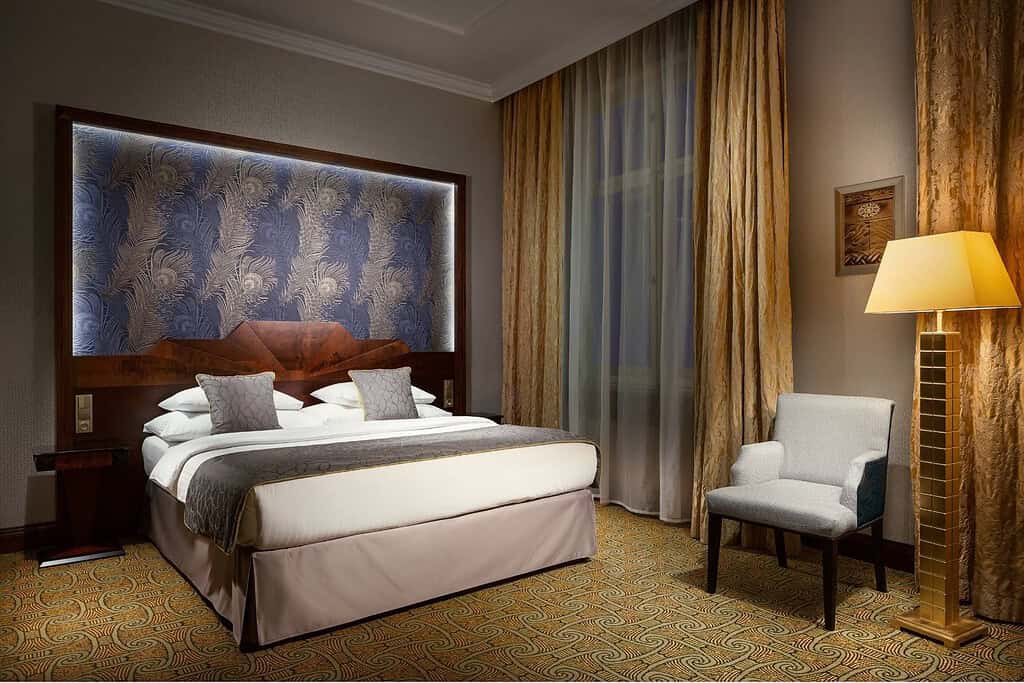
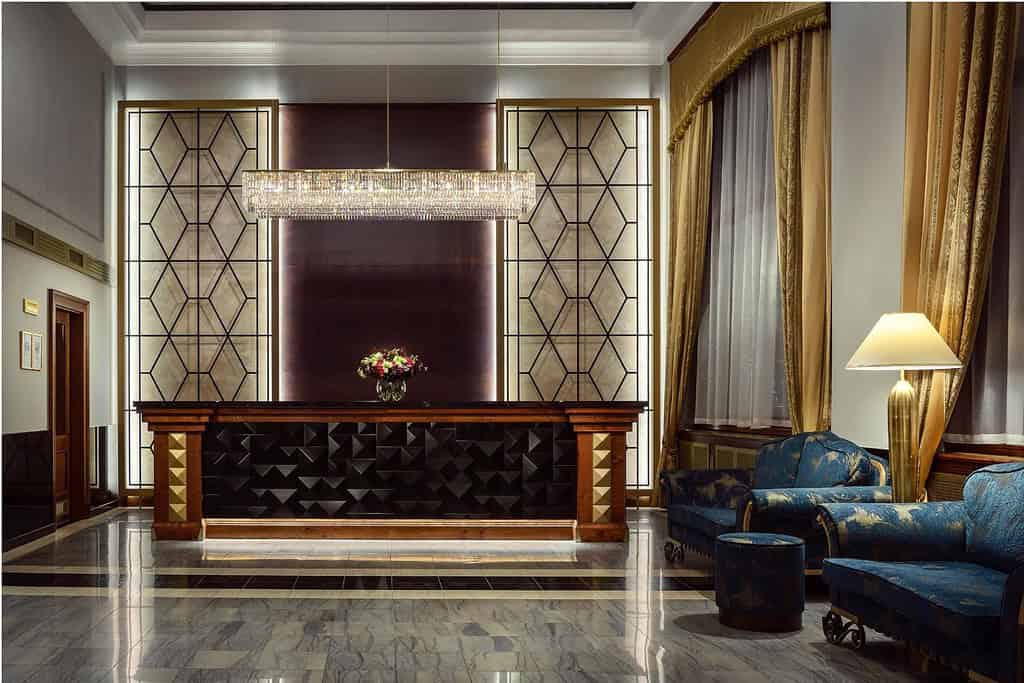
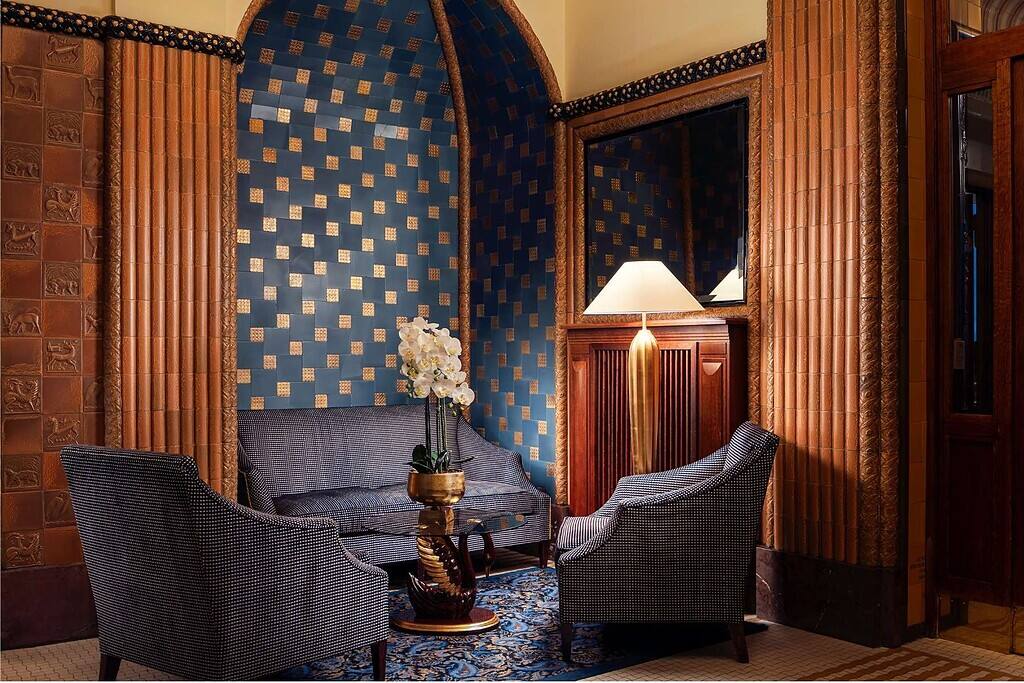
Photos: Courtesy of the Art Deco Imperial Hotel Prague
Relationship To History
A building has stood on this corner of Na Poříčí and Zlatnická streets since at least the fourteenth century. Burned out during the Thirty Years’ War, the property was rebuilt around 1730 as an inn, but it was during a wave of urban renewal in the early 20th-century that the Hotel Imperial was born.
It quickly became one of the city’s most notable modern hotels, attracting Czech and international elites in the waning days of the Austro‑Hungarian Empire and throughout the interwar First Republic.
From the 1939 Nazi occupation onward, however, the Imperial navigated a complex fate. Popular with German officers during WWII, it was later nationalized and requisitioned for use by trade unionists following the Communist coup in 1948. As hard as it may be to imagine today, the building slipped into decline over the next four decades with little concern given to its preservation.
Architectural Intelligence
The Imperial’s exterior is imposing, but comparatively restrained, featuring geometric ornament defined by cubist elements rendered in greige-hued stone. Despite the building’s heft, the facade all but fades into the background on a rainy winter day. On the inside, however, something quite unexpected awaits.
The hotel is a masterpiece of Czech Art Nouveau applied arts at its pinnacle and, simultaneously, on the precipice of the Art Deco era. The interior feels almost cinematic with handcrafted ceramic wall reliefs, mosaic tiles, intricate friezes, carved wainscoting, decorative metalwork, and Bohemian glass. Floral motifs, geometric patterns, and classical allegories draw from Greek, Egyptian, and Moorish art.
Social Posture
The Imperial will appeal to travelers who are looking to temporarily inhabit a bygone era, one defined by a dramatic visual identity, café culture, and traditional service. It’s the kind of place Phryne Fisher might have stayed, should the fictional sleuth ever have visited Prague (and honestly, Prague seems like her kind of town).
The hotel itself invites guests to view themselves as part of a long and esteemed lineage of cultured visitors that included movie stars, statesmen, and artists. Early 20th-century design lovers will delight in every inch of this space.
Ritual and Rhythm
Café Imperial shapes the daily rhythms at the hotel. Breakfast, coffee, pastry, lunch, wine, or dinner can all turn into small occasions beneath its celebrated interiors. A favorite haunt for some and a place of wonder for the newly anointed, it’s a space where locals, expatriates, and tourists comfortably intermingle. The New Town location adds practical convenience and a less overtly touristic setting than some Old Town addresses.
Read more about the Café Imperial in my article, Prague Pause: A Travel Designer’s Guide to Early Modernist Cafés, part of a series on Czech Café culture and the best coffeehouses in Prague.
Cultural Fluency
Thanks to an authentic and meticulous restoration, the Imperial features a Central European, and decidedly Czech interpretation, of Art Nouveau and emergent Art Deco design, not to mention one of the clearest examples of Orientalist influence in early-20th-century decor.
There is no global brand generality on display here. The Imperial offers an experience that is uniquely Czech. Even those who opt to stay at another of the city’s five-star luxury properties would be well-advised to stop by for a look and to indulge in some pastry at the Café Imperial.
Sustainable Stay
The Imperial markets itself as an “eco‑friendly” choice with initiatives such as LED lighting, waste sorting, reduced single‑use plastics and eco‑friendly cleaning products. There is no publicly available property‑specific sustainability report or independently audited certifications like Green Key, EU Ecolabel or LEED.
VISITOR INFORMATION
Website: Art Deco Imperial Hotel
Address: Na Poříčí 15, 110 00 Praha 1, Czech Republic
Location highlights: Republic Square (Náměstí Republiky), the Powder Tower, Municipal House, the Palladium shopping center, and Masaryk Railway Station
Planning Your Stay in Prague?
As you plan your trip to Prague, look beyond neighborhoods, creature comforts, and standardized star ratings. The better question is how you want to inhabit the city of a hundred spires: as a quiet retreat, riverfront stage, design narrative, historic interior rich with atmosphere, or a lifestyle destination? Each of the hotels reviewed here can deliver luxury. The difference is tempo, setting, and character.
Room availability and rates at Prague’s leading luxury hotels vary significantly by season, especially in spring and summer. For the most accurate pricing, current offers, and room selection, consult each hotel’s official website directly.
If you’re pairing your trip to Prague with a visit to Vienna, take a look at my companion guide, Grand Addresses: A Travel Designer’s Guide to the Best Luxury Hotels in Vienna, for an equally elevated experience.