Introducing Vienna Unscripted: Donna Eacho on Life in Vienna

Donna Eacho spent four years living in Vienna while her husband served as U.S. Ambassador to Austria. She returns several times each year. In this introductory conversation for her Vienna Unscripted guest column, she reflects on Viennese culture and traditions, music and museums, ball season, everyday life, and the value of slowing down to experience Vienna as locals do.
How Donna Eacho’s Vienna Story Began
Donna, thank you for agreeing to be interviewed and for contributing to The Triptych Unpacked blog. The logical place to start is probably to learn more about how your relationship with Austria started. How did you first encounter it?
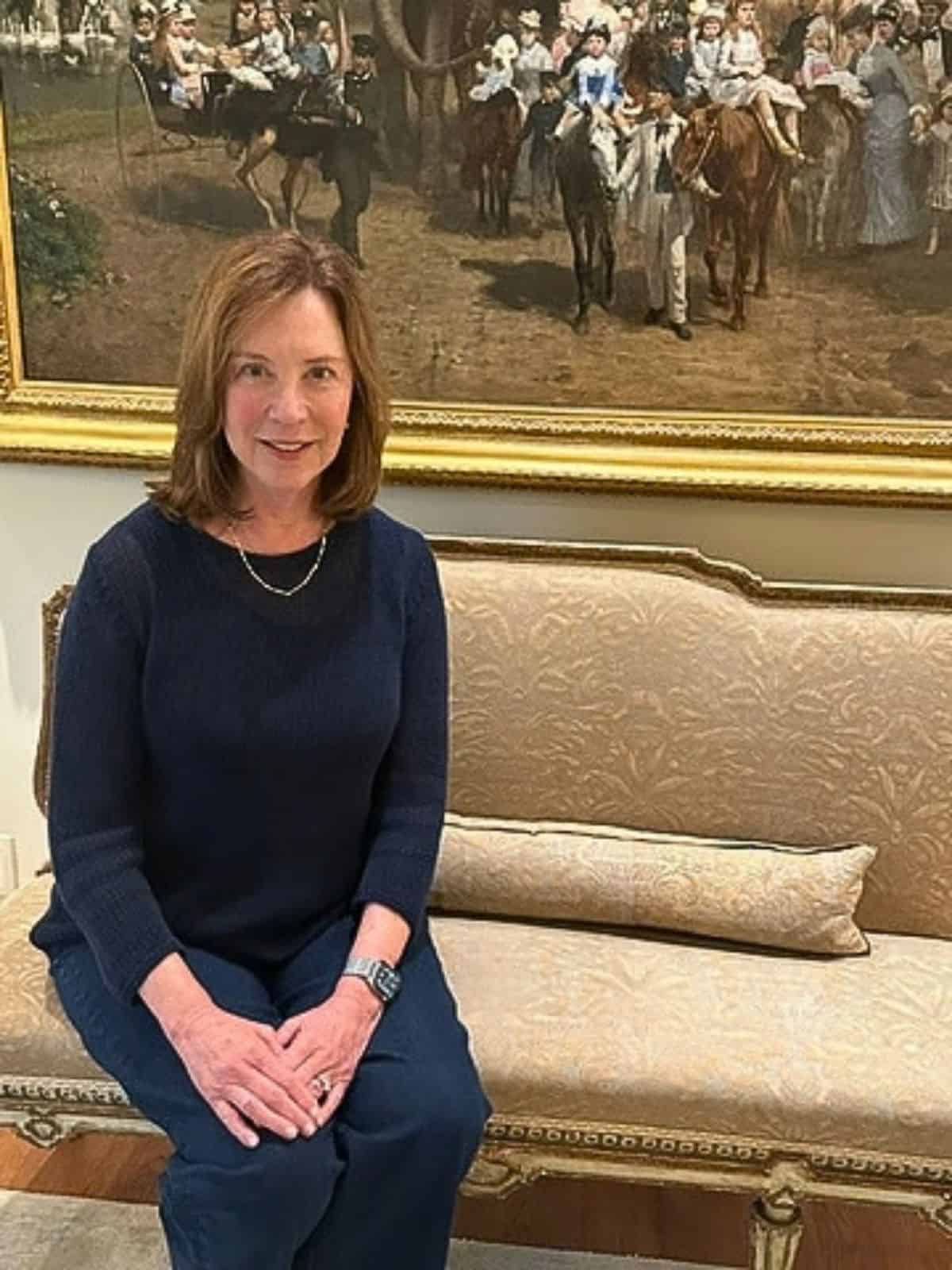
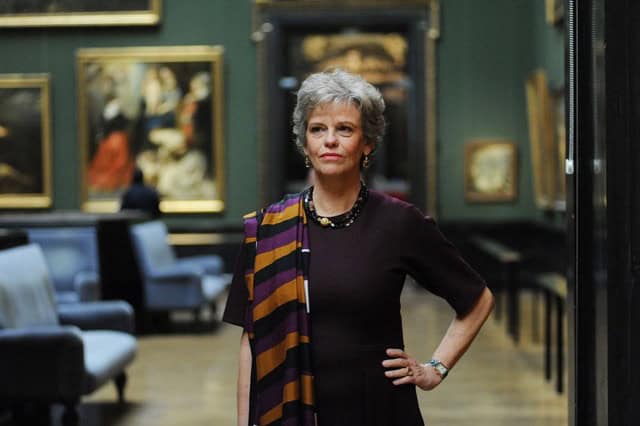
Photo: Donna Eacho beneath Otto von Thoren’s “Afternoon at the Zoo, Bois de Vincennes, Paris.”
I first traveled through Vienna in 1992 for a business tour. I don’t have a lot of memories from that other than how gray the weather was. And how majestic the city was. Honestly, it was a bit of a whirlwind. I really hadn’t thought much about it until my husband was asked to be the American ambassador and I found out that I was going to move there.
It was a little different than touring. I was going to move there for four years and do a job that I didn’t really know how to do. So I think the adjustment was more about moving overseas than necessarily about where I was going, other than that everybody said it was nice.
Of the many places you could be assigned for a diplomatic posting, Vienna is definitely up there.
Absolutely.
So once you arrived back in the city so many years later, what were your impressions? What surprised you most?
Well, I wasn’t surprised to still find it very grand and majestic, but it’s also incredibly charming. I don’t think I got that the first time because you’re seeing the main sites, the cathedrals and the music halls, and you get taken in by the old buildings and cobblestone streets, and how authentic everything is.
But I think I was a little perplexed. It’s a different culture. You don’t know the language or the culture. Everybody arrives exactly on time when you invite them. Men kiss your hand. There was a formality to the culture that we as Americans didn’t have. So, I think it was more of a culture shock.
When I first read some of your interviews, I was interested in how Austrians spoke about themselves and how outsiders perceive them. They have a bit of a reputation, at least among Americans, of being unfriendly. But my sense is that has more to do with American gregariousness. How did your understanding of the people change once you got to know them?
We were invited to so many people’s homes, and when the Viennese have dinner with you, that’s a long event. We would often be invited at 7:00 PM and leave after 10:30 PM, and there was no question they were going to then sit and talk about us for the next two hours or so. I mean they stay up late. They’re shockingly warm once you get to know them. There is a formality, and they’re incredibly intellectual and well-traveled. It’s a small country and it’s not that big of a city, so people travel quite a bit and are very knowledgeable about world affairs. They have kind of a precarious geographic and geopolitical position, so they’re very aware of what’s going on. But it’s not superiority. They like that we’re informal.
How to Experience Vienna Beyond the Tourist Circuit
I imagine being an ambassador’s wife gave you access to a lot of cultural events. What do you think American tourists are missing in terms of the cultural scene?
There are so many wonderful gems there, but there’s no one thing you must see, so I always tell people to tailor it to what they’re interested in, whether that’s architecture, or art, or shopping. Do all those things, but also take time just to slow down!
And don’t feel like you have to be on a tour.
If you stay in the first district, you’ll think you’re lost, but you’ll always end up back at St. Stephen’s. The city’s not that big. Just wander the streets. Everything’s charming. You’ll see different people sitting somewhere and having a coffee. You can take as much time as you want. That’s more what Vienna is, and I think that’s how anybody can connect with the city, through the pace of it and the style of it.
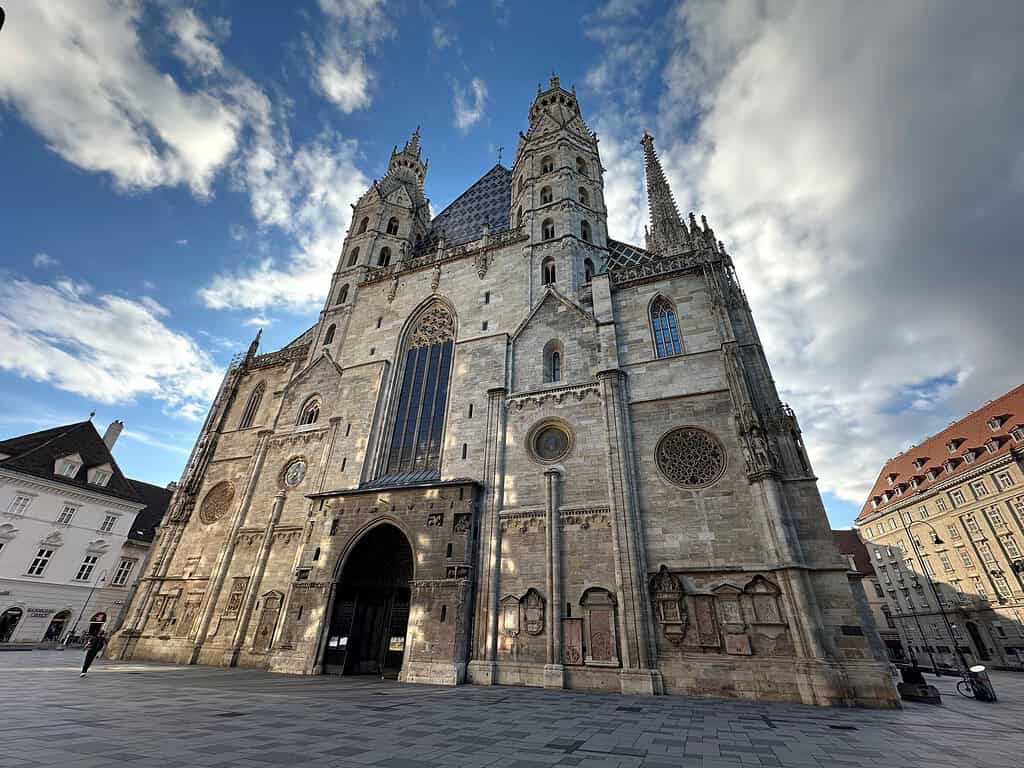
St. Stephen’s Cathedral serves as Vienna’s central landmark and point of reference—wander far enough through the Innere Stadt, and you are likely to find your way back to it. Photo: Catherine Barnes.
And then there are the exhibits. My friends see all the newly opened exhibits, and they also go back to see their old favorites. And the music events are not just for tourists. But I would say, try to go to the things that the locals go to. Get tickets to the Konzerthaus, or the Musikverein, or the State Opera, or any of the other operas. There are quite a number of musical opportunities that are more geared towards the tourists, and they’ll be in a lovely space, and you’ll like the music, but you are not going to really get a sense of the culture of the city as much as going where the locals go.
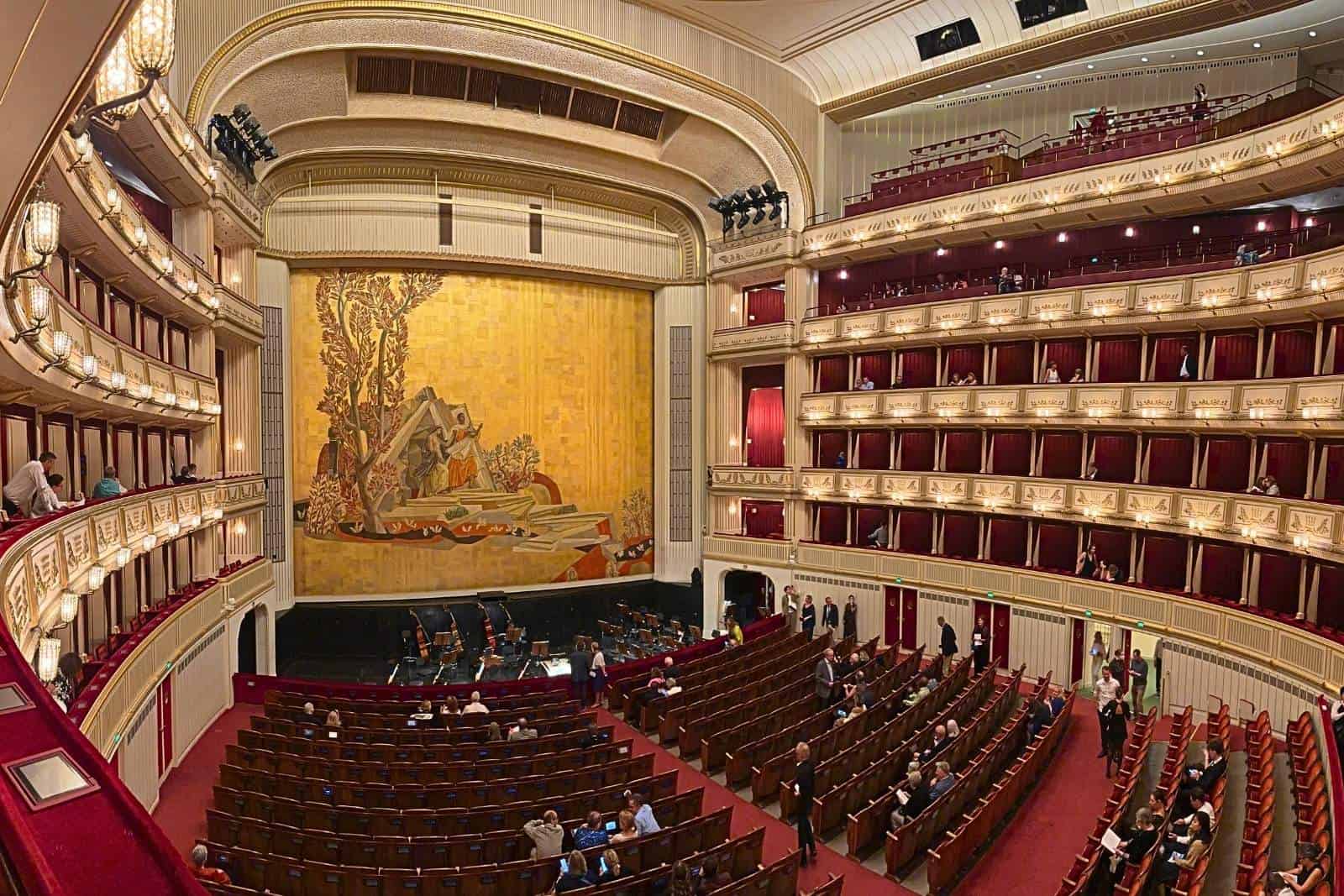
Interior of the Vienna State Opera House. Photo: Catherine Barnes.
And do not buy concert tickets from anyone wearing a Mozart outfit!
Absolutely not! (laughs). The main thing is to organize something that’s a little more authentic. Don’t limit yourself to events designed just for tourists. And don’t think you have to know German. People speak English, and they’re happy to do it.
What Everyday Life in Vienna is Really like
You mentioned just meeting with a friend at a café. What does ordinary life in Vienna look like, beyond the fact that almost all the shops are closed on Sundays?
You know, it’s funny being an ambassador’s wife. There’s a lot you’re expected to do but it’s not like you have a job. And the residence comes with staff, so a lot of the things are taken care of. So that freed up a lot of time. I wanted to accept almost any invitation because I wanted to meet people and, you know, wave the flag for the United States.
I did a lot of walking. There are so many beautiful places to walk, and the American ambassador’s residence is next to Schönbrunn Palace, and so it was a 5-minute walk to get to those gardens, which was fantastic.
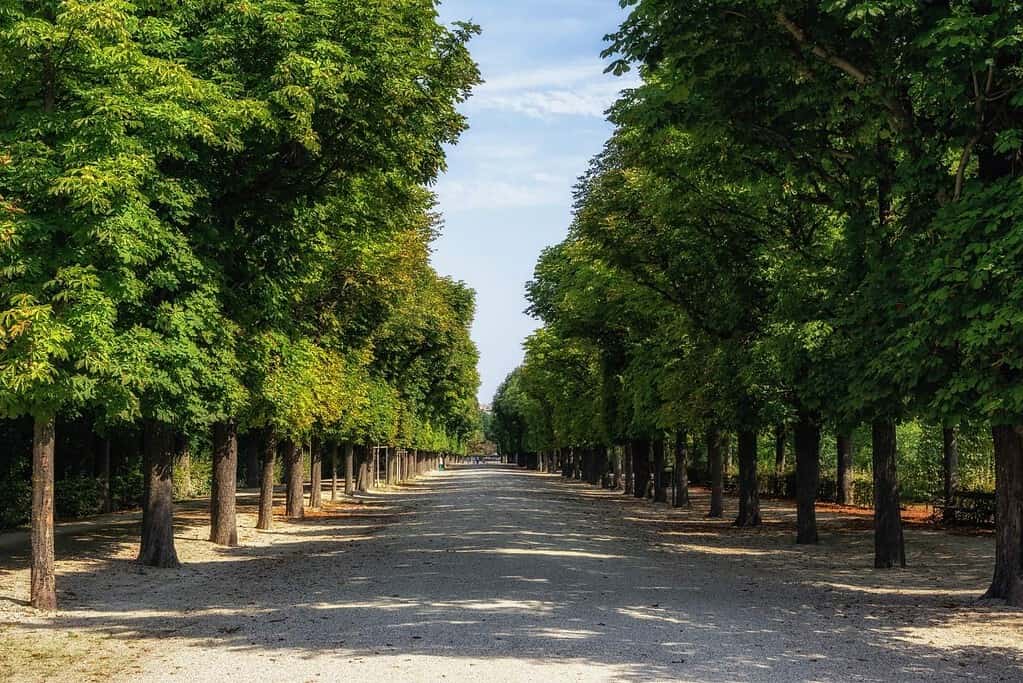
A tree-lined promenade through the gardens of Schönbrunn Palace, one of Vienna’s most inviting places to walk and wander.
And then there were the ordinary things: driving my teenager to high school, helping my 87-year-old mother, who, God bless her, came to live with us for a while, and taking care of a new puppy. Those sorts of things are the same everywhere. And, of course, trying to stay in touch with my friends back home. To be honest, I was rather homesick in the beginning. So I started a blog where I put together my photographs and little write-ups about what was happening. That was a lot of fun!
About the blog, that’s how we landed on the idea of having you as a guest contributor to our blog, The Triptych Unpacked – Vienna.
Yes, a number of people said, ‘You should keep it up!’ And I said, ‘You know I’ve lost my muse.’
Well, not entirely. You don’t live there full-time anymore, but you continue to go back there because you have an apartment.
Yes, we go at least two to three times a year, for a total of six weeks or so.
During the four years you were posted there, was there a point when it started to feel like home and you began to think seriously about buying an apartment and maintaining a relationship with the place and the people you met there?
It was gradual. Every year would feel more like home. You know, I had gotten accustomed to this somewhat unusual life of living in the ambassador’s residence and doing all the official events. So every year got more and more comfortable, and by the end I realized we’d really made some good friends, sincere friendships that weren’t just because of our position or being the new flavor of the month. They evolved over time into real friendships.
My husband kind of joked about how stressed I was going over in the beginning, and I was kind of in tears, and then when we left four years later, I cried all the way back.
I was surprised at how much I didn’t want to leave. It grows on you.
Viennese Traditions That Still Shape Everyday Life
In Austria, tradition is taken very seriously. It’s not just a show that’s put on for the tourists. How did you see that play out? What are the traditions the Austrians really protect or hold most dear?
They really do. I think sometimes in America we hold on to a tradition because we feel it’s an obligation to our families or our heritage, but they really love their traditions. I mean, they like to look forward, but they still cherish their traditions. Many people live in apartments that their grandmother lived in. I even remember going to a ball, and a friend had on this great dress. When I complimented her, she said, ‘Oh, it was my grandmother’s.’ I love that.
Unlike some other cities in Europe, people really live in the center. They really live that tradition, so when you go see Saint Stephen’s or visit the churches, you know that’s where people go on Sundays or for Christmas Eve. And the local cafés, not the ones tourists stand in line for. The Viennese are always going to museums. And the opera. And the balls.
Inside Vienna’s Famous Ball Culture
I was going to ask about that. Not many Americans can claim that they’ve been to a Viennese ball. What’s that experience like?
Well, it was quite a shock the first time I went. First of all, they start at 9:00 or 10:00 at night so you organize dinner first and then you go. Most of them are white tie for the men. My husband came to Vienna with one white tie and tails and two tuxedos, and quickly shipped a tuxedo home and said, ‘Send me another set of tails!’ They’re very formal.
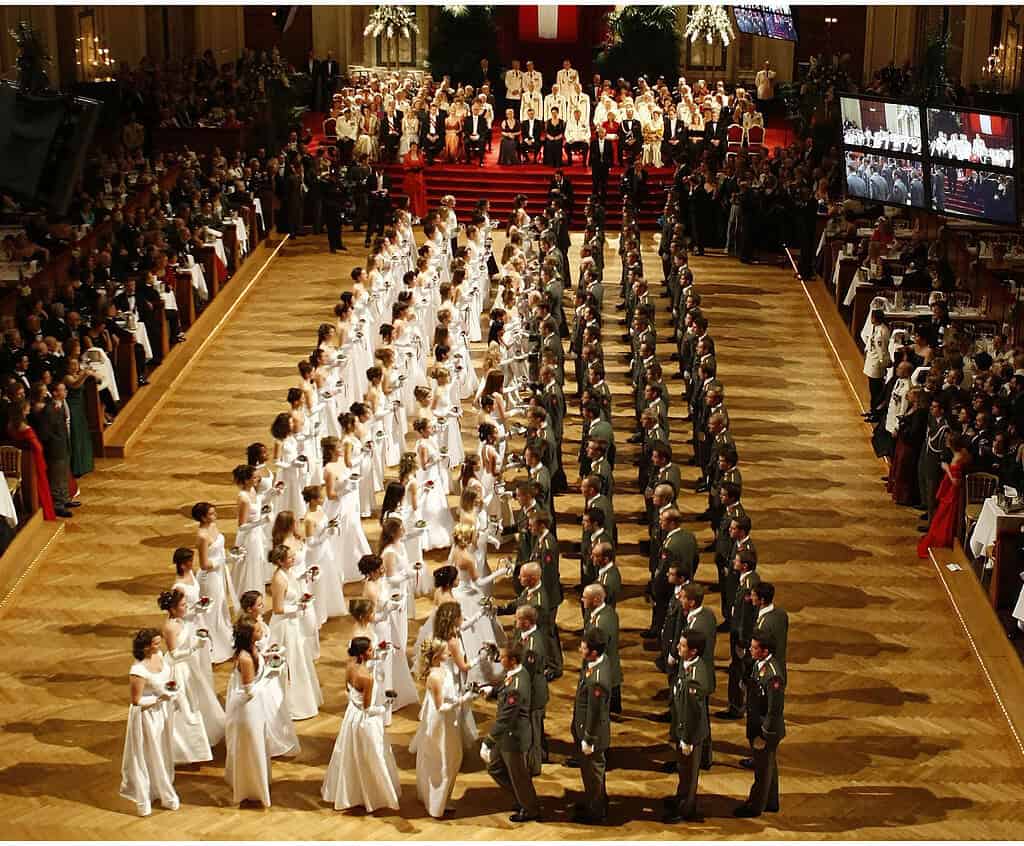
Debutantes and escorts at the Ball der Offiziere in Vienna’s Hofburg. Photo: Andreas Wenzel / Wikimedia Commons, CC0.
At the beginning, there’s a formal presentation. They’re basically a giant debutante ball, but for one thing, they’re huge, the smallest one I ever went to was maybe 500 people. Most of them are thousands of people and everybody’s all dressed up. The women, not all of them but most of them, get their hair done, and I mean totally done.
There’s every kind of dancing. Each room will have different music. Like a jazz club, an orchestra, maybe swing, and there’s always a disco somewhere for the young people. So you just go to the different rooms and dance whatever they’re dancing.
And everybody eats Würstel. It’s basically a hot dog and a roll on a plate with mustard and horseradish. You eat it with your fingers in your fancy ball gown at midnight because you need more sustenance. And then for the people who stay late, they eat goulash at 4:00 in the morning.
Eating Würstel in a ball gown is such an amusing image! It sounds like a long night.
The first time we went, our hosts were in their mid-70s. It was a Thursday night. Around 2:00 AM, I said to my husband, ‘We’ve got to go home. You’ve got work tomorrow. These people have got to work tomorrow. And our hosts are even older than we are.’ They’re not going to leave until we leave. So we did. The next morning, when the staff asked how late we stayed, and we said, ‘Around 2:30 AM,’ they said, “Oh my gosh, your host would have been so insulted!”
What To See and Do in Vienna Beyond the Obvious
What fun! OK, so you also had an opportunity to host a good number of visitors. Where did you always take them?
I usually sent them to see some of the main attractions, with a map or a guide. Sometimes I just took them to whatever I was interested in seeing. And sometimes it depended on the season. Everything in Austria, and I assume all of Europe, is very seasonal. What you eat is seasonal. Where you go and what you do is seasonal. So maybe we’d go to a vineyard or a new art exhibition or a monastery. Some a little more off the beaten path. And definitely a concert or a ball if I could work that out. People always loved that.
Kirche am Steinhof: Otto Wagner, Koloman Moser, and the Gesamtkunstwerk
Steinhof is one of the places you frequently mention. It’s definitely off the beaten track, though. What makes it worth a visit?
Steinhof was part of a complex created for people who had mental illnesses. The idea was that they still needed to live in dignity and beauty. At that time, the avant-garde artists and architects were brought in to develop the campus. I haven’t seen all of it, and much of it isn’t open now, but the church is stunning.
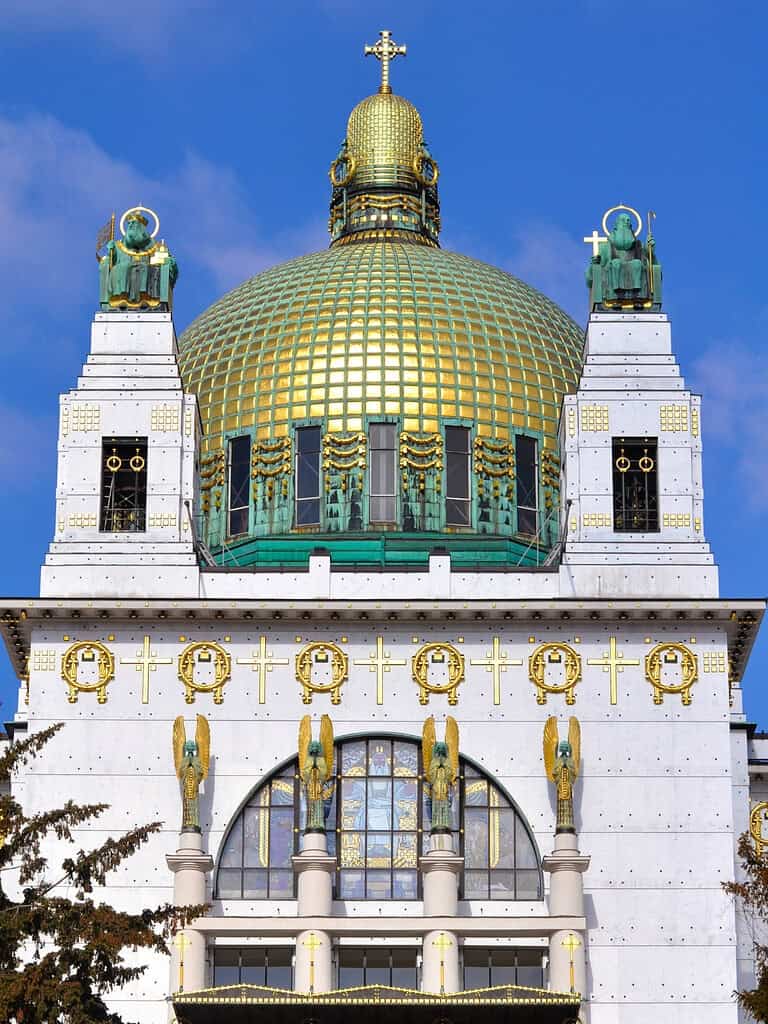
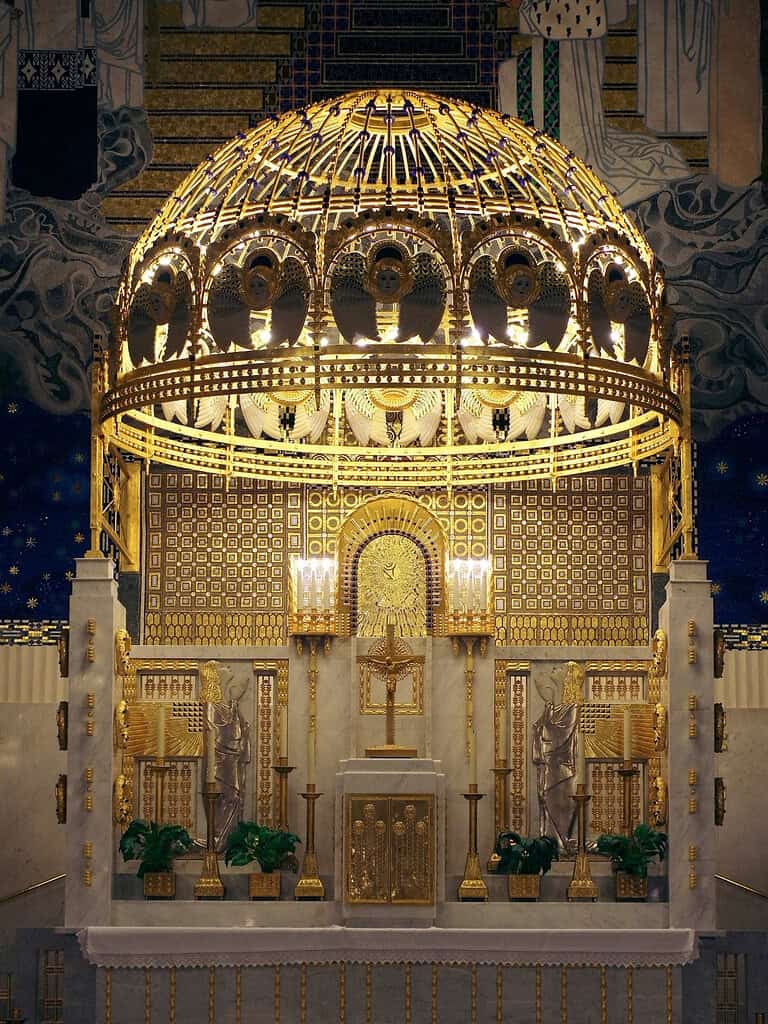
Exterior and interior of Otto Wagner’s Kirche am Steinhof in Vienna, where Secession-era architecture, gilded ornament, and geometric design come together in one of the city’s most distinctive sacred spaces.
It has beautiful stained glass windows designed by Koloman Moser. They’re breathtaking, and every single thing in the church is visually coordinated, from the hymnals to the windows to the architecture to the vestments that the priests wore. If somebody’s interested in the Secession and the Wiener Werkstätte, they should plan ahead to figure out how to see it because it’s unusual. I can’t think of another place where everything is so integrated. It’s just stunning.
AUTHOR’S NOTE: The Kirche am Steinhof, Otto Wagner’s Jugendstil masterpiece, also incorporates work by Koloman Moser, co-founder of the Wiener Werkstätte, and stands as a striking example of the Secessionist ideal of the ‘Gesamtkunstwerk,’ meaning total work of art.
Donna Eacho’s Perfect Day in Vienna
So when you’re interviewing the Viennese, you ask what their perfect day looks like. What does your perfect day look like when you’re back in Vienna?
Yeah, so it was so funny when I thought of that question for other people, but now for me I’m like, oh that’s hard! Well, since it’s hypothetical, it will have perfect weather. Vienna does not have perfect weather. So I would probably start with a walk through the gardens at Schönbrunn.
Oh, the gardens are beautiful, but they’re quite large!
Yes, you could probably walk easily five miles or more. Then I’d go into town and have lunch someplace with a terrace with a good view, or maybe somewhere on a little side street. Then I would probably visit some of my favorite works of art, like the Bruegels at the Kunsthistorisches Museum. I know that’s cliché, but they really are special. Or the Beethoven Frieze at the Secession Building. Then I’d organize drinks at the Blaue Bar at the Sacher. It’s a beautiful location right by the opera. I love it. And then music either at the Musikverein or the Opera, followed by dinner with friends.
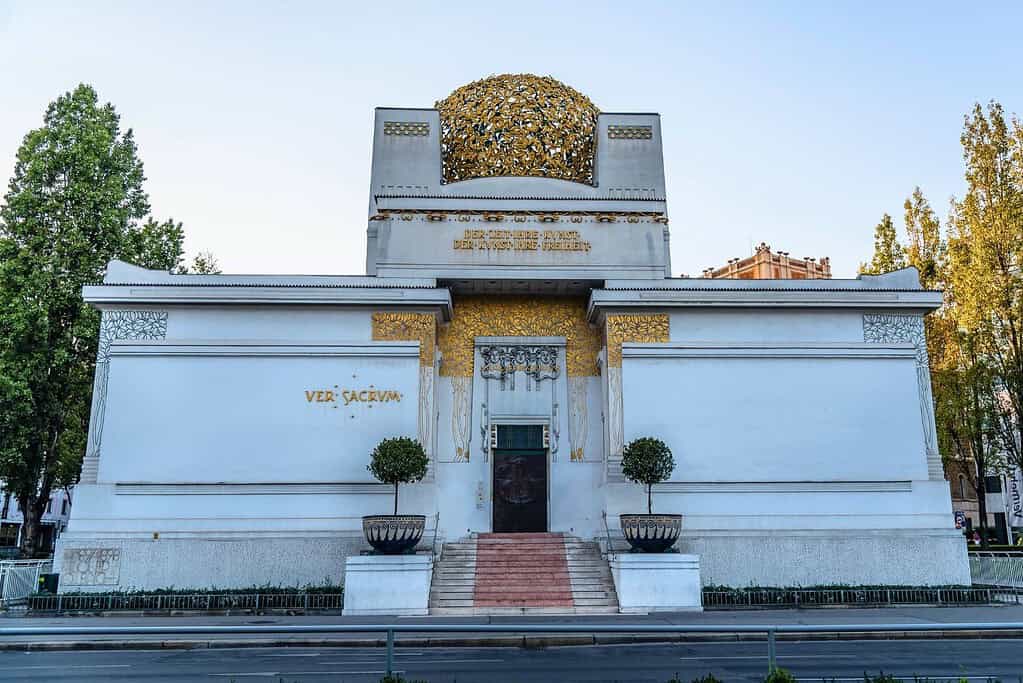
The Vienna Secession building in Vienna, whose striking Art Nouveau exterior gives way to one of the city’s most important interiors, including Gustav Klimt’s Beethoven Frieze.
Speaking of Austrian traditions, late dinner after the opera is one of them. Given the timing of the curtain times around 6:00 or 7:00 in the evening, that means you’re having dinner at 10:00 PM or so.
Yes. It’s a little complicated. You have to organize your food for the day. We usually have drinks at the Blaue Bar before the opera and then dinner at Sole. It’s a late-night spot on a nearby side street where performers and musicians sometimes go after the opera. We always see people we know, and the owner always finds us a table.
Having been to the opera several times over the years, I stress to everyone who will listen that you can’t wait till the last minute to get an opera ticket or to make dinner reservations on the same night as an opera performance. Because the Austrians take opera very seriously.
They do! They plan way ahead on these things. They book their dinners way in advance. You even need reservations for cocktails.
Why Vienna Unscripted Brings Local Voices to Vienna Travel
So, we’re coming to the end of this interview. But you’ve already done about six interviews for the guest column, which I should mention is called Vienna Unscripted. I wonder whether there are any commonalities in what the locals recommend to you?
Hmmm. I would say almost everybody, when they talk about what their perfect day is or when they recommend something to see or do, they say just walk around the city and take it in. You’ll sense the history and the culture and the beauty. That’s always a theme. And, slow down a little bit.
And finally, what motivated you to pick up blogging again?
I think when you love a place, you want other people to love it too. So I wanted people to understand Vienna a little bit better. You don’t have to be an expert to visit, but just having a little more of an understanding and a sense of the place and the pace makes a difference. By listening to the people who are so proud of their city, those local voices, you’ll learn some really fascinating things. You’ll know what to look for and how to reach the culture yourself.
Quite right. Thank you, Donna.
FROM THE TRAVELER’S TRIPTYCH
Want to keep following the thread?
Sign up for our newsletter, The Triptych Dispatch, for the latest interviews and new articles, guides, and itineraries from The Traveler’s Triptych.
Subscribe.