Vienna Easter Markets in Bloom: Spring Days of Palaces, Parks, and Painted Eggs

When visiting the Vienna Easter markets in 2026, allow time for at least one historic chocolate salon, a traditional confectioner, a religious service or classical music performance, and a slow stroll through the Inner City to admire seasonal blooms and meticulously composed window displays.
Whether you’re visiting Vienna for Easter or planning a trip to Vienna in spring, this travel guide, informed by more than 30 years of returning to the city, will help you move beyond the obvious and experience the Easter markets and the city itself with greater intention and depth.
Affiliate Disclosure(*): Some links on this page are affiliate links. If you make a booking or purchase through one of these links, The Traveler’s Triptych may earn a referral fee at no additional cost to you. Our recommendations are independently selected and reflect our editorial judgment and deeply curated approach to travel.
Why Visit Vienna at Easter?
Many people dream of visiting Vienna’s famous Christmas markets. To be sure, the city is magical during the yuletide, all light and sparkle, with the scent of evergreen mingling with spice. And yet, there are just as many reasons, if not more, to visit Vienna’s Easter markets in 2026.
Most notably, there are far fewer crowds in Vienna at Easter than at Christmas. This reality means you’ll be able to enjoy an authentic local experience without an overwhelming tourism presence. In three decades of visiting Vienna, I’ve often found myself there at Easter time. I never tire of it. And, I’ve got the egg collection to prove it.
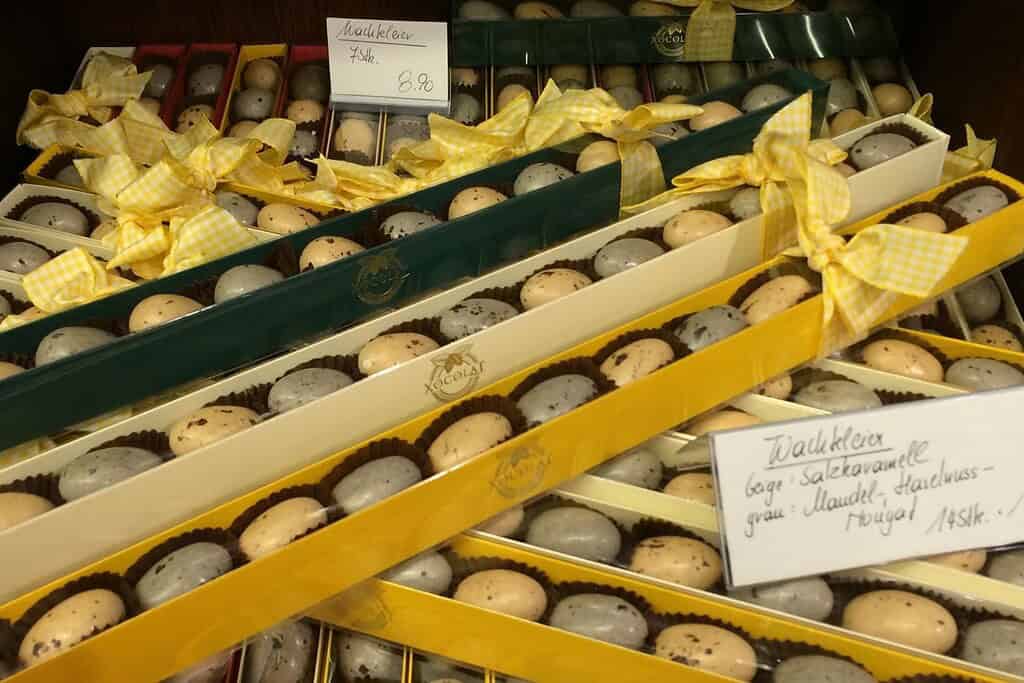
Ribbon-tied Easter chocolate eggs at Xocolat in Vienna’s Freyung, where seasonal confectionery is presented with flair.
Photo: Catherine Barnes
Vienna’s Easter traditions date back centuries, with roots in the city’s deeply Catholic heritage and the imperial traditions of the Habsburg Court. At the markets, you’ll find artisanal crafts and genuine traditions. Even beyond the markets, you’ll have an opportunity to witness centuries-old customs still practiced by Viennese families. Easter in Vienna is an experience with legitimate cultural depth.
And then there’s spring. The sense of renewal can be felt everywhere, from blossoming flowers and trees in the city’s many parks and palace gardens to the reopening of outdoor cafes and the brightly decorated shop windows beckoning the new season.
Still dreaming of the Christmas markets? Vienna at Christmas is a very special experience, with Advent traditions, lights, decorations, holiday crafts, food, seasonal music, markets, and ice skating across the city. For more insights, explore our 2026 Vienna Christmas markets guide.
Jump to:
Major Easter Markets in Vienna
The Art of the Easter Egg in Vienna
Easter Window Displays and Spring Shopping
Vienna Chocolate Shops and Confectioners
Spring Blooms and Parks in Vienna
Easter Services and Seasonal Music
Practical Tips For Visiting Vienna at Easter
Vienna’s Easter Market Traditions
Vienna’s Easter markets are not an invention of the modern age. They grew out of centuries of devotional practice, imperial ritual, and seasonal exchange.
Major Easter Markets in Vienna
Freyung Easter Market
Setting the historical and Cultural Stage
The Old Viennese Easter Market (“Altwiener Ostermarkt“) on Freyung Square is the most traditional and historically significant of Vienna’s Easter markets. The Old Town setting is defined by a baroque square anchored by the Schottenkirche, founded during the 12th century. The square that formed in front of the complex gradually came to be known as the Freyung, a “free” space under the abbey’s special privileges.
With upwards of 45 stalls each season and a dense concentration of egg, craft, and food stands around the square, it’s one of the more intimate, atmospheric markets in the city’s historic center.
A Mountain of Decorated Eggs
At the Freyung Easter Market, the sheer volume and variety of eggs is part of the spectacle. A central “egg mountain” or pyramid displays tens of thousands of individually decorated shells, with more spread across surrounding stalls.
These eggs are sourced from across Austria and neighboring Central European regions, so you’ll see both Viennese and rural Austrian styles alongside Hungarian, Czech, Slovak, Croatian, Polish, and Ukrainian designs. They’re carefully sorted and presented by color, motif, and technique –– rows of deep reds and blues, delicate pastels, and metallics. Many stalls group eggs thematically by religious symbols, floral patterns, folk ornaments, and contemporary graphics.
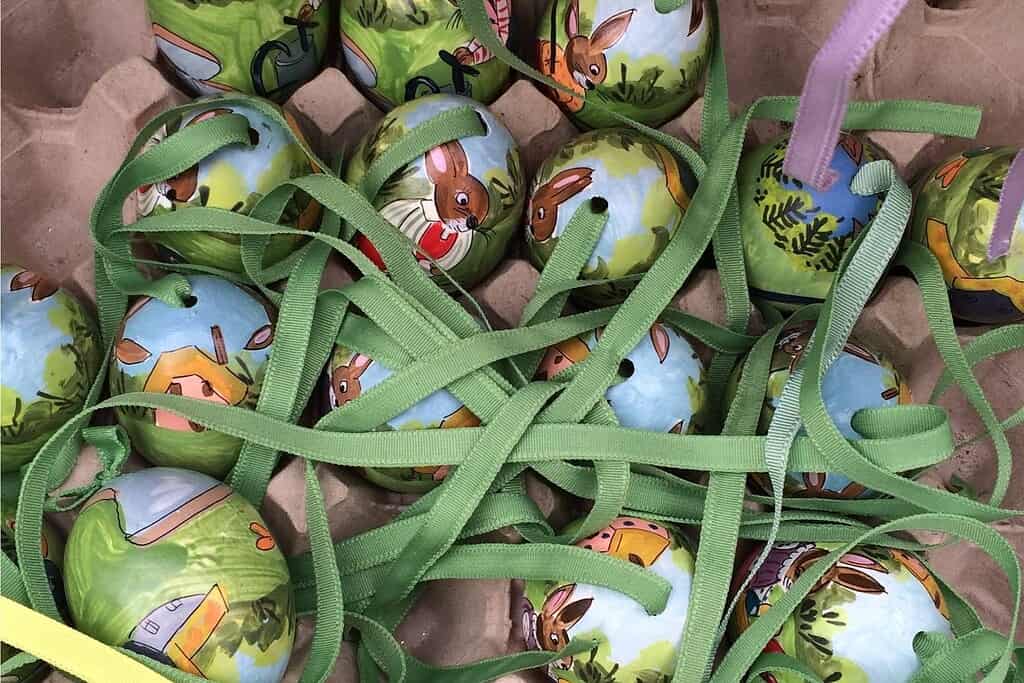
Hand-painted hollow Easter eggs with rabbit motifs at the Freyung Easter Market in Vienna’s historic center.
Photo: Catherine Barnes
The eggs are displayed in straw‑lined crates, wooden trays, or hanging on tree branches and ornamental stands so that the whole market reads like an open‑air gallery. Here, you’re invited to browse slowly and select a few pieces as if you were choosing small artworks rather than simple souvenirs. If you want to start a collection, this is the place to be.
Farm‑Fresh Produce and Regional Specialities
Freyung’s regular farmers’ and specialty markets make it one of the best places in central Vienna to see how deeply Easter and spring still connect to regional foodways. On market days, stalls are piled with farm‑direct products from around eastern Austria and neighboring regions:
- Cured meats and sausages
- Mountain cheeses
- Smoked fish
- Farm butters, honey, and fruit jams
- Oils and vinegars
- Wild garlic, asparagus, and early greens
- Nut‑filled brioche loaves, poppy‑seed cakes, marzipan
- Small‑batch chocolate
What distinguishes the Freyung Easter Market is that many of these stalls are run by the producers themselves or by long‑standing family businesses. It functions as a city‑center showcase for rural Austria and its neighbors, with an emphasis on traceable, high‑quality ingredients.
Hand-made Easter Decor
Beyond the eggs and food, the Freyung Easter Market is known for its seasonal handicrafts. Stalls are bright with spring flowers and potted bulbs. Wooden decorations range from rustic carved rabbits and lambs to more refined, minimalist pieces for your Easter tabletop. You’ll also find pottery and ceramics, embroidered linens, beeswax candles, and small turned‑wood objects, many signed or labelled with their workshop and place of origin.
Activities for Young and Old
In addition to the painted eggs, food stalls, and local crafts, the Freyung Easter Market offers a range of activities.
There’s a craft workshop, where children can paint eggs or make simple decorations (daily from late morning into mid‑afternoon). On selected mornings, “Punch‑and‑Judy” style shows are performed on the Kasperl puppet stage. And as evening rolls around, there’s music from brass ensembles, folk dance groups, and Wienerlied bands.
VISITOR INFORMATION
Website: Altwiener Ostermarkt
Location: Freyung Square, 1st District
Dates: March 20 – April 6, 2026
Hours: Daily, 10:00 AM – 8:00 PM (hours may shift; always check in advance of your visit)
Best for: Traditional painted eggs, artisan crafts, and an intimate Old Town setting anchored by the Schottenkirche
Nearby: Schottenkirche, Schottenstift Monastery and Museum, Palais Ferstel and Ferstel Passage (Café Central and Xocolat), Am Hof Square, Herrengasse, Hofburg Palace (Michaelerplatz entrance)
Am Hof Easter Market
Historical and cultural setting
The Am Hof Easter Market unfolds on one of Vienna’s largest and most historic squares, a former Roman encampment site, medieval marketplace, and ceremonial space framed by Baroque façades and the Kirche am Hof.
Founded in the late 14th century by the Carmelites on the site of an earlier ducal court, the Kirche am Hof signifies the concentration of medieval power in Vienna before the Hofburg became the main residence. Behind its striking 17th‑century Baroque façade survives a Gothic hall church that eventually passed to the Jesuits and later became a key site of Counter‑Reformation preaching and of Habsburg representation.
The balcony over Am Hof has hosted major public events over many centuries, including papal appearances and, famously, the 1806 proclamation announcing the end of the Holy Roman Empire.
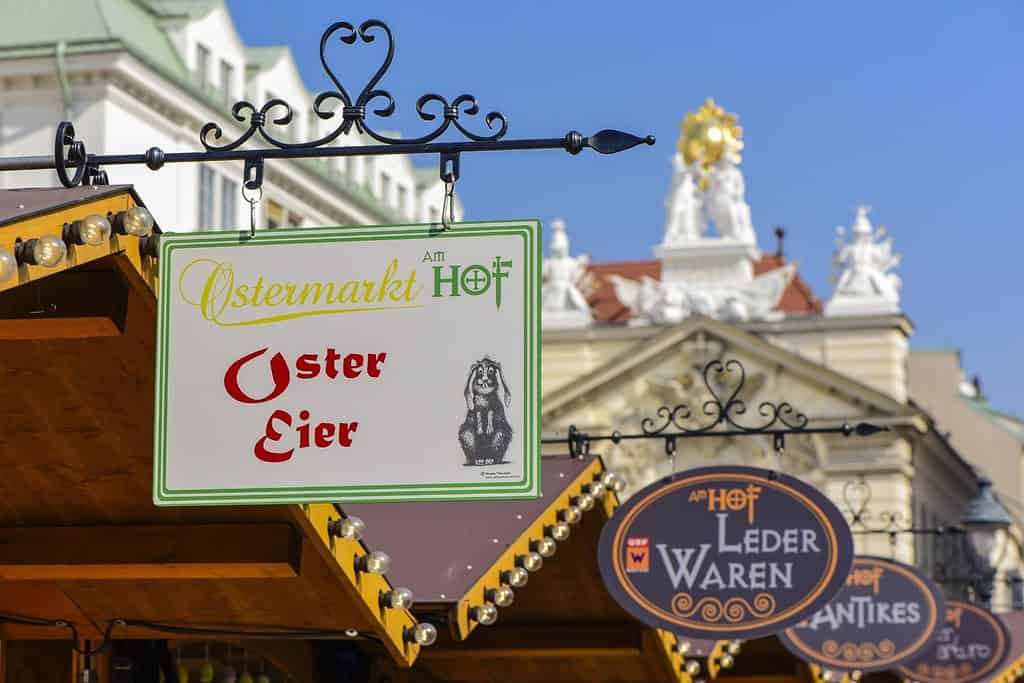
The Am Hof Easter Market (Ostermarkt am Hof) in Vienna is set against the baroque Kirche am Hof in the historic center.
Photo: allOver – Collection 001/Alamy
Am Hof reads as a broad urban stage, with old guild houses, the Marian column, and views into the Inner City providing the backdrop for this busy seasonal fair. Its Easter market boasts more than 50 exhibitors, among the largest in the city, along with food counters and generous standing tables. Here, you’ll find both locals and visitors who like the mix of historic ambiance and lively after‑work crowd.
Decorated eggs Within the Easter Tableau
Am Hof leans into Easter customs with a strong but slightly more understated egg offering than Freyung’s famous “egg mountain.” Stands highlight skilfully decorated eggs and floral arrangements as part of a broader Easter tableau, with eggs often integrated into wreaths, table centerpieces, and window or door décor.
You’ll still find classic Central European hand‑painted and dyed eggs — hung on branches, arranged in baskets, or paired with ceramics and textiles — but the emphasis here is on how eggs anchor decorative vignettes for home or holiday table, matching the market’s positioning as an Easter‑customs and handicraft fair.
Hearty Easter Fare
From a culinary perspective, Am Hof is one of the heartier Easter markets, with a row of Wirts‑Standln, larger huts with the feel of a traditional Austrian wine tavern (“Heuriger“) that offer solid, traditional fare. Expect long counters laden with:
- Strings of sausages
- Grilled and smoked meats
- Meatloaf and ham platters
- Goulash and stews
- Spicy cheeses
- Rustic breads and potato dishes
- Kaiserschmarrn, strudel, crepes, and waffles
- Handmade chocolates
Wine, beer, and schnapps stands, and, depending upon the temperatures, hot punch (with alcohol), and hot chocolate, make it a popular after‑work and evening spot. Many visitors simply claim a table around the Marian column and treat Am Hof as an open‑air heuriger with an Easter twist.
Handmade Décor
Am Hof’s core identity is as an arts and crafts” market (“Kunst‑ und Handwerksmarkt“), so Easter décor here has a distinctly artisan, handmade feel. Stalls showcase traditional and contemporary pieces in wood, glass, ceramics, metal, felt, leather, and textiles.
The curators explicitly pitch the market as “kitsch‑free,” with a mix of traditional craftsmanship and modern design, so it’s an excellent place to look for one‑off table pieces, wreaths, or wall hangings that feel more like studio work than souvenir‑shop stock.
Child-Focused Activities
The Easter Market at Am Hof offers a children’s program and hands‑on stations, especially on weekends and afternoons. Activities include simple crafts, occasional performances, and child‑friendly games that make it an easy stop for families already wandering the First District.
VISITOR INFORMATION
Website: Easter Market at Am Hof
Location: Am Hof Square, 1st District
Dates: March 20 – April 6, 2026
Hours: Monday through Thursday, 11:00 AM – 8:00 PM; Friday through Sunday and Holidays, 10:00 AM – 8:00 PM (hours may shift; always check in advance of your visit)
Best for: Lively atmosphere, hearty Austrian fare, and a broader arts-and-crafts mix in a grand historic square
Nearby: Kirche am Hof, Marian Column (Mariensäule), Park Hyatt Vienna, Judenplatz and the Jewish Museum Vienna (Judenplatz), Hoher Markt and the Ankeruhr, Graben, Kohlmarkt, Hofburg Palace (Swiss Gate entrance)
Fully immerse yourself in Easter festivities by turning this market into your front garden. In my Vienna luxury hotels guide, I review top stays, including the Park Hyatt Vienna, whose doors open directly onto Am Hof, placing the Easter market’s stalls, Punsch stands, and evening atmosphere just steps from your room. A stay at any of these five‑star addresses provides a seamless way to experience Vienna’s spring festivities in genuine luxury.
Schönbrunn Palace Easter Market
Setting the Historic and Cultural Stage
At Schönbrunn Palace, the former summer residence of the Habsburgs, the Easter and Spring Market has the feel of a curated courtyard fair. Framed by imperial architecture and sculpted lawns and hedges, this market is set in the palace’s parade court with stalls radiating out from the baroque yellow façade with views toward the formal gardens.
With around 70 stalls each season, it’s one of Vienna’s more expansive Easter markets. Continuing as a Spring Market after the holiday, it’s also the longest‑running seasonal market in the city. Browsing decorated eggs, glassware, and textiles here feels naturally woven into the Habsburg story that surrounds you.
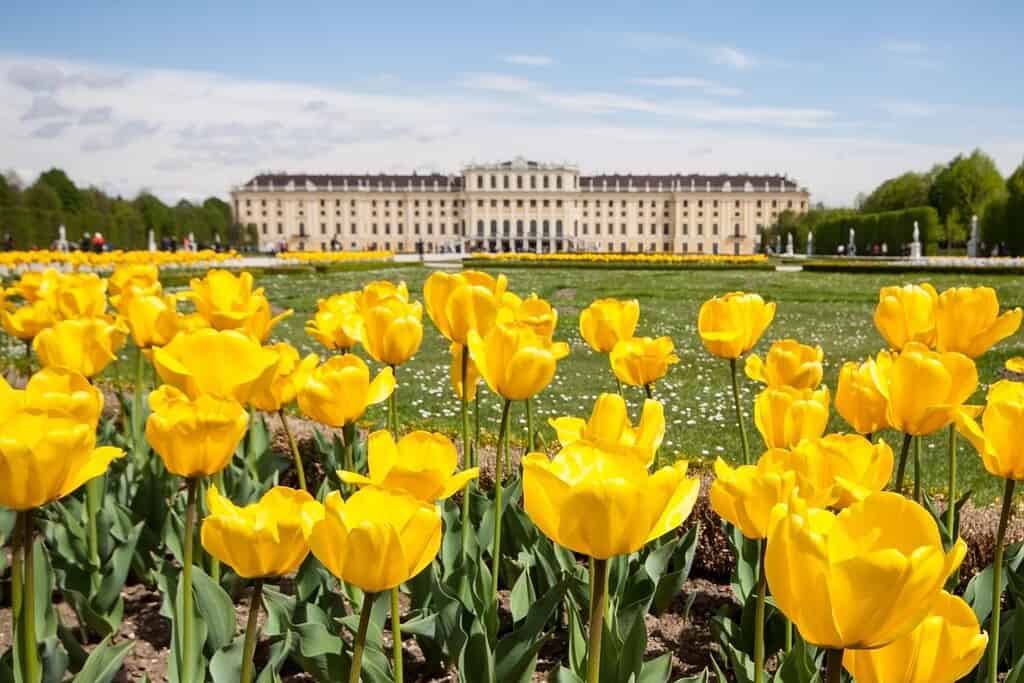
Spring tulips in bloom at Schönbrunn Palace, one of Vienna’s most elegant settings for Easter and seasonal garden walks.
Photo: Tetyana Kochneva/Alamy
Decorative Eggs Meet Gallery Gift Shop Mood
At Schönbrunn’s Easter Market, decorative eggs reflect the imperial garden decor. Many stands emphasize refined painting, gilding, and contemporary design from Austria and its near neighbors.
Vendors emphasize limited‑series designs and higher‑end work that sits comfortably next to palace‑shop souvenirs, making Schönbrunn an especially good place to choose one or two eggs as lasting keepsakes.
Artisinal Food Offerings
Schönbrunn’s Easter Market tilts toward artisanal food specialities and ready‑to‑eat treats rather than the farm-to-table take-home offerings of the Freyung Easter Market. You can also sip wines and schnapps on the spot.
Food at Schönbrunn combines classic Austrian Easter baking with a more international, family‑friendly street‑food lineup:
- Ham, sausages, and cheeses
- Honey, mustards, and spreads
- Buchteln, Reindling, and other Easter pastries
- Filled dumplings and baked potatoes
- Kaiserschmarrn, waffles, and churros
- Lángos, Spätzle, and bruschetta
- Pulled‑meat sandwiches
- Wines, schnapps, hot chocolate, and specialty coffees
There are plenty of places to perch with a plate, menus that clearly mark vegetarian options, and enough depth in the regional products that you can pick up picnic supplies for the gardens as easily as a warm, immediate lunch.
Artisinal Quality Easter Decor
Easter décor at Schönbrunn leans into its palace setting, with an emphasis on artisanal handicrafts and refined seasonal objects that feel intentionally curated and gift‑oriented.
Stands offer traditional Easter ornaments and rabbit or lamb figures in wood, glass, porcelain, felt, and wool, along with hand‑painted ceramics, blown‑glass decorations, linocut art prints, textiles, jewelry and accessories, beeswax candles, soaps, children’s toys, and upcycled or contemporary design pieces.
Activities for Young and Old
Activities are programmed and strongly family‑oriented: a children’s “Easter bunny workshop,” craft stations, storytelling or puppet shows, and regular live music that ranges from folk and brass ensembles to more polished performers suited to the imperial setting.
Pairing Your Easter Market Visit With Another Attraction
The singular setting of this Easter market makes it convenient to pair with a visit to Schönbrunn Palace. Also on the grounds, you’ll find The Imperial Carriage Museum (“Wagenburg“), which displays ceremonial coaches along with Sisi’s equestrian gear. Toward the back of the formal gardens, you can stop by the zoo at the Tiergarten Schönbrunn, or walk up the winding path to the Gloriette for a light bite at the café and stunning 360-degree views.
Pairing the Schönbrunn Easter & Spring Market with another major attraction on the grounds is realistic if you give yourself a half‑day to a full day.
The market is compact enough to enjoy a snack and a leisurely browse within an hour and a half. A standard palace interior tour or visit to the Imperial Carriage Museum typically takes 60–90 minutes door‑to‑door, not counting wandering the gardens. The Tiergarten Schönbrunn easily fills half a day on its own, while the Gloriette is a lighter add‑on (allow roughly an hour, including the climb and views).
To thoroughly enjoy your visit and to avoid feeling overwhelmed, plan to combine two things rather than trying to see everything. While the Easter market is free, you’ll want to book any other sites in advance to ensure access and to avoid queues.
VISITOR INFORMATION
Website: Easter and Spring Market at Schönbrunn Palace
Location: Schönbrunn Palace grounds
Dates: March 25 – April 19, 2026 (transitions into spring market after Easter)
Hours: Daily, 10:00 AM – 7:00 PM (hours may shift; always check in advance of your visit)
Best for: Imperial scenery, curated handicrafts, and pairing market browsing with palace gardens and major attractions.
Nearby: Schönbrunn Palace, Imperial Carriage Museum, Vienna Zoo
The Art of the Easter Egg in Vienna
The Egg as Symbol of Austria and Central Europe
In Austria and across Central Europe, the Easter egg grows out of layered religious and folk traditions that long predate modern markets. In Christian thought, the egg symbolized the promise of new life, making it a natural focus for Easter after the Lenten fasting period, when eggs were often restricted.
In the Habsburg lands and neighboring Slavic regions, that symbolism fused with older spring and fertility customs. Decorated eggs were given as blessings within families, between godparents and godchildren, or to priests and benefactors. Over time, these practices became highly regionalized, so that by the 19th century, decorated eggs were both devotional tokens and prized pieces of seasonal folk art.
Techniques You’re Likely To See
At Vienna’s Easter markets, you’ll find hollowed eggs transformed through a surprising range of materials and techniques. Artisans work with natural dyes and paint, beeswax, engraving tools, micro-drills, metallic foils, and delicate wire filigree. Forms are made from real eggshells, wood, ceramic, fabric, or plastic. Designs draw from Alpine florals, spring garlands, geometric rosettes, Christian iconography, and Baroque or Biedermeier-inspired ornamentation.
Most decorative eggs are hollowed to preserve longevity, allowing them to be hung on willow branches in a traditional Osterbaum or displayed year after year. In the days leading up to Palm Sunday and Easter, bundles of willow branches — the foundation of the Osterbaum — begin arriving at markets and neighborhood florists across the city.
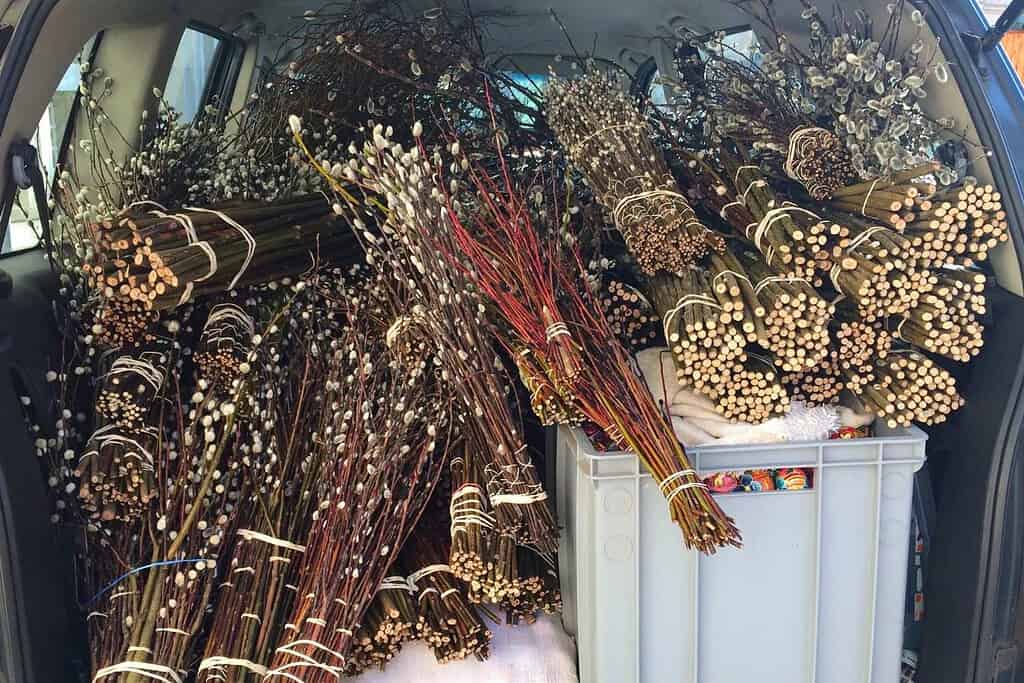
Bundles of pussy willow branches are delivered to Vienna’s flower markets ahead of Easter, ready for seasonal displays and Osterbaum decorations.
Photo: Catherine Barnes
Blown and Painted Eggs (“Handbemalt“)
Eggs are carefully hollowed through two small pinholes, rinsed, dried, and sealed before decoration. Artists use fine sable brushes and acrylic paints to render alpine flowers, rabbits, wreaths, and miniature landscape scenes. Goose eggs are especially prized for their thicker shells, which allow more detailed work and greater durability.
Scratch Technique (“Kratztechnik” / “Eierkratzen“)
The shell is first dyed, often in deep reds, blues, or blacks, then fine needles or engraving tools are used to scratch away pigment, revealing the white shell beneath. The technique produces high-contrast floral or geometric patterns and requires steady rotational control to avoid cracking the shell. In Austria, this is most notably associated with the Burgenland tradition of Stinatz.
Wax-Resist (“Wachsbatik“)
Melted beeswax is applied with a stylus to create a design before the egg is dipped in dye. After coloring, the wax is gently warmed and wiped away, leaving the original shell color beneath. Multiple wax-and-dye layers allow for increasingly complex patterns. The method is widely practiced across Central Europe and appears regularly at Austrian Easter markets.
Beaded Eggs (“Perlenverzierung“)
Some eggs are embellished with applied micro-beads or seed beads fixed in floral or geometric patterns over a painted base. The technique creates a subtle raised texture and a jewel-like effect, especially when paired with metallic finishes. These dimensional eggs are particularly eye-catching when hung on an Osterbaum or displayed in groups.
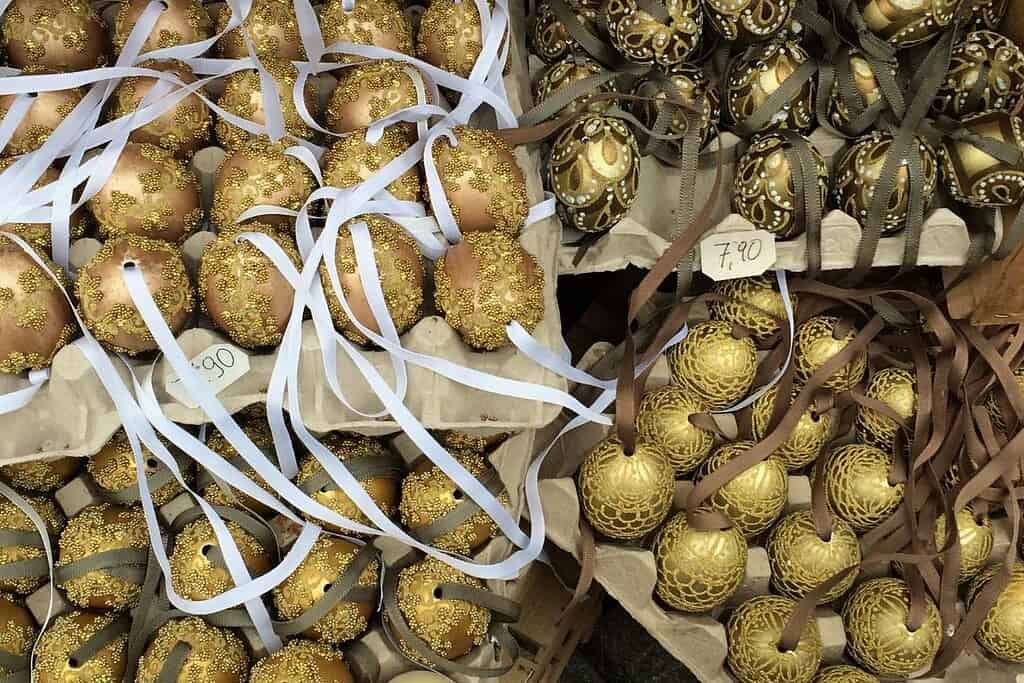
Intricately hand-painted and beaded metallic Easter eggs at the Freyung Easter Market in Vienna’s historic center.
Photo: Catherine Barnes
Lace or Drillwork Eggs (Perforierte Eier)
Using fine electric drills, artisans carve intricate lace-like patterns directly into the shell. The technique requires a completely dry, grease-free egg to prevent cracking from vibration. Goose eggs and, occasionally, ostrich eggs are favored for their thickness. Designs often resemble doilies, rosettes, or cathedral window tracery, and some are illuminated from within.
Wire-Wrapped Eggs (Drahtkunst / Filigran-Eier)
In this delicate technique, extremely fine wire, often brass, copper, or silver-plated, is wrapped around the hollow shell to form filigree patterns. The wire may be shaped into spirals, lattice structures, crosses, floral motifs, or sometimes secured with discreet adhesive points. The result resembles jewelry or lacework and reflects Austria’s broader tradition of metal filigree craft seen in regional folk art and devotional objects.
Buying and Transporting Decorated Eggs
When buying eggs, look for fine brushwork, traditional motifs (flowers, religious symbols, and folk patterns), and quality indicators (symmetry, color vibrancy, and finishing technique). Serious collectors seek specific regional styles and master craftspeople. Vintage eggs from earlier decades are increasingly valuable, while contemporary, artist-signed eggs have the potential to become investment pieces.
For standard-sized, hollowed-out eggs, vendors will package your purchases in traditional egg cartons, while larger and more expensive pieces will be protectively wrapped for careful transport back home.
Remaining Sections:
Easter Widow Displays and Spring Shopping
Vienna Chocolate Shops and Confectioners
Spring Blooms and Parks in Vienna
Easter Services and Seasonal Music
Practical Tips For Visiting Vienna at Easter
Beyond Vienna’s Easter Markets
Painted eggs are only the beginning of Easter in Vienna. Step away from the stalls and the whole city becomes an Easter showcase, from florist stands to carefully curated window displays.
Prefer autumn to Advent or spring? Read our guide to Central Europe in Fall, featuring Vienna, Prague, Budapest, and Berlin.
Easter Window Displays and Spring Shopping
At any time of the year, window displays in Vienna are works of art in their own right. This is particularly true along Kärntner Straße, the main pedestrian shopping street with elaborate seasonal displays; the Graben with its luxury shops and sophisticated window designs; and the Kohlmarkt, where the Imperial purveyors, including Demel, Sacher, and Gerstner, are concentrated. Demel, in particular, is renowned for its photogenic window displays.
You can expect to see traditional themes including Easter bunnies, decorated eggs, willow branches, and spring flowers; a pastel palette of pinks, yellows, lavenders, and greens; marzipan shaped like chicks, lambs, rabbits, carrots, and floral garlands; Easter cakes (“Ostertorten“), elaborate iced cookies(“Osterkekse“), pastel-glazed petits fours and jewel-like pastilles, elaborate chocolate structures, and historical references.
While pastry and chocolate shops present obvious viewing opportunities, you’ll also find beautiful displays at stationery shops, flower shops, children’s stores, high-end fashion salons, jewelry stores, and porcelain shops. The Austrians really go all in for Easter, in the very best way.
Vienna Chocolate Shops and Easter Confectionery
When it comes to chocolate and pastries, one is hardly going to admire the window display and move along. You will want to go inside. Here are my top picks for an immersive and indulgent Easter sweets experience:
Gerstner K. u. K. Hofzuckerbäcker
At Easter, Gerstner feels almost cinematic. The shop’s signature pale green interior — symmetrical vitrines, mirrored surfaces, orderly displays — creates a composed, almost Wes Anderson-like backdrop for the season’s confections.
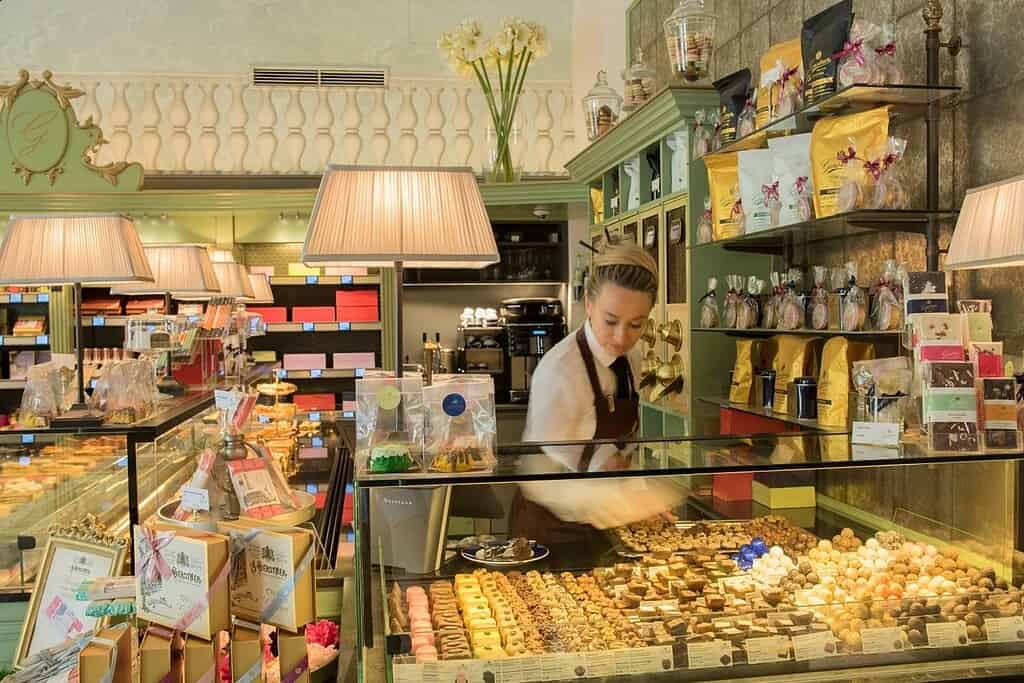
Inside Gerstner’s elegant Vienna confectionery, where Easter chocolates are presented with colorful precision.
Photo: Hackenberg – Photo – Cologne/Alamy
Chocolate eggs, sculpted marzipan lambs, and neatly tiered Easter cakes are arranged with deliberate precision, while boxed praline collections appear in softly gilded, pastel-accented packaging that reflects Gerstner’s roots in court confectionery. It’s a strong stop if you’re looking for something giftable — beautifully packaged Easter chocolates that feel unmistakably Viennese.
VISITOR INFORMATION
Website: Gerstner
Location: Kärntner Str. 51, 1010 Wien, Austria
Hours: 8:00 AM – 10:00 PM for the confectionery shop at Palais Todesco (hours may change, confirm online)
Note: Ground floor shop offers chocolates, pralines, and seasonal confectionery separately from the café and restaurant upstairs.
Demel
At Easter, Demel transforms its Kohlmarkt windows into full confectionery street theater. Towering chocolate hares, intricately molded hens, and hand-painted marzipan chicks may appear alongside sugar blossoms and meticulously iced Osterlamm cakes, all arranged in layered, almost operatic compositions.
The palette leans toward polished pastels, gilded accents, and high-gloss finishes, evoking the ceremonial elegance of imperial Vienna. Glass cases glitter with seasonal pralines and sculpted eggs, as much decorative arts as sweets. You visit Demel not simply to purchase chocolate, but to witness the dramatic tradition of Viennese confectionery at its best.
VISITOR INFORMATION
Website: Demel
Location: Kohlmarkt 14, 1010 Wien, Austria
Hours: Daily, 10:00 AM – 7:00 PM for the confectionery shop (hours subject to change, confirm online)
Note: Purchase chocolates and Easter specialties from the shop and enjoy pastry in the café.
Bel Étage & Sacher Confiserie
At Easter, the experience at the Hotel Sacher extends beyond boxed pralines to the refined setting of the Bel Étage, where seasonal pâtisserie and chocolate artistry are presented in a more intimate, upholstered calm above the bustling cafe below.
In addition to classic Sacher-Torte in spring packaging, you’ll find elegantly molded chocolate eggs, marzipan figures, and Easter pastries rendered with the brand’s signature precision. The mood is less whimsical than ceremonial — polished silver trays, deep reds, and restrained pinks. Visit not only for seasonal confections, but for the opportunity to take Easter tea in one of Vienna’s most storied interiors.
VISITOR INFORMATION
Website: Café Bel Étage (Hotel Sacher)
Location: Kärntner Str. 38, 1010 Wien, Austria
Hours: Daily, 8:00 AM – 10:00 PM (hours may change, confirm online)
Note: Part of Hotel Sacher’s café experience; chocolates and seasonal treats are available here and at the adjacent Sachertorten & Confiserie retail area.
Xocolat (Freyung Passage location)
Tucked inside the Freyung Passage in the Palais Ferstel, Xocolat offers a more contemporary counterpoint to Vienna’s grand court confectioners. At Easter, the displays are cleanly composed: artisan chocolate eggs, modern molded figures, curated single-origin bars, and beautifully boxed seasonal assortments arranged with symmetry and restrained elegance.
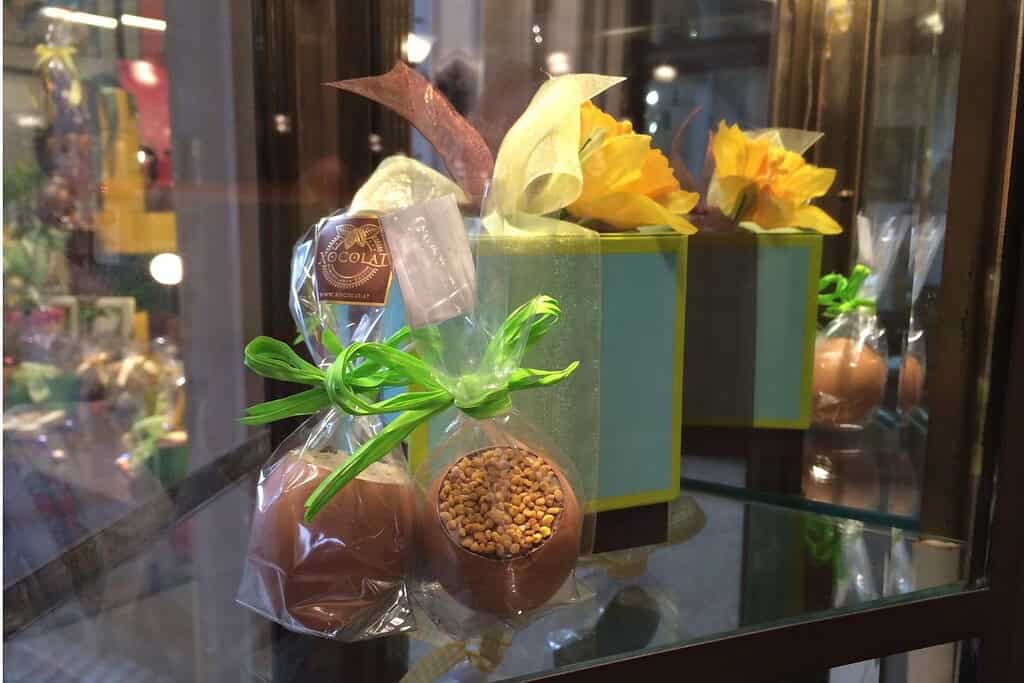
Easter chocolate eggs in the window of Xocolat at the Freyung Passage in Vienna’s historic center.
Photo: Catherine Barnes
The aesthetic is less baroque spectacle and more design-conscious refinement, yet the vaulted arcade surroundings lend it quiet grandeur. Visit if you appreciate exceptional cacao presented with clarity and craftsmanship — Easter rendered in a more modern key.
VISITOR INFORMATION
Website: Xocolat
Location: Freyung 2, 1010 Wien, Austria
Hours: Monday – Saturday, 10:00 AM – 6:00 PM; Sunday, Noon – 5:00 PM (hours may change, confirm online)
L. Heiner (Wollzeile location)
Steeped in Viennese history, this branch of L. Heiner — once a K.u.K. court sugar baker –– has been family-run since 1840. The interior on Wollzeile evokes jewel-box intimacy: wood-trimmed counters, glass displays bursting with sweets, and a sense of old-world patisserie just steps from Stephansdom.
At Easter, expect an inventive array of handmade chocolates and seasonal specialties alongside classic Kardinalschnitte, marzipan figures, and Easter-themed pralines. The emphasis here is on craftsmanship, tradition, and visual delight rendered in bright colors and creative themes.
VISITOR INFORMATION
Website: L. Heiner
Address: Wollzeile 9, 1010 Wien, Austria
Hours: Monday – Saturday, 9:00 AM – 7:00 PM; Sunday and public holidays, 10:00 AM – 7:00 PM (hours may change, confirm online)
Many of these grand establishments operate adjoining confectionery counters, making it easy to pair your Easter chocolate stops with a proper Viennese coffee and slice of torte in surroundings that have defined the city’s social life for generations.
For a closer look at Vienna’s historic café culture — and the patisseries that shape the city’s Easter traditions — explore my Viennese Pause series on Imperial and Old Town coffeehouses.
Altmann & Kühne
On the Graben, Altmann & Kühne treats Easter as a study in miniature elegance. The chocolates themselves — small, cube-shaped pralines made to historic recipes — are arranged in lacquered drawer boxes, jewel-toned papers, and Art Deco-inspired designs.
At Easter, seasonal editions appear in pastel or spring-accented packaging, sometimes accompanied by refined chocolate eggs or small molded figures. Visit as much for the artistry of the packaging as for the chocolate within. These sweets feel like objects collected rather than consumed, and few places in Vienna make gifting feel so ceremonious.
VISITOR INFORMATION
Website: Altmann & Kühne
Location: Graben 30, 1010 Wien, Austria
Hours: Monday – Saturday, 09:00 – 6:30 PM (hours may change, confirm online)
Note: Flagship Graben boutique focuses on handcrafted chocolates with distinctive packaging. Seasonal and Easter editions offered during the holiday period.
Leschanz Wiener Schokolade König
Leschanz Wiener Schokoladekönig delights before you even reach the chocolate. Housed in a former button shop, the space retains the proportions and cabinetry of its earlier life, lending it the cozy, slightly nostalgic feel of an Old Town specialty store.
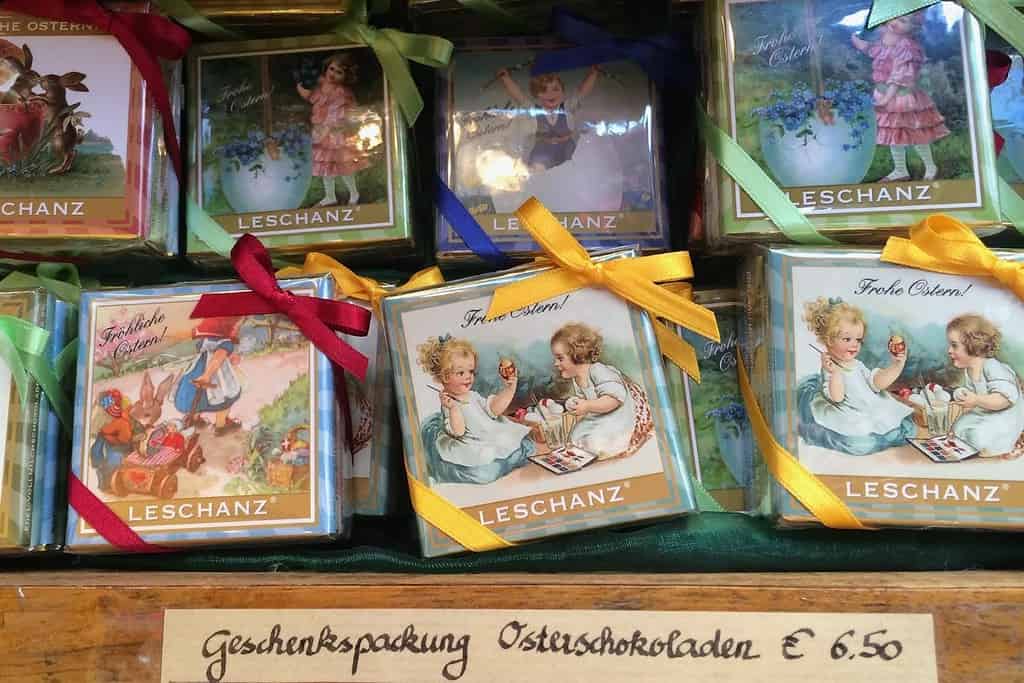
Vintage-inspired Easter chocolates tied with satin ribbons at Leschanz Wiener Schokolade König in Vienna’s historic center.
Photo: Catherine Barnes
At Easter, the displays burst with color — vividly glazed chocolate eggs, rabbits, chicks, and whimsical seasonal figures arranged in cheerful abundance. The assortment tends toward bright finishes and playful themes rather than austere elegance. It’s a joyful stop, especially if you appreciate historic shop interiors paired with a lively, color-saturated interpretation of Easter confectionery.
VISITOR INFORMATION
Website: Leschanz Wiener Schokoladekönig
Location: Freisingergasse 1, 1010 Wien, Austria
Hours: Monday – Saturday, 10:00 AM – 6:00 PM (hours may change, confirm online)
Note: Small, artisan chocolate shop with rich interior details.
If you don’t have much time, you can also find excellent chocolates at the Julius Meinl gourmet grocery store at Graben 19. Inside, among elaborate counters for cheese and charcuterie, you’ll find a large confectionery section and shelves of in-house chocolates and high-end international brands. Treat yourself to a cup of coffee while you’re there.
Interested in learning more about the histories and aesthetics of some of Vienna’s oldest and most notable chocolate shops? Read my article, Gilded Ganache: A Travel Designer’s Guide to Vienna’s Chocolate Salons (forthcoming).
It’s an easy rhythm: a praline here, a marzipan egg there, and then a turn into a park or palace garden to see the progression of spring in real time.
Spring Blooms and Parks in Vienna
Vienna is one of Europe’s greenest capitals, with around half of its total area dedicated to parks, gardens, forests, and vineyards. In fact, 43 percent of the city center is green space. Even in and around the historic center, you’re rarely far from manicured lawns and tree‑lined promenades.
The Ringstraße is strung with formal parks such as the Stadtpark and Burggarten, while expansive landscapes like the Prater and the palace gardens at Schönbrunn and Belvedere effectively wrap Vienna in flora. That density of accessible green space means that when cherry trees, magnolias, and tulip beds reach their peak in late March and April, you can experience blossom season not in isolated pockets, but as a continuous thread running through the city.
If you’re in Vienna at Easter, two parks deliver the most rewarding return. Burggarten, tucked behind the Hofburg in the 1st District, is the city’s most elegant all-around spring setting. Here, magnolias bloom against imperial façades, and formal beds of tulips and hyacinths bring structured color to the lawns near the Palmen House. It’s central, refined, and effortlessly paired with a stroll past the Albertina or along the Ringstraße.
A short walk away, Stadtpark, straddling the 1st and 3rd Districts, offers a softer riverside atmosphere. Cherry blossoms and scattered magnolias appear among winding paths and bridges over the Wienfluss, making it an easy addition to a café stop or a Ringstraße circuit.
If you hope to see peak blooms at Easter, you will be somewhat beholden to the calendar and the weather. In 2026, Easter comes relatively early, occurring on April 7th.
For a more specific aesthetic, a few additional gardens are worthy of a visit:
- In the historic core, the Volksgarten (1st District) is the most florally dense option for structured seasonal plantings.
- The grand parterre of Schönbrunn Palace Gardens (13th District) delivers the most formal and architectural spring display.
- Setagaya Park (19th District) offers an intimate Japanese garden setting, where cherry blossoms unfold among stone lanterns, a koi pond, and gently arched bridges.
- On Danube Island (22nd District), the Kirschenhain offers a concentrated grove of cherry trees with open skies and waterside views.
Together, these settings allow visitors to experience Vienna in bloom without straying far from the city’s most compelling surroundings.
The Naschmarkt In Spring
Another place for blooms, of the cut variety, is The Naschmarkt (6th District). Buckets of tulips and ranunculus welcome you to explore the explosion of colors, scents, and tastes that lies beyond. The city’s most famous permanent open-air market, the Naschmarkt has been operating since the 16th century.
Here you’ll find a mix of locals shopping for groceries, culinary tourists, and novice photographers hoping to capture the atmosphere. It’s always on my list of places to visit in Vienna.
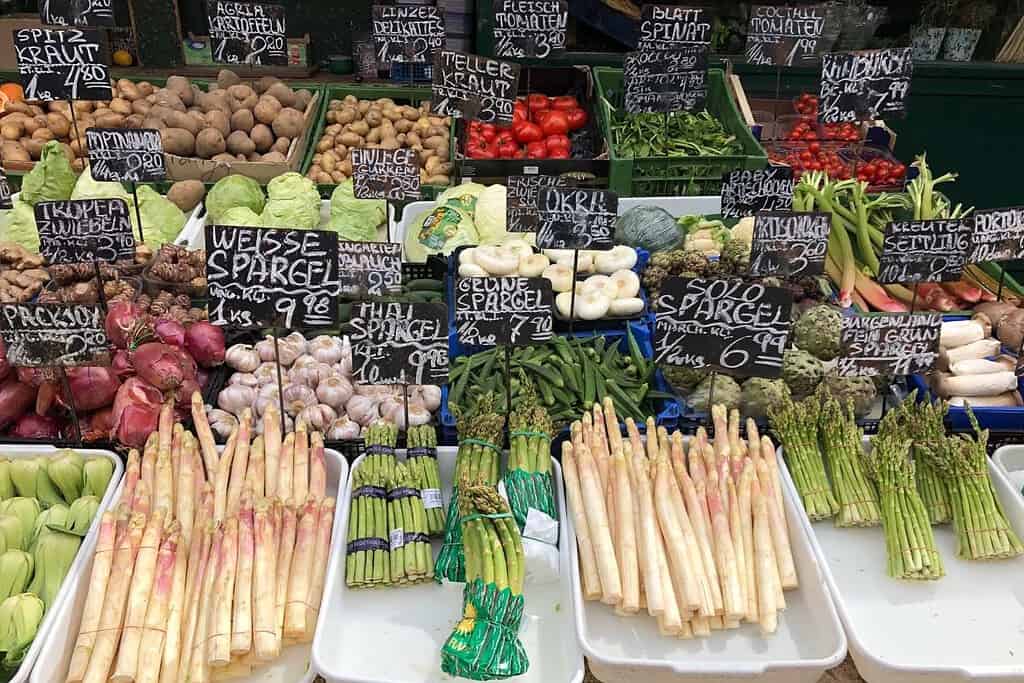
Spring asparagus and seasonal produce at Vienna’s Naschmarkt, a highlight of Easter and early spring in the city.
Photo: Catherine Barnes
In spring, the market comes alive with the first signs of the growing season. Piles of white and green asparagus appear in neat bundles. Bunches of fresh herbs, chives, dill, parsley, and wild garlic perfume the air as vendors slice samples and trim stems with practiced efficiency.
Early strawberries, small but intensely fragrant, are stacked in shallow crates, while stalks of rhubarb glow deep pink against the metal counters. Jars of flower preserves and the season’s first berry jams line the shelves beside golden spring honey.
In this season, the Naschmarkt feels like a working pantry as Vienna prepares for Easter tables and lighter spring meals ahead.
For a deeper look at the market beyond a quick stroll between fruit crates and spice stands, read my Viennese Pause guide to culinary and cultural detours in Vienna
Easter Services and Seasonal Music In Vienna
Easter in Vienna is not only visual and culinary; it is profoundly musical. In a city that gave the world Haydn, Mozart, Schubert, and Bruckner, the weeks surrounding Easter carry a distinctive soundtrack.
For some, these performances are devotional; for others, they are cultural touchstones. From solemn Passion settings performed during Holy Week to choral and orchestral programs devoted to themes of renewal and awakening.
Easter 2026 in Vienna falls on the following dates: Maundy Thursday: April 2; Good Friday: April 3; Easter Saturday: April 4; Easter Sunday: April 5; Easter Monday: April 6.
It’s always advisable to check exact dates and times for Easter services in Vienna along with classical music programming. Always visit official websites when planning your visit.
St. Stephen’s Cathedral (“Stephansdom“)
Vienna’s spiritual landmark on Stephansplatz is the principal setting for Holy Week liturgies. Daily Masses continue throughout Lent, followed by Palm Sunday services, the solemn Easter Vigil on Holy Saturday evening, and multiple Easter Sunday celebrations that combine ritual, cathedral choir, and organ in the soaring Gothic nave. The cathedral also hosts regular organ recitals year-round.
See the cathedral’s website for current Holy Week schedules and concert listings.
St. Peter’s Church (“Peterskirche“)
Just off the Graben, Peterskirche maintains regular Catholic liturgies. With music and an active concert calendar, the church welcomes sacred and classical repertoire, from Bach and Mozart to Schubert and Beethoven, into its richly decorated Baroque interior throughout the year. Visitors will find both
Mass times and evening classical performances are listed on the church website, while concert listings are posted by their partner, Classic Ensemble Vienna.
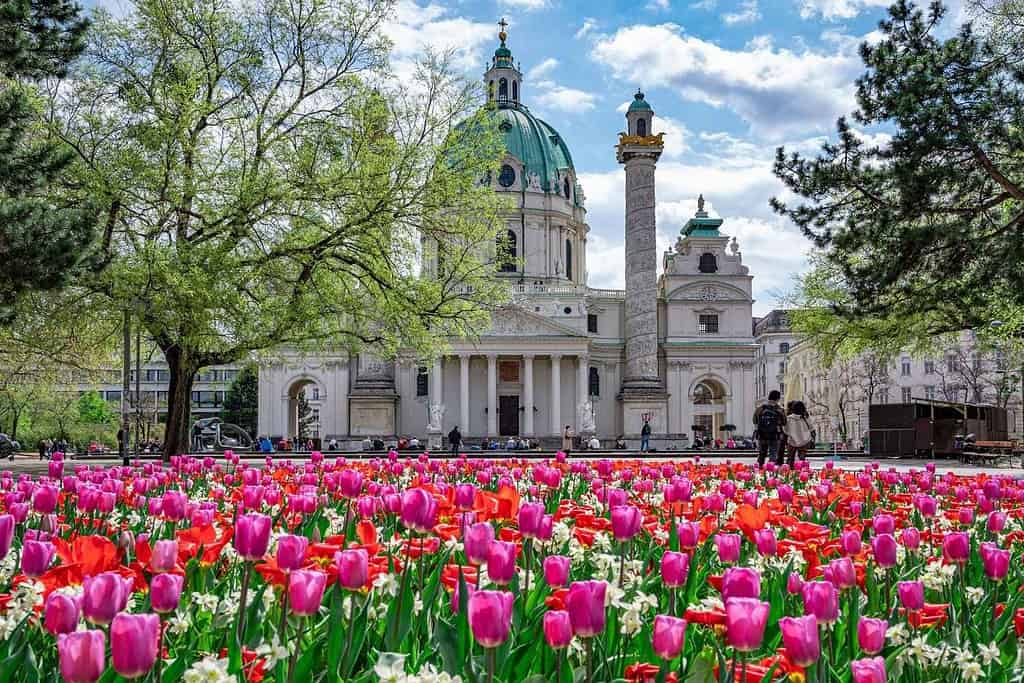
Tulips in full spring bloom at Karlsplatz with Karlskirche’s baroque dome framing the scene in Vienna.
Photo: Maria Vonotna/Alamy
St. Charles Church (“Karlskirche“)
This church on Karlsplatz is one of Vienna’s most atmospheric Baroque settings for sacred music outside formal liturgy. It is especially known for orchestral programs such as Vivaldi’s Four Seasons performed on period instruments beneath the dome — concerts that run across much of the year and pair beautifully with a spring visit.
Visit their website for information on Sunday Mass, or go here for concert details.
Hofburg Chapel (“Hofburgkapelle“)
Within the Imperial Palace, the Vienna Boys’ Choir and Vienna Court Music Ensemble continue the centuries-old tradition of sung Sunday Mass, often featuring music by the great Viennese composers. These services are especially popular around Easter. Current Mass dates and musical performances are published by Hofburgkapelle.
Practical Tips for Visiting Vienna at Easter
To make the most of your Easter in Vienna, keep in mind…
- Easter markets will be less crowded on weekdays and early mornings.
- Spring has mercurial weather. It can still be quite cold, blustery, and rainy. Always check the forecast and be sure to pack layers, rain boots, and an umbrella. It’s also a good idea to have a “Plan B” for outdoor activities.
- Cathedrals, churches, or chapels can be a bit cool. Bring a wrap when attending an evening concert.
- Shops are closed on Sundays and holidays, including Easter Monday. Museums will still be open. Check venue websites for holiday hours.
- Always ask permission before photographing artisans or their work.
- At Easter markets, prices are typically non-negotiable. Be sure to bring cash, as smaller stalls may not accept credit cards.
- Sampling food before buying is expected at the stalls. But don’t overdo sampling without purchasing.
- Many vendors speak English, but the basic greetings “Grüß Gott” (pronounced “grooss got”) and “Danke” (pronounced “dahn-kuh”) will be appreciated.
- Beautiful Easter cards and postcards can be found at The Old Pharmacy shop, conveniently located near the Hofburg at Reitschulgasse 2.
- Families traveling with small children can find more information on kid-friendly programs at this dedicated site.
Explore Vienna in another season: If you’re considering a winter visit, our Vienna Christmas markets 2026 guide covers the city’s best-known markets, what to buy, when to go, and how to plan your trip.
Planning Your Vienna Stay?
As you map out your Easter or spring escape, let the mood you’re seeking, whether ceremonial, cosmopolitan, or contemplative, guide your selection of five-star hotels in Vienna.
Start Planning your stay
If you’re still deciding where to stay on your visit to Vienna for Easter or during the Spring season, our guide, Grand Addresses: A Travel Designer’s Guide to Luxury Hotels in Vienna, offers a curated overview of the city’s most distinguished properties. Or explore a broader set of options at the link below.
* Affiliate links may earn us a referral fee at no extra cost to you.