Grand Addresses: A Travel Designer’s Guide to the Best Luxury Hotels in Vienna

This Vienna luxury hotel guide curates urbane cosmopolitan stays (Rosewood, Park Hyatt), storied traditional addresses (Sacher, Imperial), and quiet contemporary retreats (Amauris, Almanac), each offering a considered interpretation of this once-imperial capital.
Best Luxury Hotels in Vienna: How to Use This Guide
Context, Not Rankings
Luxury in Vienna has never been about novelty. It’s been shaped by continuity — of institutions, social codes, and cultural life unfolding over centuries rather than seasons. The city’s most compelling luxury hotels succeed not by breaking with this inheritance, but by negotiating it carefully: deciding what to preserve, what to reinterpret, and what to leave in the past.
This Vienna luxury hotel guide provides a range of answers to that question. Some hotels maintain the rituals and scale of imperial Vienna; others embed contemporary life within historic properties; still others offer restraint and privacy in contrast to the city’s public grandeur. Each reflects considered decisions about how to inhabit Vienna today, how to engage its history and culture, while delivering the highest standards of service.
This guide to the best five-star hotels in Vienna draws on more than three decades of travel to the city. More than places to stay, each property is a social, architectural, and cultural landmark. Some I know as a guest and through their bars, restaurants, salons, and spas, and through the role they play in Vienna’s ceremonial and everyday life. Others I’ve come to appreciate through staff-guided walk-throughs that offered insights into how Vienna’s newer luxury properties position themselves within the city’s historic fabric.
Taken together, this perspective reflects how luxury hotels in Vienna are encountered in practice, not just by guests with room keys, but by locals and visitors as places of gathering, ritual, and quiet indulgence. To help you prioritize where to stay in Vienna and how to choose among the best luxury hotels, the criteria below draw on lived familiarity, focusing less on star ratings and more on how each hotel engages with the city itself…
Sustainability information reflects publicly available disclosures at the time of publication.
Prioritizing sustainability and social responsibility in your travels? Explore my guide to responsible luxury stays, from eco‑certified hotels to properties with strong community and cultural commitments (coming soon).
Best Luxury Hotels in Vienna: At a Glance
|
HOTEL |
LOCATION |
TOTAL KEYS |
STYLE |
KNOWN FOR |
MICHELIN DINING |
SPA & POOL |
SUSTAINABILITY |
PRICE POINT |
|
ROSEWOOD |
Petersplatz, Old Town |
99 |
Cosmopolitan |
Old Town immersion, Rooftop bar |
No |
Asaya Spa |
GTSC-aligned group certification |
$$$$ |
|
PARK HYATT |
Am Hof, Golden Quarter |
146 |
Cosmopolitan |
Golden Quarter immersion, vault pool |
No |
Arany Spa, vault pool |
Hyatt 2030 environmental goals |
$$$$ |
|
SACHER |
Opposite Staatsoper |
152 |
Traditional |
Opera, The Original Sacher Torte |
Michelin Listed |
Boutique Spa |
Austrian Ecolabel |
$$$$ |
|
IMPERIAL |
Ringstraße, Musikverein |
138 |
Traditional |
Ceremony, Royal Staircase, Musikverein |
Temporarily Closed |
Fitness facilities |
Marriott 360 Sustainability Framework |
$$$-$$$$ |
|
ALMANAC |
Parkring, Ringstraße |
111 |
Contemporary |
Modern art, spa retreat |
No |
Spa, 14m pool |
Operational sustainability initiatives |
$$$$ |
|
AMAURIS |
Kärntner Ring, Opera District |
62 |
Contemporary |
Boutique stay, art collection |
Yes (one star) |
Amauris Spa, pool |
Relais & Châteaux commitments |
$$$$ |
Note: Rates vary by date, demand, length of stay, and room category. For exact pricing, visit the hotel website to select rooms and dates. All data reviewed as of August 2026.
Jump To:
The Cosmopolitans: Rosewood Vienna | Park Hyatt Vienna
The Traditionalists: Hotel Sacher Wien | Hotel Imperial Vienna
The Contemporaries: Almanac Vienna | The Amauris Vienna
The Cosmopolitans: Best Luxury Hotels in Vienna’s Old Town
Cultural fluency, architectural presence, urban assurance
The cosmopolitans represent Vienna at ease with the world: outward-looking, urbane, and intellectually confident, yet deeply attentive to local context. Housed within historically significant buildings, each with a banking pedigree, these luxury hotels translate Vienna’s traditions into an urban register, balancing architectural gravity with contemporary sensibility.
Rather than replicating global luxury formulas, they demonstrate cultural fluency, thoughtfully engaging Vienna’s past while accommodating the pace, expectations, and diversity of an international clientele. The result is a style of hospitality that feels both grounded and expansive, equally suited to cultural immersion and modern city life.
Jump to: The Rosewood Vienna | Park Hyatt Vienna
Rosewood Vienna
Gracious Refinement
A recent luxury flagship on Petersplatz, the Rosewood Vienna infuses musical lore, a banking pedigree, Belle Époque-meets-21st-century elegance, and a rooftop bar with Old Town views.
Relationship To History
The Rosewood Vienna is located in a series of grand townhomes designed in 1835 by architect Alois Pichl, who worked primarily for aristocrats and members of the House of Habsburg. The Old Town setting was once home to the flat where Mozart is said to have composed “The Abduction from the Seraglio.”
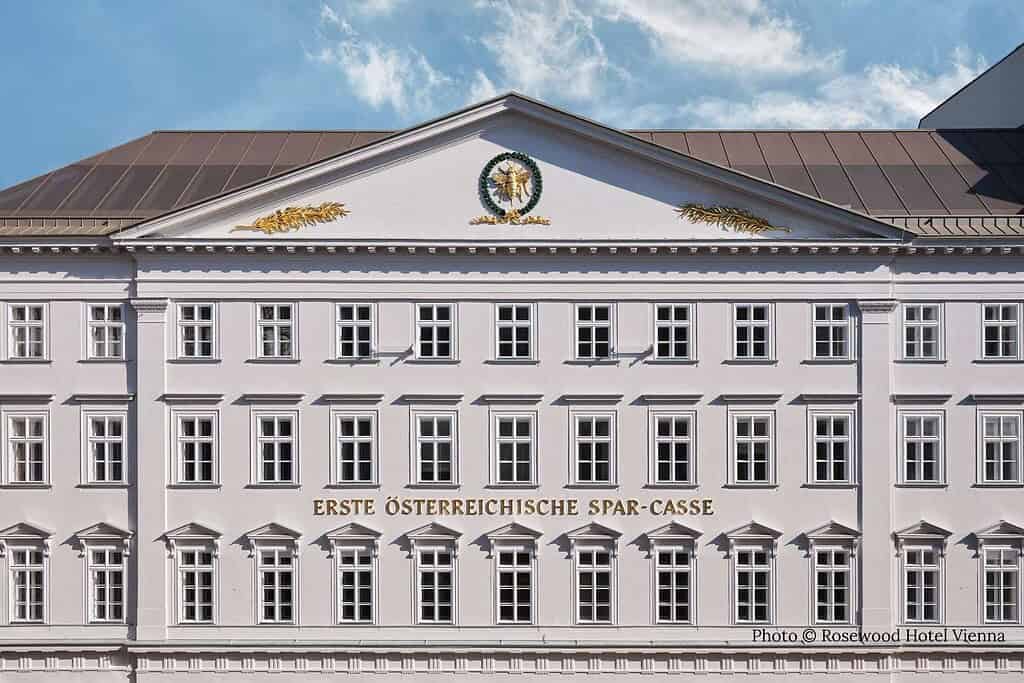
Until recently, the building served as the headquarters of the Erste Bank Group, whose crest of a golden bee, symbolizing the collective process of gathering honey, is still visible within the central pediment, above the principal axis of the façade facing St. Peter’s Church.
HISTORICAL CONTEXT
Finance as Civic Architecture
Founded in 1819, Erste Österreichische Spar-Casse was among Vienna’s most consequential civic institutions, established to promote thrift, stability, and financial responsibility among the city’s emerging middle class. Unlike private merchant banks, it treated finance as a public good, embedding moral purpose in both its mission and architecture. Its neoclassical headquarters projected trust, restraint, and continuity, aligning the institution with courts, academies, and other pillars of civic life. In doing so, Erste helped shape not only Vienna’s financial system but also the bourgeois culture that defined the city in the 19th century.
Source: Erste Group Corporate History
Architectural Intelligence
The transformation of the 19th-century Belle Époque building into a modern five-star hotel retained many original elements. Marble corridors and staircases, stucco ceilings, and parquet floors remain intact, while the bank’s protected former boardroom has been repurposed as a 100-square-meter salon. These elements, along with touches of Viennese Modernism, intentionally framed skyline views, and contemporary conveniences, fuse seamlessly to create an experience that evokes the building’s history and context, while exceeding the expectations of modern, discerning travelers.
Social Posture
Just steps from high-end shopping on the Graben, the Spires of St. Stephen’s Cathedral, and the patina of the Hofburg’s imperial dome, the Rosewood Vienna will appeal to those who want to be situated in the heart of the Old Town, while tucked just a bit beyond its bustle. The hotel’s award-winning concierge (recipient of the Les Clefs d’Or International Young Concierge of the Year Award, one of Europe’s most respected honors in the profession) can deftly arrange fine dining, opera tickets, and private tours of the Schönbrunn Palace, among other special experiences.
For refined dining in Vienna, explore my Savoring Vienna Guide, a travel designer’s curated list of the best fine‑dining restaurants, tasting menus, and memorable evening meals across the city.
Ritual and Rhythm
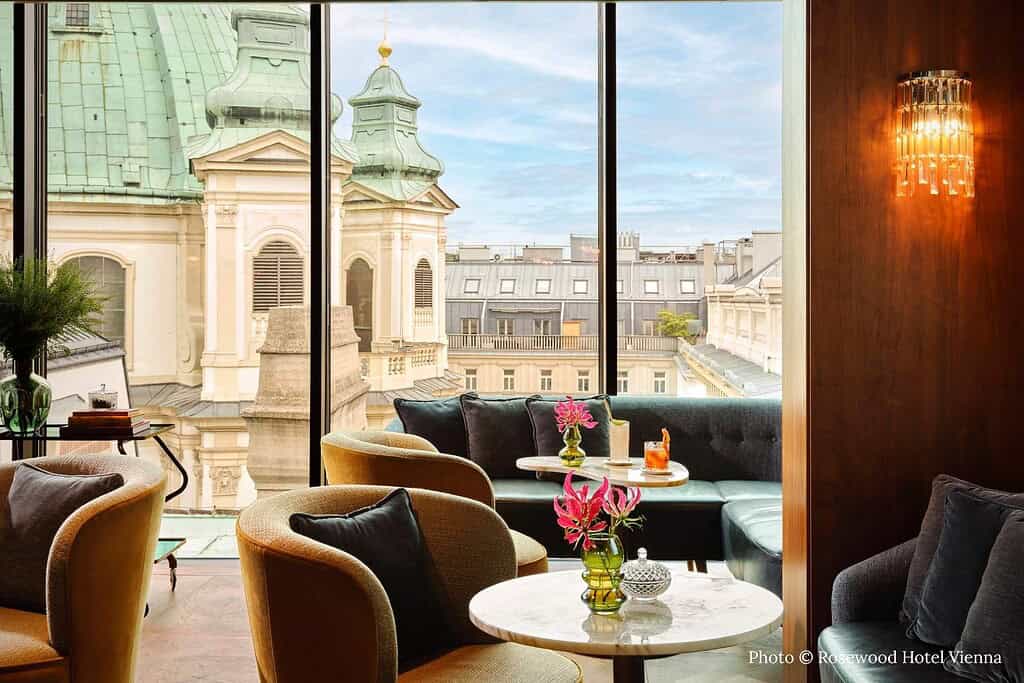
The Rosewood Vienna strikes the right balance between formality and ease, with the daily rhythm set by attentive, knowledgeable staff who are never intrusive. That rhythm is further marked by the chiming of the nearby church bells at the quarter, half, and top of the hour, by the clatter of horses’ hooves as they lead carriages around Peterskirche toward the Milchgasse, and, most spectacularly, by the arrival of golden hour at the hotel’s Neue Hoheit restaurant and bar at the heights of the hotel. As a counterpoint to the city’s public pace and to slow time down, the Asaya Spa can attend to your wellness and restoration.
Cultural Fluency
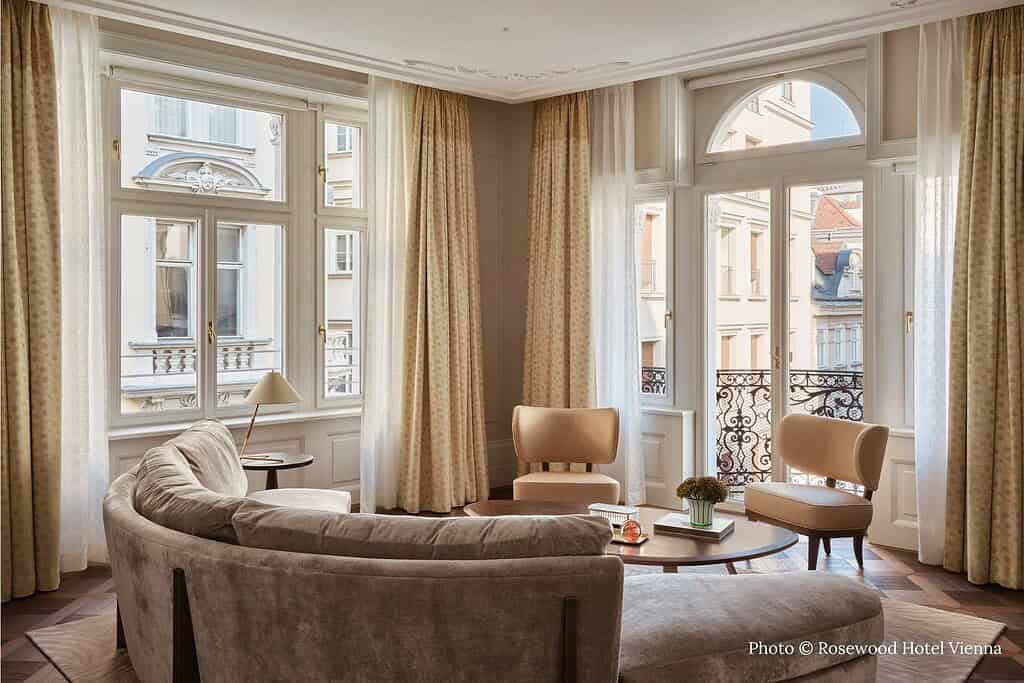
While a global brand, the Rosewood has mastered the fusion of Viennese history, culture, and design, ensuring contextualized rather than generic luxury. Art and decorative elements by contemporary local artists and craftsmen, along with those of the Wiener Werkstätte, are integrated throughout the hotel’s public areas and guestrooms. This is evident in the custom-made furnishings, distinctive fabrics produced by Backhausen (established in 1849), and the fully integrated design of Hoffmann House, the hotel’s nearly 2,000-square-foot corner residence with stunning views. Vienna’s Palmenhaus served as the inspiration for decorative nature motifs in the murals painted by Maria Hartig, while handcrafted brass light fixtures represent Austria’s alpine flower, the edelweiss.
Sustainable Stay
The Rosewood Hotel Group has received group-wide multi-site Global Sustainable Tourism Council (GSTC) certification conducted by Bureau Veritas, covering 47 properties across its three brands, including Rosewood Vienna. This certification verifies that the group’s operational standards and guest experiences align with four key GSTC criteria: effective sustainable management, social and economic benefits for local communities, preservation of cultural heritage, and environmental responsibility. Its sustainability disclosures are primarily group-wide, rather than property-specific.
Explore current availability directly with Rosewood for your travel dates.
VISITOR INFORMATION
Website: Rosewood Vienna
Address: Petersplatz 7, 1010 Vienna (Innere Stadt)
Location highlights: Petersplatz, Stephansplatz, Le Cru champagne bar, and the Graben, Kohlmarkt, and Tuchlauben pedestrian streets right beyond the doorstep, with the Hofburg Palace, Staatsoper, and Albertina within walking distance
Park Hyatt Vienna
Accrued Elegance
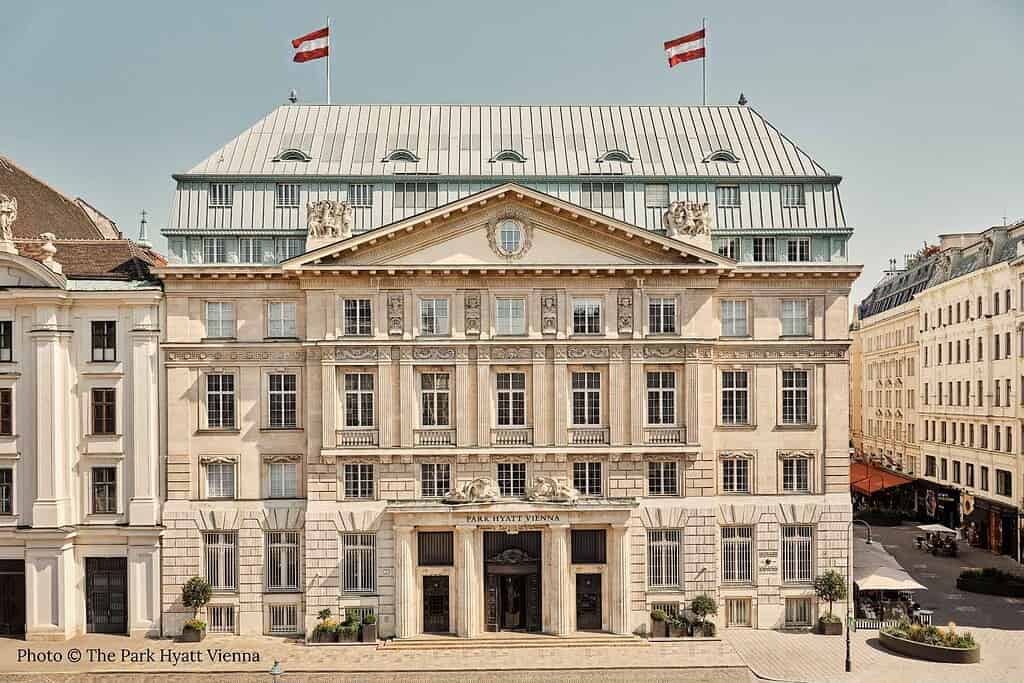
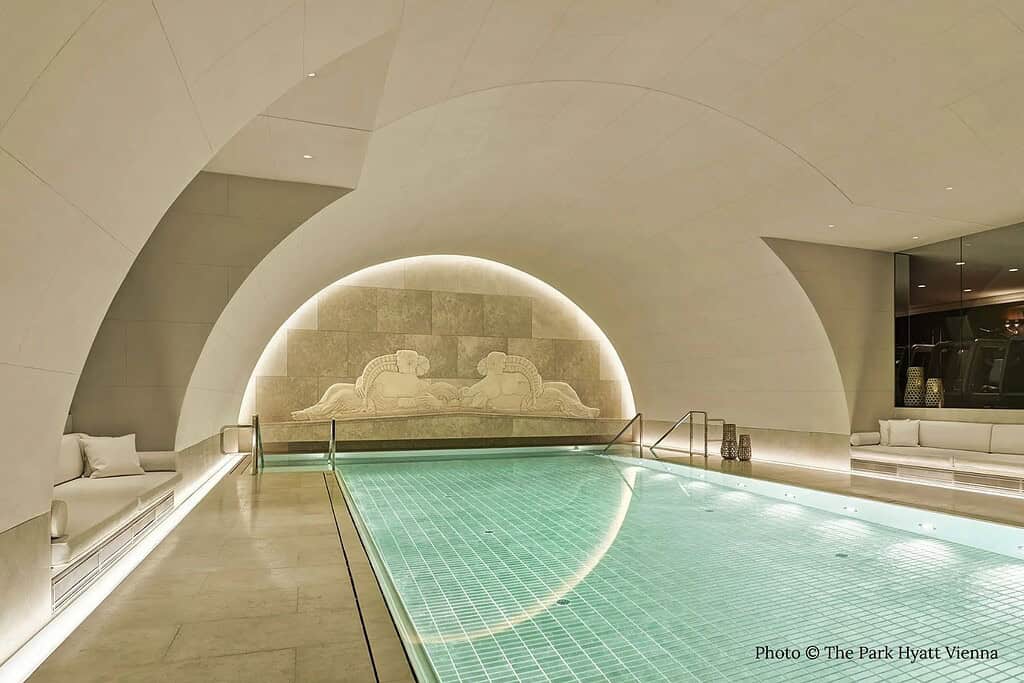
A bank-turned-luxury hotel in Vienna’s “Golden Quarter,” the Park Hyatt Vienna is known for the Arany Spa’s vault pool and a polished urban take on grand Viennese scale.
Relationship To History
The Park Hyatt Vienna anchors the Am Hof in one of the oldest quarters of the city’s historic center. Over several centuries, the square has witnessed pivotal periods in the city’s evolution. Once host to Roman encampments, the site’s fortifications were used by the Duke of Austria to build Babenberg Castle/Residence, which later served ecclesiastical functions during the Reformation. In the early 20th century, the palatial building that now houses the Park Hyatt served as the headquarters of a major Habsburg‑era bank, anchoring a neighborhood where the monarchy’s great financial institutions, from commercial lenders to the Austro‑Hungarian Bank that managed its gold reserves, clustered until the empire’s collapse.
Architectural Intelligence
Designed by Ernst von Gotthilf and Alexander Neumann, the Beaux Arts building was constructed between 1913 and 1915 as a grand urban palazzo. A century later, it was carefully restored as the five-star Park Hyatt Vienna. Conservation specialists and artisans from across Europe preserved the stone, glass, and wood detailing, while modern systems were discreetly integrated throughout. Among the most dramatic interventions –– a feat that required hoisting the building –– was the creation of the Arany Spa pool within the former gold vault.
Social Posture
The Park Hyatt Vienna is tailored to globally fluent luxury travelers who want the classic grandeur of Vienna, but with the modern predictability of a top-tier international brand. The popularity of The Bank Restaurant and Bar, which leans heavily –– and with sophistication –– into the building’s former identity, an on-site beauty salon, luxury shopping, and day passes and memberships to the spa and pool mean that you’re likely to find a dynamic mix of locals and tourists.
Looking for well‑appointed bars in Vienna? Check out the Vienna edition of Pour Decisions (coming soon) for a curated review of the best cocktail bars and wine bars in the city, from atmosphere to mixology.
Ritual and Rhythm
At the Park Hyatt Vienna, the rhythm of the stay unfolds in dialogue with the square just beyond its doors and moves outward into the boutiques of the Golden Quarter and the historic lanes beyond. Late afternoons often draw visitors inward to The Bank Bar for a cocktail, or downward to the subterranean calm of the Arany Spa. Evenings return to polished dining and bar culture that subtly nods to the building’s financial past. The experience moves between grandeur and retreat, commerce and indulgence, creating a cadence that feels both distinctly Viennese and comfortably international.
Cultural Fluency
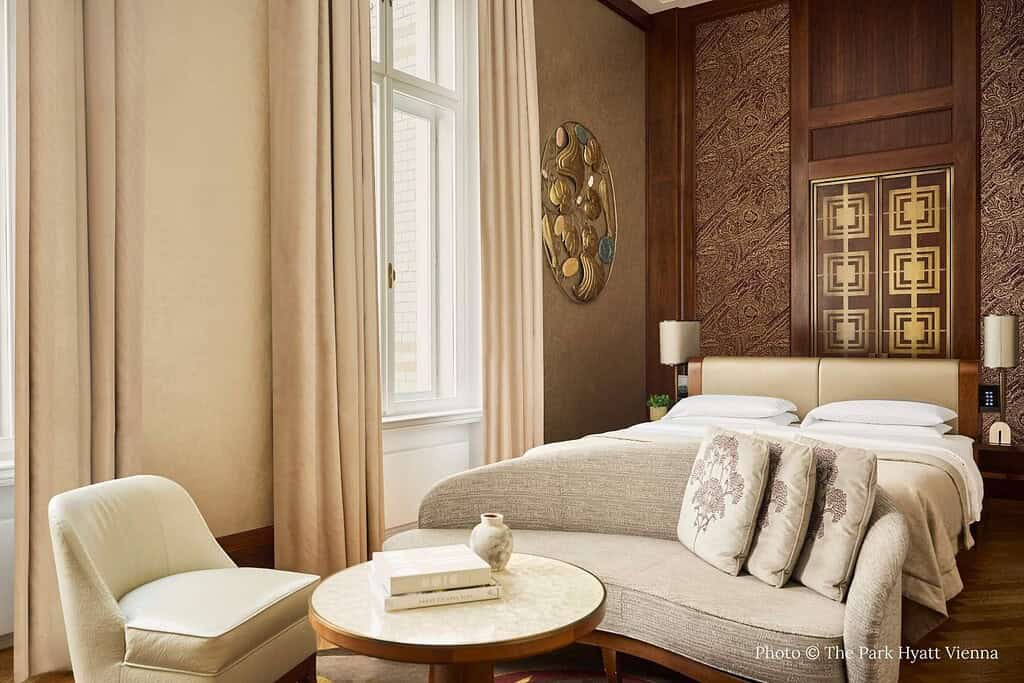
While the hotel delivers a globally legible experience, starting from its setting on the Am Hof, the interpretation is entirely Viennese. From the lobby’s soaring alabaster ceiling and massive marble columns to the aptly named bar and restaurant, “The Bank,” once the grand cashier’s hall. The latter features custom crystal luminaires, coffered ceiling, clerestory glazing, veined marble, an allegorical relief with a monumental brass clock and cascading sconces. Guest rooms incorporate bespoke textiles and design elements inspired by the Wiener Werkstätte, including oversized artwork based on brooches from the era (which can be seen at the Museum of Applied Art (MAK).
Sustainable Stay
Hyatt Hotels Corporation operates under robust environmental sustainability commitments, with 2030 goals focused on reducing emissions and food waste, and enhancing water conservation targets. Hyatt Hotels Corporation regularly reports on environmental sustainability and has achieved verified emissions-reduction standards across regions, although performance metrics for the Park Hyatt Vienna could not be found in publicly accessible independent reports.
Check availability at Park Hyatt Vienna to compare room categories and spa access.
VISITOR INFORMATION
Website: Park Hyatt Vienna
Address: Am Hof 2, 1010 Vienna, Austria
Location highlights: Am Hof Square, Palais Ferstel and Freyung Passage, luxury shopping on the Graben and Kohlmarkt, and Spanish Riding School and Hofburg Palace within a few minutes’ walk
The Traditionalists: Best Historic Luxury Hotels Near the Opera and Musikverein
Continuity, ritual, and imperial opulence
Vienna’s grand hotels were built not just to impress but to endure. The Traditionalists embody this ethos, preserving the rituals, scale, and social codes of imperial Vienna with remarkable continuity. These are hotels where history is not simply staged but practiced. Where service remains ceremonial, interiors favor patina over sleek design, and the rhythms of the past continue to structure daily life.
To stay in one of these imperial five-star hotels is to step into a lineage. The experience is defined less by reinvention than by stewardship, offering a form of luxury grounded in memory, formality, and an unbroken relationship to the city’s cultural life.
Jump to: Hotel Sacher Wien | The Hotel Imperial Vienna | The Hotel Bristol
Hotel Sacher Wien
Grand Dame
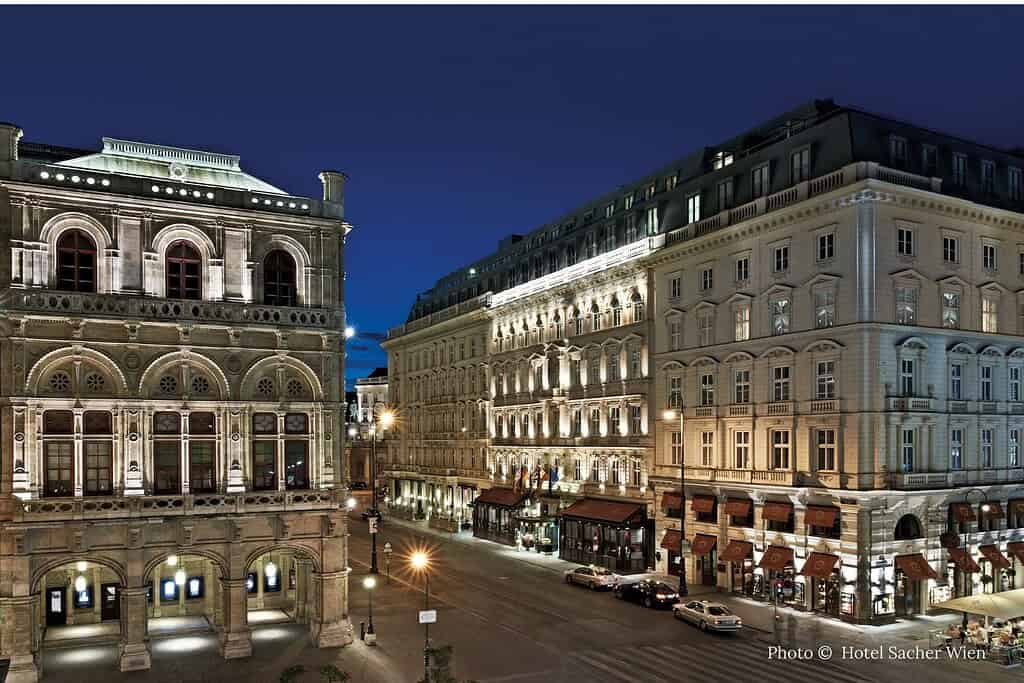
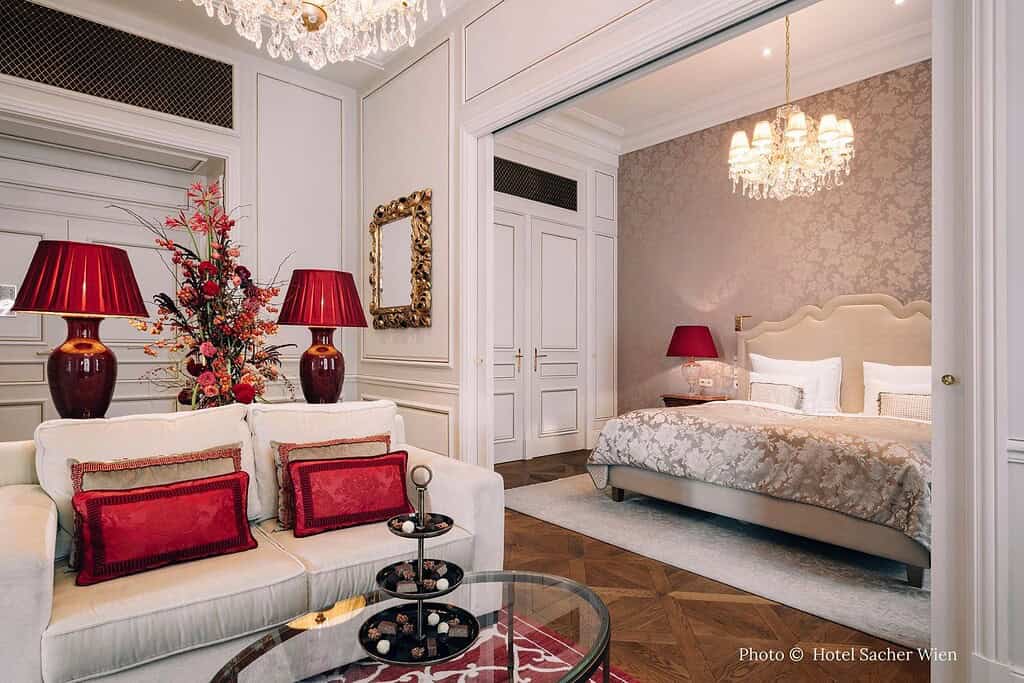
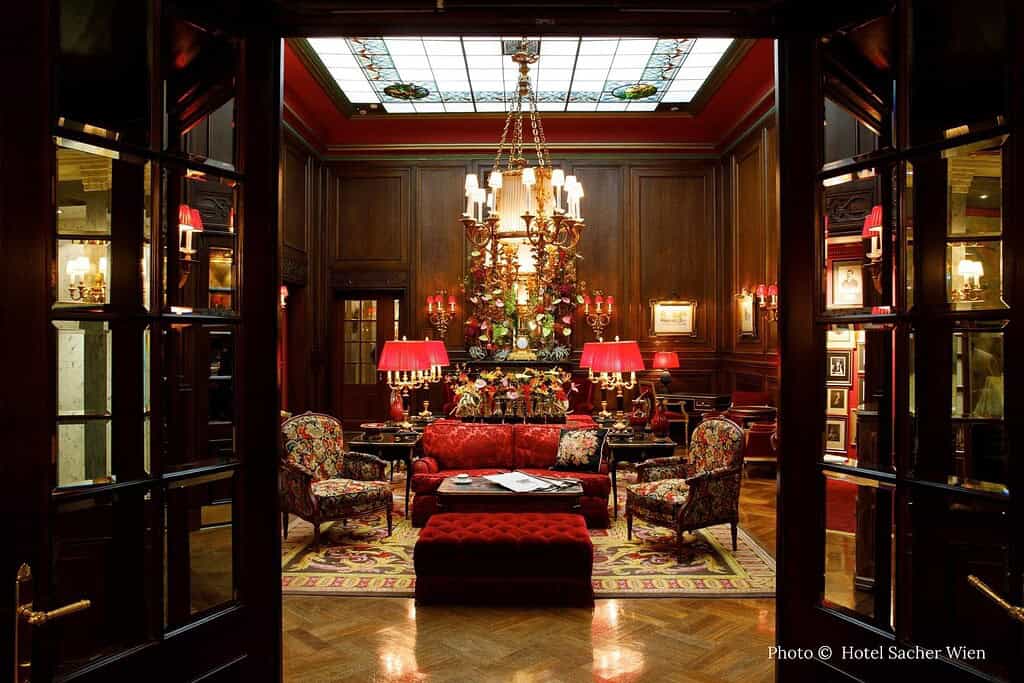
Vienna’s most storied addresses for operagoers, the Hotel Sacher Wien, is a 19th-century icon opposite the Staatsoper, a classic Habsburg-era Grand Dame defined by high-society lore, red-velvet glamor, and the Original Sacher Torte.
Relationship To History
Founded in 1876 by Eduard Sacher, this historic hotel’s identity is inseparable from the Original Sacher Torte, its role as a high-society meeting place, and its proximity to the Staatsoper. Anna Sacher, who ran the hotel for decades after her husband’s death, is remembered for a “tough love” management style and a fondness for French bulldogs and cigars, which she was rarely seen without.
HISTORICAL CONTEXT
A Proper Scotch…and Intrigue
The Hotel Sacher endured the upheavals of the 20th century, from the fall of the Habsburg monarchy to the German annexation of Austria. During the Allied occupation at the end of the war, control of the hotel shifted from Russian to British forces (while the Americans camped out at the Hotel Bristol).
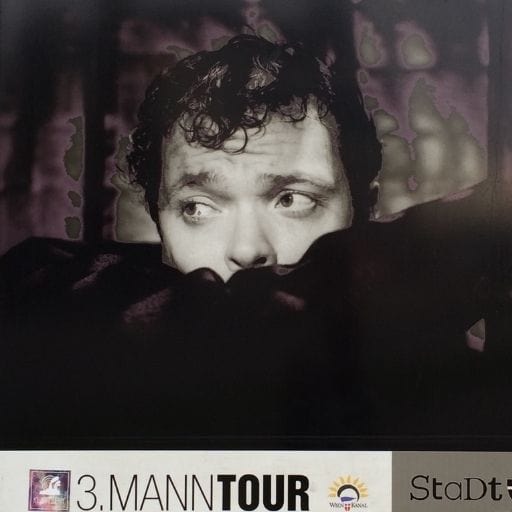
According to popular lore, only the British Club at the Sacher was known for pouring a proper Scotch or Slivovitz, provided you could produce the right papers. It was here that author Graham Greene reportedly encountered a British Intelligence Officer whose stories of intrigue later inspired The Third Man.
Source: The Most Famous Hotels in the World, “Vienna: Hotel Sacher – Third Man’s Birthplace.”
Architectural Intelligence
Built on the site of the old Kärntnertor Theater, the Hotel Sacher’s Neo-Baroque façade faces the Staatsoper across the Ringstraße, with all the presence of an imperial-era grand hotel. A stately corner block with tall arched windows and ornate stone detailing, the hotel beckons guests with the unmistakable Sacher red canopy that’s visual shorthand for Old-Viennese luxury. Inside, the property is dripping with its signature red velvet (among other plush jewel tones in its various salons), sparkling chandeliers, gilding, oil paintings, dark wood, and other opulent accents, with dramatic effect.
Social Posture
Alongside its longstanding reputation for faultless, peerless service, Hotel Sacher was named one of the World’s 50 Best Hotels in 2025, an unusually selective list even by luxury standards. Here, guests will enjoy the height of Viennese hospitality in a property that has aged with grace, while being thoughtfully updated to ensure all the modern conveniences luxury travelers expect. It’s ideal for those who want to be at the social and cultural heart of the city, and, in 2026, to join this historic hotel’s 150th anniversary celebration.
Ritual and Rhythm
Given its location directly opposite the Vienna Staatsoper, the Hotel Sacher revolves around pre- and post-performance ritual. Evenings unfold around curtain times and encores, with guests drifting between the Michelin-listed Rote Bar and Grüne Bar for high-end dining, or settling into the intimate Blaue Bar for proper cocktails. The Bel Étage offers a confectioner’s refuge removed from the tourist queues at the Sacher Café, while Salon Sacher provides a lighter, Campari-infused, Art Deco counterpoint to all the velvet and gilt. Ceremony here is social rather than sovereign. It’s theatrical, indulgent, and deeply tied to the cultural heartbeat of the Opera.
If you need inspiration to intersperse your fine dining experiences with the traditional offerings of the city’s famed cafés, see the Viennese Pause series, starting with Vienna’s best Imperial cafés.
Cultural Fluency
The Sacher Wien embodies a distinctly Viennese identity through its continuous family stewardship, its historic position opposite the Staatsoper, and the enduring cultural currency of the Original Sacher Torte. With properties in Vienna and Salzburg and Sacher cafés across Austria and into Italy, the brand extends its heritage beyond a single address while maintaining its core aesthetic and culinary standards. Through initiatives such as the Sacher Artists’ Collection, which pairs limited-edition packaging of its eponymous torte with philanthropic support for local causes, the hotel sustains a living dialogue among tradition, artistry, and civic engagement.
Sustainable Stay
The Hotel Sacher Wien has historically held the Austrian Ecolabel certification, which demonstrates a company’s commitment to environmentally-aware management practices and social responsibility. A detailed third-party environmental performance audit, carbon footprint assessment, and specific compliance metrics have not been independently published as of the latest available documentation.
Review current rates and room categories at Hotel Sacher Wien, and plan ahead for the opera and ball seasons.
VISITOR INFORMATION
Website: Sacher Wien
Address: Philharmoniker Straße 4, 1010 Wien, Austria
Location highlights: Staatsoper, Albertina Museum, Schmetterlinghaus (Butterfly House), Burggarten, Hofburg Palace (Augustinertrakt entrance side), Augustinerkirche, and Imperial Crypt
Hotel Imperial, a Luxury Collection Hotel, Vienna
Aristocratic Lineage
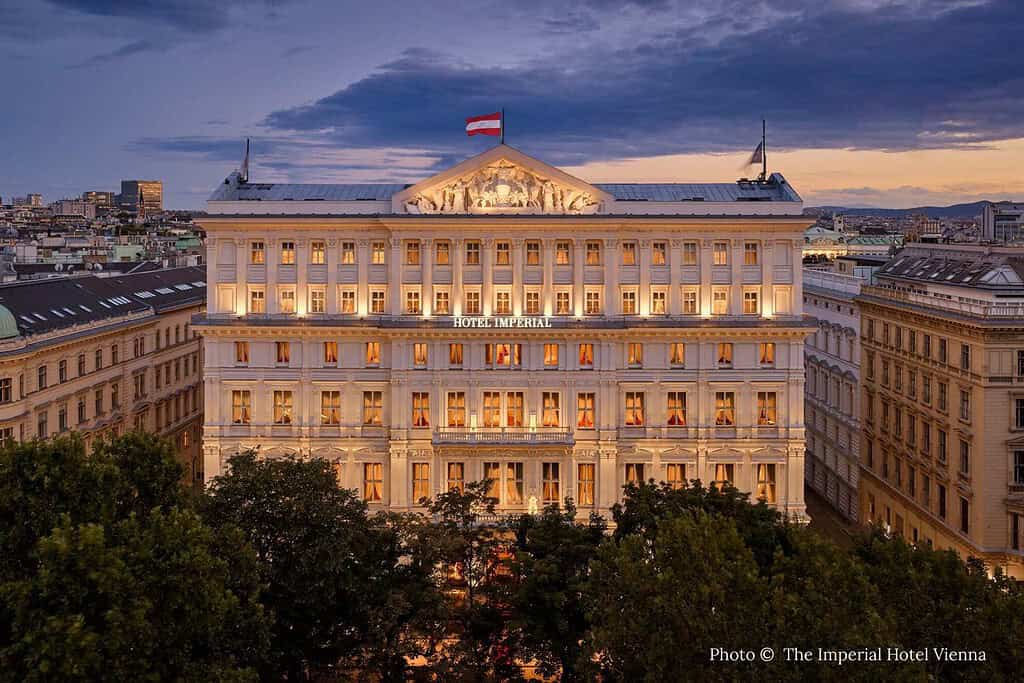
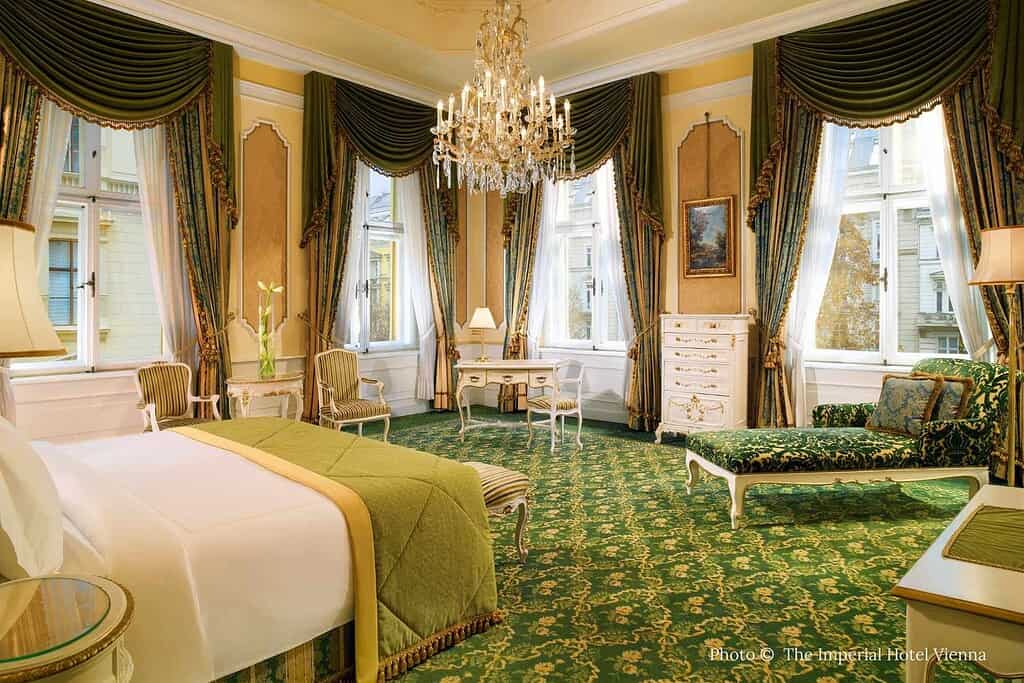
A Ringstraße palais (urban palace) turned hotel for the 1873 World’s Fair, the Hotel Imperial Vienna boasts a famous-guest roster, an unapologetically imperial aesthetic, and an exceptional location beside the Musikverein.
Relationship To History
As a token of affection for his beloved wife, the Archduchess Marie Therese, Duke Philipp of Württemberg built the residential palais that is today the Imperial Hotel. A decade later, this grand private residence was converted into a luxury hotel to accommodate emperors, kings and queens, state chancellors, and other famous dignitaries attending the 1873 World’s Fair in Vienna. The exposition coincided with the 25th anniversary of the reign of Emperor Franz Joseph I, who received royal guests at the hotel.
HISTORICAL CONTEXT
Stefan Plank: Between the Reich and the Red Army
Soon after the German Anschluss in 1938, the Imperial’s manager, Stefan Plank, a vocal opponent of the Nazis, had to receive Hitler at the hotel. The visit went like clockwork. Soon after, the Imperial became the Führer’s Vienna headquarters. Plank was denounced as a “Friend of Jews,” removed from his position, and sent to prison. He was released a week later for lack of evidence and, remarkably, later pursued a claim against his former employer and received compensation during the war.
Despite the approximately 80,000 tons of bombs that fell on Vienna during the war, the Hotel Imperial remained undamaged. Upon the city’s liberation, the Soviet military set up camp in the Imperial and reinstated Plank to his position.
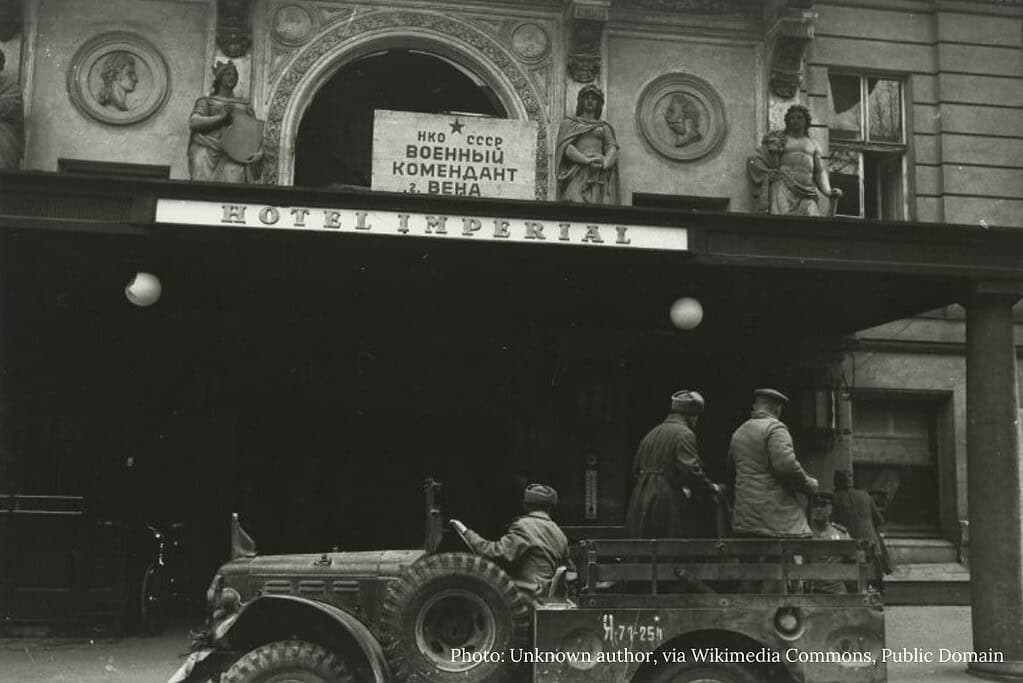
His unruly new guests proved light fingered. Plank needed a plan to safeguard the property’s remaining assets. As the story goes, he quietly removed more than a hundred of the hotel’s finest carpets “for cleaning” to keep them, and other easily portable valuables, safely out of reach. Plank remained as General Manager until 1955, when Allied Forces left Vienna.
Source: The Most Famous Hotels in the World, “Fired – Unfit for Hitler.”
Architectural Intelligence
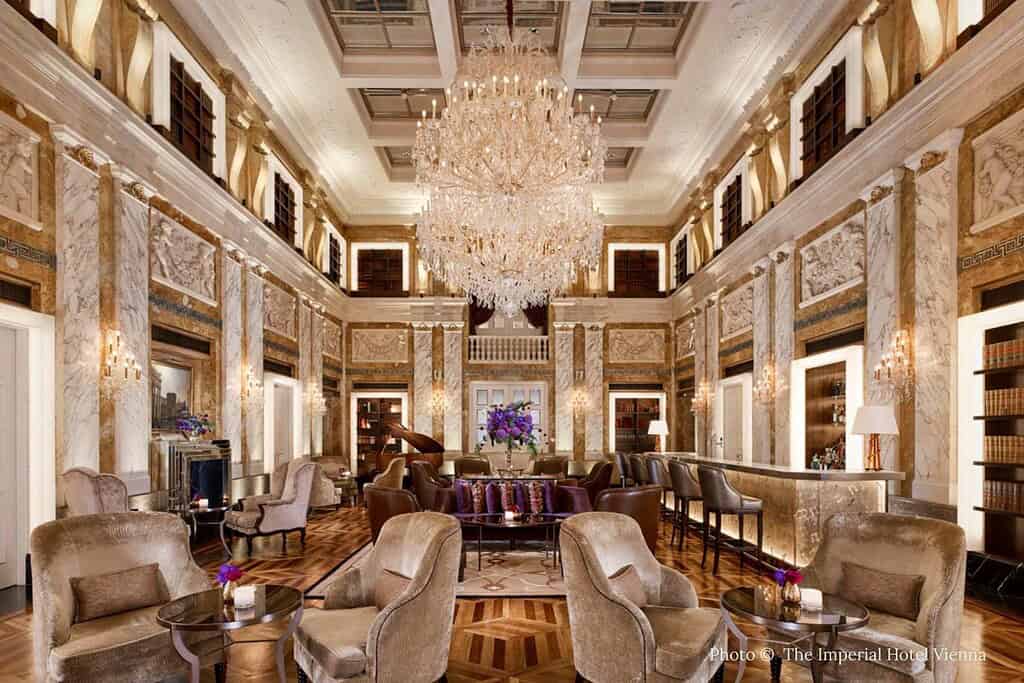
The Imperial still reads very much as the 19th-century Palais Württemberg once did, an Italian Neo-Renaissance town palace on the Ringstraße, with a balustraded façade and heraldic sculpture marking its aristocratic origins. Inside, the architecture opens into marble-lined halls, hand-carved statuary, and high stucco ceilings, with the double-height lobby and “Royal Staircase” bringing the drama. Most of the guest floors continue the palace vocabulary with silk-clad walls, parquet floors, deep reveals at the windows, antiques, crystal chandeliers, and period artworks. The atmosphere is less salon and more state chamber. Formal. Symmetrical. And unapologetically grand.
Social Posture
If the thought of passing by a wall map from the early 1700s on the way to your room sends your heart racing, this is the hotel for you. The Imperial attracts those who favor historical hotels with palais-scale opulence, large rooms with high ceilings, formal furnishings, and original art. For the fullest expression of the Imperial’s historic character, consider a junior suite or higher; private butler service is also available upon request. With immediate proximity to the Musikverein next door, this five-star hotel in Vienna remains a preferred address for state banquets and Philharmonic Ball festivities.
CULTURAL LEGACY
A Grand Budapest Connection
Readers of my blog know I have a fondness for Wes Anderson’s cinematic vision. Few cities lend themselves to that vision quite like Vienna (and Prague). The Hotel Imperial Wien actually has a direct connection to The Grand Budapest Hotel: its long-serving concierge Michael Moser, who inspired the film version of Mr. Mosher, played by Larry Pine. Today, the real-life Moser serves as the hotel’s chief historian, preserving 150 years of artifacts, from guest books to furnishings and artworks, reinforcing the Imperial’s status as a living repository of memory.
Sources: Condé Nast Traveler, “Hotel Imperial, a Luxury Collection Hotel, Vienna”; Hotel Imperial Website, “Paging Mr. Moser.”
Ritual and Rhythm
The Imperial is well versed in the processional movements of monarchs, state dignitaries, and music royalty, and in orchestrating the rituals of high occasion. Its tempo is shaped not by casual tourism but by Vienna’s ceremonial calendar: ball season, the Musikverein’s concert program, and the tight schedules and security protocols that accompany visiting heads of state. Yet within this formality, wide-eyed visitors and well-tailored locals alike find their place. In the Imperial Bar, a grand living room of plush velvet, soft leather, marble, carved friezes, and thousands of gleaming crystals, diplomacy, culture, and daily life intersect with effortless poise.
Cultural Fluency
Firmly embedded in Vienna’s aristocratic heritage and Ringstraße story, this historic hotel is a deeply place-specific fixture of civic life. It participates in living traditions rather than merely referencing them, maintaining relationships with the city’s cultural institutions, diplomatic corps, and long-standing patrons who treat the Imperial not as spectacle, but as inheritance. Its role extends beyond accommodation; it remains a setting where Vienna presents itself to the world in full ceremonial dress.
Sustainable Stay
The Hotel Imperial, a Luxury Collection Hotel operated by Marriott International, benefits from both property-specific initiatives and the broader Marriott Serve 360 Corporate Sustainability Framework and corporate-level reporting and verification. However, property-specific environmental performance data is not published in publicly available independent monitoring reports.
Confirm suite availability at the Imperial and plan early for major concerts and during ball season.
VISITOR INFORMATION
Website: Imperial Vienna
Address: Kärntner Ring 16, 1010 Vienna, Austria
Location highlights: Musikverein, Vienna State Opera (Staatsoper), Kärntner Straße, Karlsplatz, Albertina Museum, Hofburg Palace, and the Secession Building
Temporarily Closed: The Hotel Bristol
Keep your eyes peeled for the December 2027 re-opening of the Hotel Bristol, another of the city’s Grand Dames, part of the Marriott Luxury Collection, which is currently undergoing a major renovation. Facing the State Opera, the Hotel Bristol has for over a century occupied a front-row seat to Vienna’s cultural life. Its salons and bar have quietly hosted artists, patrons, and political figures alike, an address where performance, power, and private conversation have long intersected.
The Contemporaries: Best Quiet Luxury Hotels Along the Ringstraße
Art, restraint, and reinterpretation
The Contemporaries inhabit Vienna’s historic fabric without performing it. Positioned along the Ringstraße, they operate within 19th-century architecture yet articulate a distinctly modern sensibility, one that favors proportion, materiality, and restraint over ceremonial display.
These addresses approach luxury as a matter of editing rather than embellishment. Their engagement with art, design, and restoration reflects a commitment to cultural fluency in the present tense: acknowledging Vienna’s imperial inheritance while reframing it for contemporary life. Atmosphere here is cultivated rather than grand, and the experience privileges aesthetic coherence over theatrical flourish.
For travelers who admire Vienna’s architectural drama but prefer to inhabit it quietly and deliberately, this category offers a version of luxury defined by thoughtfulness, precision, and a measured relationship to tradition.
Jump to: Almanac Vienna | The Amauris Vienna
Almanac Palais Vienna
Urban Atelier
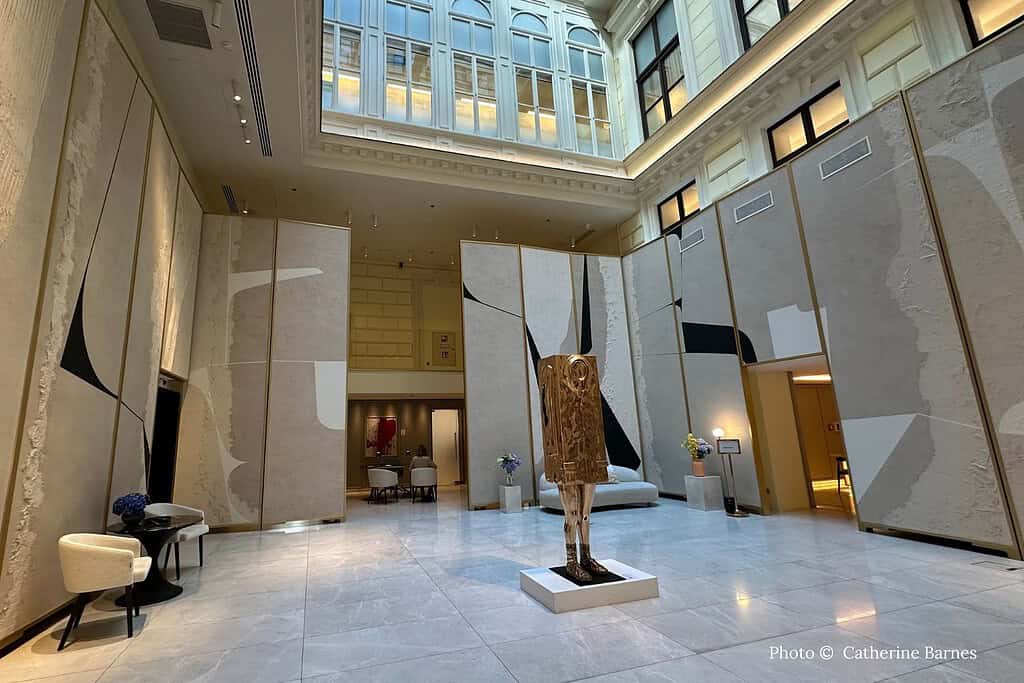
Opened in 2023 in twin Ringstraße palaces, Almanac Palais Vienna is a contemporary Vienna luxury hotel that fuses modern art, design, and a marble-clad spa just steps from Stadtpark.
Relationship To History
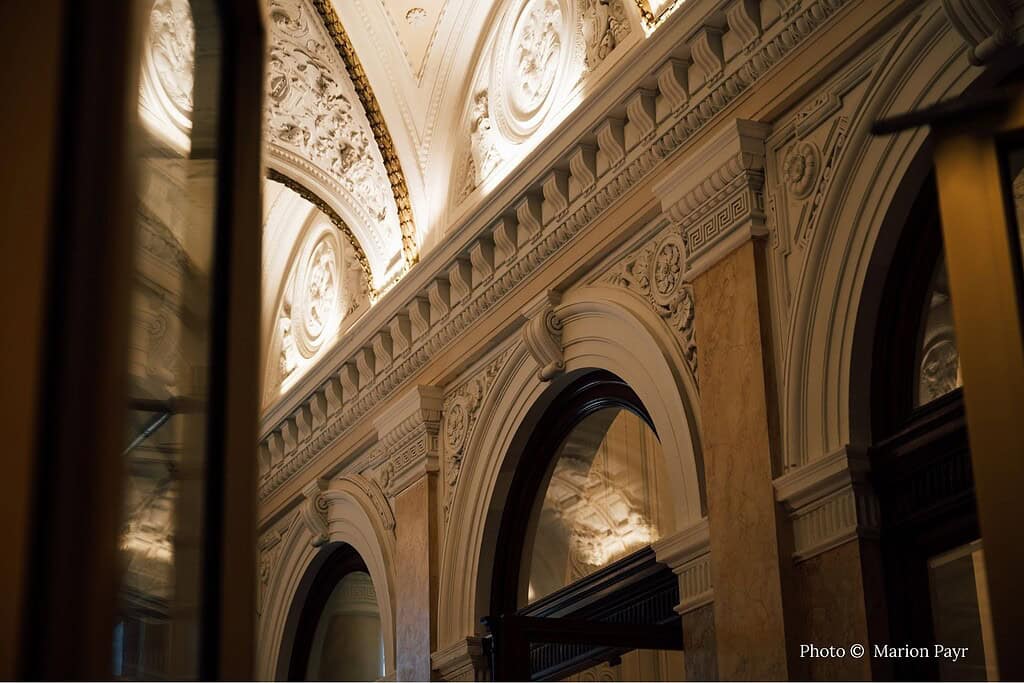
Almanac Palais Vienna doesn’t borrow Vienna’s imperial mood — it inhabits it. The hotel is stitched together from two 19th-century palais built by German-Austrian entrepreneur Hugo Henckel von Donnersmarck and Baron Friedrich Leitenberger, a textile manufacturer. Once part of the Ringstraße’s aristocratic residential world, the buildings’ fused identity today is less “palace hotel” and more “private Vienna.” This residence-scale address juxtaposes history and modern luxury. The entrance into the atrium was designed to accommodate horse-drawn carriages–an architectural memory that quietly frames the hotel’s contemporary choreography while ushering guests into a thoroughly modern, art-forward interior.
Architectural Intelligence
This is a hotel for travelers who notice proportion. The design approach is a study in contrast, restored historic bones paired with modern interventions. Among the original period details are opulent moldings, elegant carvings, towering ceilings, and inlaid wood floors. On the first floor, several nationally protected heritage salons have been painstakingly restored as special-event spaces.
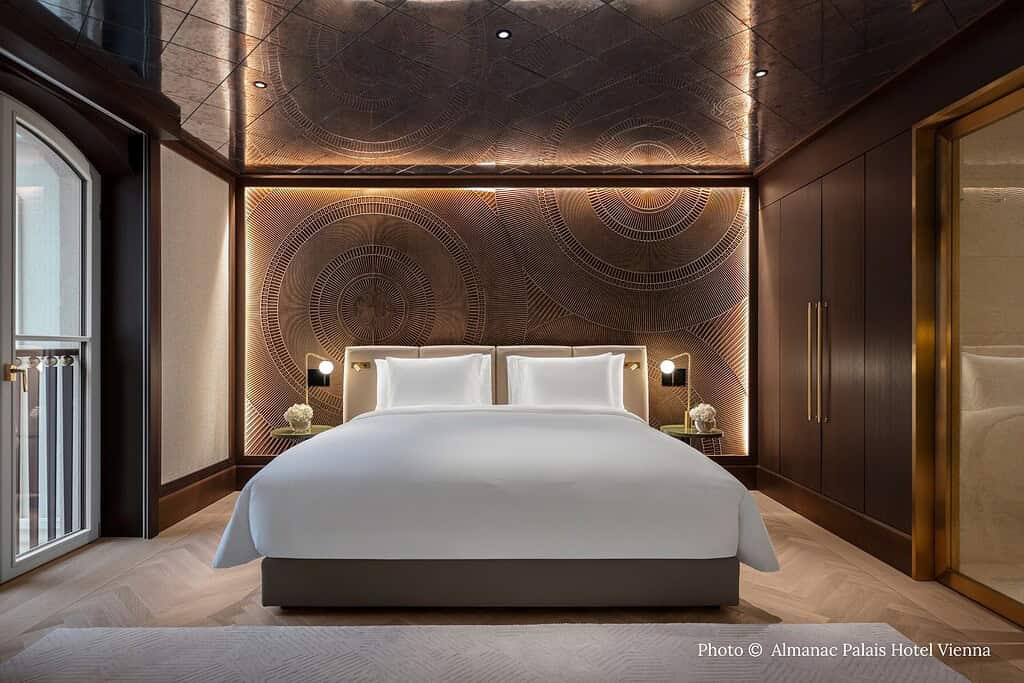
Overall, however, the property reads as strikingly contemporary. Guestrooms feature a predominantly neutral palette of beige, taupe, chocolate, and muted gold, sharpened by a deliberate pop of red (a nod to the “unexpected red” theory). Brass accents and antique mirrored ceilings introduce a restrained shimmer. Headboard panels echo the building’s 19th-century ornamentation in a swirling, abstracted motif.
Social Posture
Almanac attracts travelers drawn to Vienna’s present tense, concert-goers who also seek contemporary galleries, design-driven spaces, and the city’s newer specialty coffee bars. The mood is polished but unceremonious: luxury without excess formality.
Ritual and Rhythm
Almanac’s rhythm mirrors the natural arc of a city stay: unhurried mornings, days spent among museums and music, evenings that settle into a bar stool or a considered dinner. For wellness-driven travelers, the pace shifts downstairs to the two-story wellness sanctuary and 14-meter pool. Opposite Stadtpark, the hotel draws energy from its proximity to green lawns and mature trees — morning walks along a network of park and urban trails, evening pauses before or after a concert, and the quiet recalibration that comes from stepping briefly beyond the Ringstraße’s ceremonial scale into open air and seasonal color.
Cultural Fluency
Almanac Palais Vienna engages Vienna’s modern art lineage as deliberately as it occupies its Parkring address and historic shell. Through partnerships with Galerie bei der Albertina Zetter and the Belvedere Museum, the hotel situates guests within a curated collection that leans distinctly Austrian while incorporating select international voices.
In the grand lobby, Erwin Wurm’s paradoxical and often critical sculptures invite guests to reconsider the familiar through distortion and wit. Works by Manuel Skirl draw from organic forms and natural textures, while in the Donnersmarkt restaurant, a monumental mural by Alejandro Jaler and Nicolás Lucas translates the colors and atmospheric rhythms of nearby Stadtpark into a contemporary abstract register. In the bar, paintings by Peter Weihs introduce depth, movement, and emotional resonance.
Guests staying in the Art Suite encounter Gustav Klimt’s drawing Sitzende Dame von vorn (1913–1914), a study for his unfinished portrait of Amalie Zuckerkandl, now at the Belvedere. All guests receive complimentary admission to Belvedere 21 upon presentation of their room key, while Art Suite occupants also enjoy entry to the Upper and Lower Belvedere.
Sustainable Stay
The hotel follows a locally sourced, community-oriented philosophy with plant-forward dining and aspirations toward zero waste. Sensor-based technology conserves energy when guests are out for the day. The approach appears to favor operational choices rooted in values rather than publicly verified reporting against standardized benchmarks.
Explore current room and spa package availability at the Almanac Vienna.
VISITOR INFORMATION
Website: Almanac Palais Vienna
Address: Parkring (Ringstraße), opposite Stadtpark, 1010 Vienna
Location highlights: Stadtpark, Museum of Applied Arts (MAK), Ringstrassen Galleries and Palais streets, the Belvedere Museum(s), Staatsoper, and Musikverein
The Ringstrasse was never simply an address. It was a declaration of political ambition, financial power, and social position. Parliament and City Hall rose alongside aristocratic and bourgeois palais, each façade broadcasting influence in stone. The grand residences that now house hotels such as the Imperial and the Almanac were once instruments of that public display.
For travelers who want to read the Ring not merely as a boulevard but as a 19th-century manifesto of power and aspiration, Context Travel’s Ringstrasse Boulevard Tour: History and Architecture offers an expert-led exploration of the palaces and civic monuments that shaped Vienna’s modern identity.
Amauris Vienna
Refined Intimacy
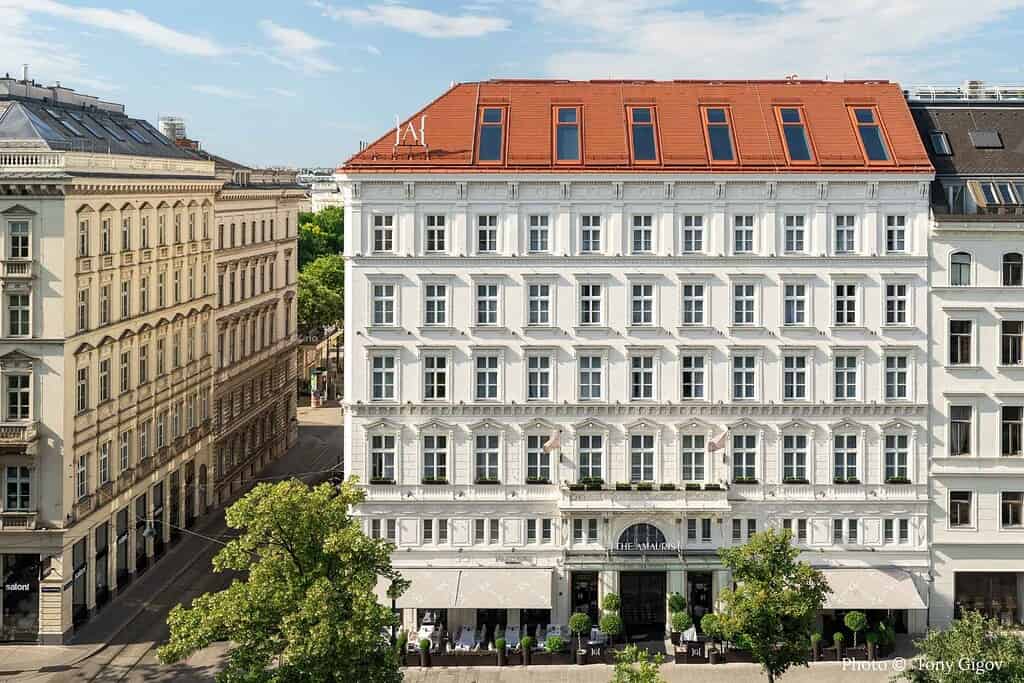
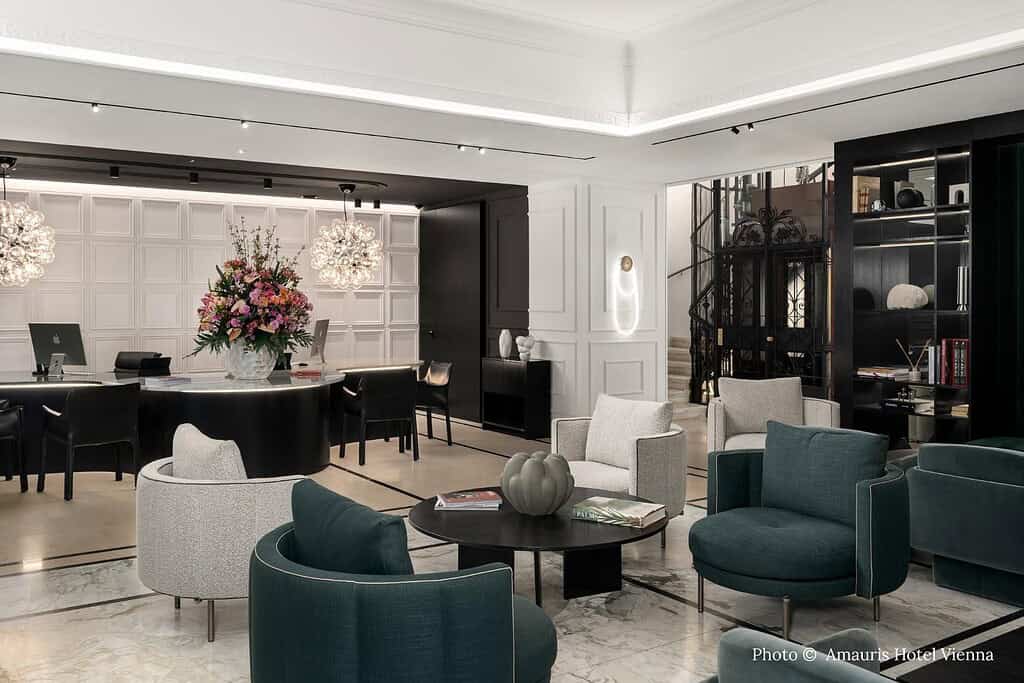
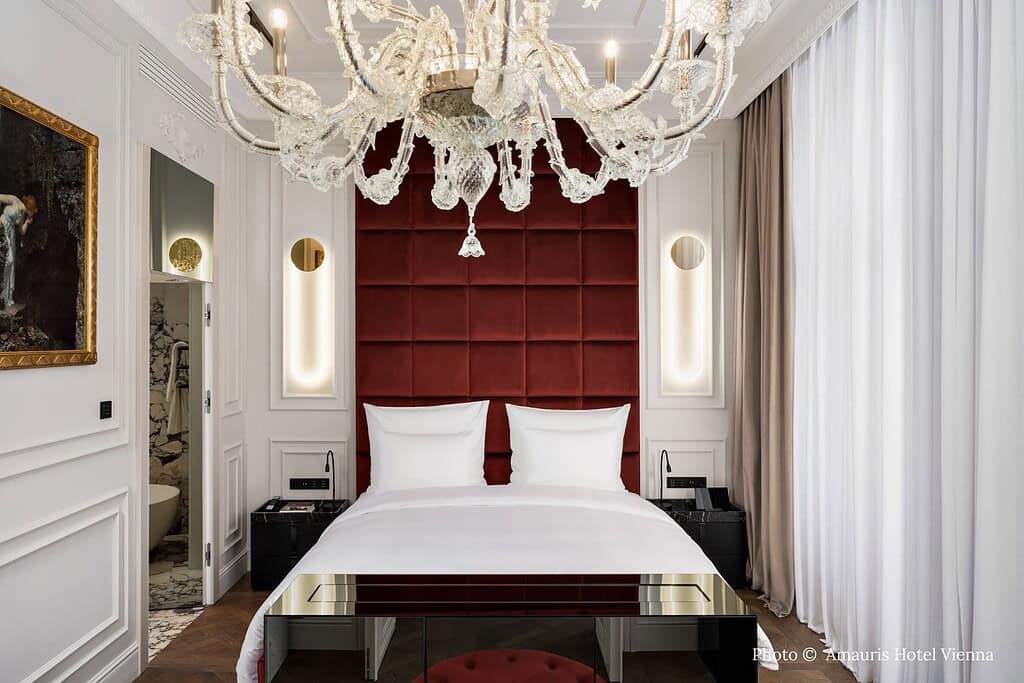
A Relais & Châteaux boutique hotel on the Ringstraße, the Amauris Vienna blends palais style grandeur with a quietly residential feel and refined interiors.
Relationship To History
The Amauris occupies a Ringstraße-era corner building completed around 1860, part of the grand urban expansion that transformed Vienna into a modern European capital. Unlike the palais-hotels conceived for imperial ceremony or World’s Fair, this address began as a refined residential and commercial townhouse woven into the everyday life of the boulevard. Its recent reinvention as The Amauris–and Vienna’s first Relais & Châteaux property represents adaptive continuity: a 19th-century shell recalibrated for contemporary luxury. Here, history provides the address and architectural framework rather than the dominant narrative.
Architectural Intelligence
Despite the building’s 19th-century origins, the Amauris approaches heritage with a boutique sensibility rather than imperial pomp. The recent redesign leans into sculptural marble (160 tons), tailored modern furnishings, and a disciplined, largely monochromatic palette that feels cosmopolitan rather than nostalgic. Traces of the past remain–most notably the original turn-of-the-century lift, complete with its driver’s cabin, cast-iron cladding, and period tiles, offering a quiet counterpoint to the hotel’s contemporary refinement.
Social Posture
The Amauris, with just 62 rooms, positions itself as a refined urban refuge for travelers who favor modern restraint over imperial nostalgia. This five-star palais hotel appeals to guests who are design-literate, understated in their tastes, and uninterested in spectacle. The atmosphere is composed and quietly cosmopolitan, more private collector than public grandee. For those who value thoughtful spa rituals, sophisticated yet subdued spaces, discreet service, and a sense of subtle insider refinement, it offers an intimate counterpoint to Vienna’s more ceremonious addresses.
Ritual and Rhythm
At the Amauris, the rhythm of the day centers on restoration. After hours immersed in Vienna’s cultural life, guests return to recalibrate, whether beneath the glass-roofed relaxation pool, in the sauna and steam rooms, or through tailored spa treatments. Evenings unfold around its Michelin-starred dining at the Glasswing restaurant, which features food-and-wine pairing menu two nights per week. Named for the butterfly genus to which the Great Monarch belongs, the hotel subtly evokes renewal and transformation, pairing refined hospitality and attentive concierge service with a cultivated devotion to food, culture, and the art of living well.
Cultural Fluency
Beyond its enviable proximity to the Staatsoper and Musikverein, the Amauris embeds Viennese culture directly into the fabric of the hotel. The owner’s family has assembled an art collection over generations, with particular strength in the Vienna 1900 period. Works by Carl Moll, co-founder of the Vienna Secession, and Olga Wisinger-Florian, who transitioned from a career as a concert pianist to become one of Austria’s notable painters, anchor the collection alongside other Austrian artists of the era.
In the guest rooms, culture is curated more quietly but no less deliberately. Each space includes a considered collection: a volume of knowledge, an object tied to Vienna’s cultural heritage, a piece of nature, a playful element such as a board game, and a design detail that echoes the hotel’s setting. Together, these elements form a quiet study in refinement, proof that thoughtful curation, even in small gestures, shapes the experience of place.
Sustainable Stay
Relais & Châteaux has set ambitious sustainability objectives across three main areas: Environmental Conservation and the fight against global warming; Sustainable Cuisine; and Social & Societal Empowerment. As a Relais & Châteaux member, Amauris Vienna’s environmental performance is subject to the association’s annual data collection and verification process conducted by Solinnen; however, property-specific sustainability data is not yet available in independent monitoring reports.
Explore current availability at The Amauris Vienna, Vienna’s refined boutique option on the Ringstraße.
VISITOR INFORMATION
Website: The Amauris Vienna
Address: Kärntner Ring 8, 1010 Wien, Austria
Location highlights: Staatsoper, Musikverein, Albertina Museum, Kärntner Straße, Karlsplatz, Karlskirche, Secession Building, and Naschmarkt
Planning Your Vienna Stay?
As you map out your Vienna escape, let the mood you’re seeking –– ceremonial, cosmopolitan, or contemplative –– guide your decision.
Room availability and rates at Vienna’s leading luxury hotels vary significantly by season– particularly during opera premieres, ball season, holiday markets, and summer vacation season.
For the most accurate pricing and room selection, consult each hotel’s official website directly.
If you’re pairing your visit to Vienna with a trip to Prague, take a look at my companion guide, Grand Addresses: A Travel Designer’s Guide to the Best Luxury Hotels in Prague , for an equally elevated experience.