Viennese Pause: A Travel Designer’s Guide to Bohemian Cafés

Explore Vienna’s literary and artistic coffeehouse culture through five landmark cafés — Café Central, Café Hawelka, Café Sperl, Café Museum, and Café Korb — where writers, artists, architects, philosophers, and the avant-garde helped shape the city’s modern identity.
Vienna’s Ritual of Rest and Reflection
Vienna’s café culture may revolve around coffee, but to truly appreciate the richness of the blend, you need context. Each café has its own origin story, shaped by ambitious founders and quirky clientele. The ideas debated over a brew and a slice of torte didn’t just influence Vienna; they helped steer cultural and political currents far beyond it. This post focuses on bohemian haunts where the grit of big ideas blends with the grandeur of an Imperial past.
This is the third installment in a series exploring Vienna’s café culture. If you’re unsure how a café, a Konditorei, and a traditional Kaffeehaus differ, the distinctions are explained in the first post in the series, Viennese Pause: A Travel Designer’s Guide to Imperial Cafés.
Explore other posts in the series:
Imperial Cafes | Old Town Institutions | Culinary Detours
Legendary Salons and Bohemian Hideaways: Where Ideas Percolate
Humming with creative and intellectual energy, these cafes hosted artists, writers, and revolutionaries who gathered to philosophize, strategize, and nurture their eccentricities.
Jump to cafés:
Café Central | Café Hawelka | Café Sperl | Cafe Museum | Café Korb
Café Central
Cerebral Theater, with Cake
Editor’s note: Café Central is temporarily closed for a planned renovation from March 16, 2026, with reopening scheduled for winter 2026. During the closure, visitors can try DECENTRAL at Freyung instead.
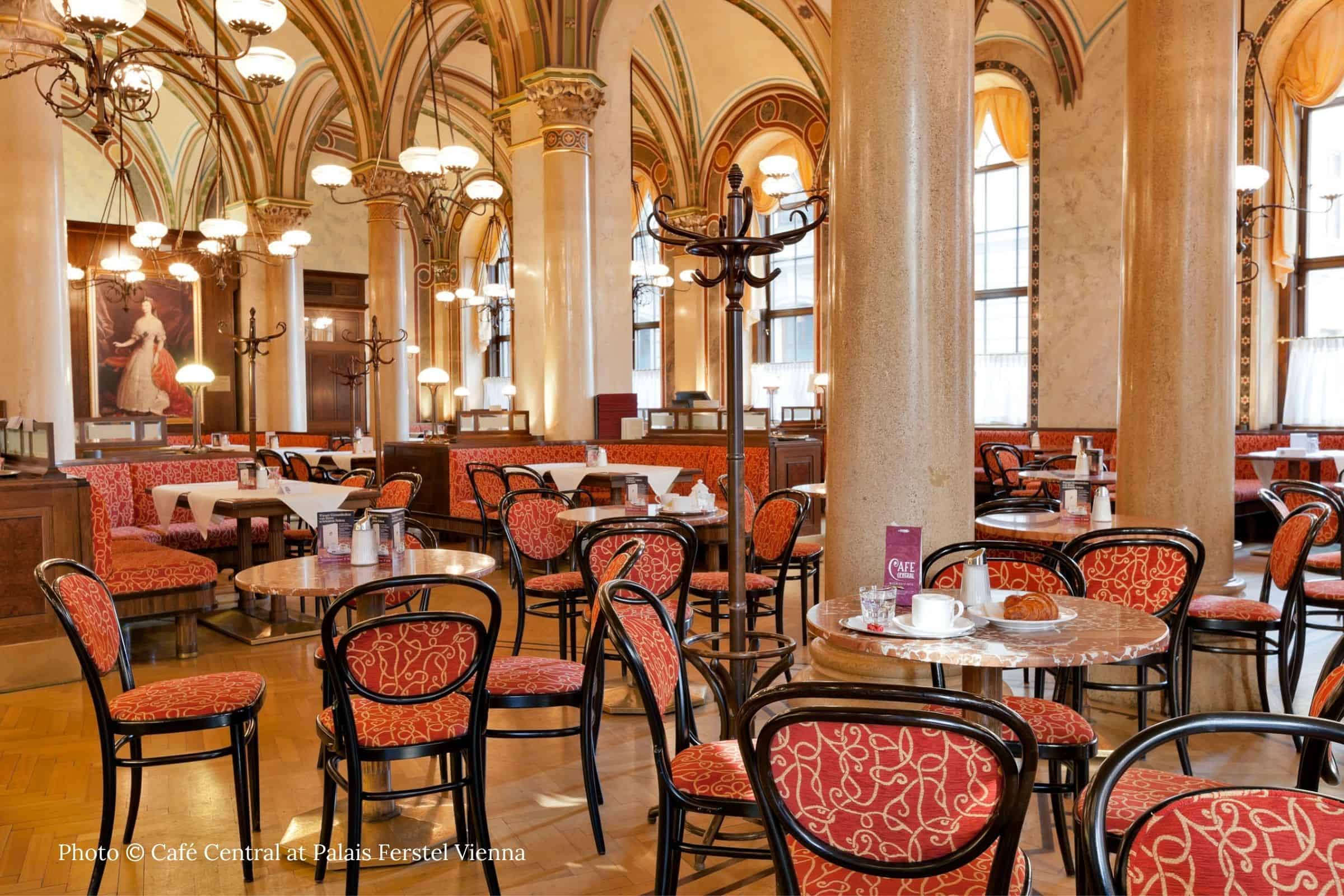
Along with Sacher and Demel, Café Central completes Vienna’s holy trinity of legendary cafés. Inside the Palais Ferstel, it’s among the city’s most photographed. Once within, it’s easy to see why. Clustered columns and soaring neo-Gothic vaults form a dramatic backdrop.
By day, tall arched windows and a constellation of brass chandeliers, each with seven milk-glass globes, cast refracted light across burnished marble floors. After WW II, this revered institution sat abandoned until a series of refurbishments in the 1970s and 80s reversed its fortunes.
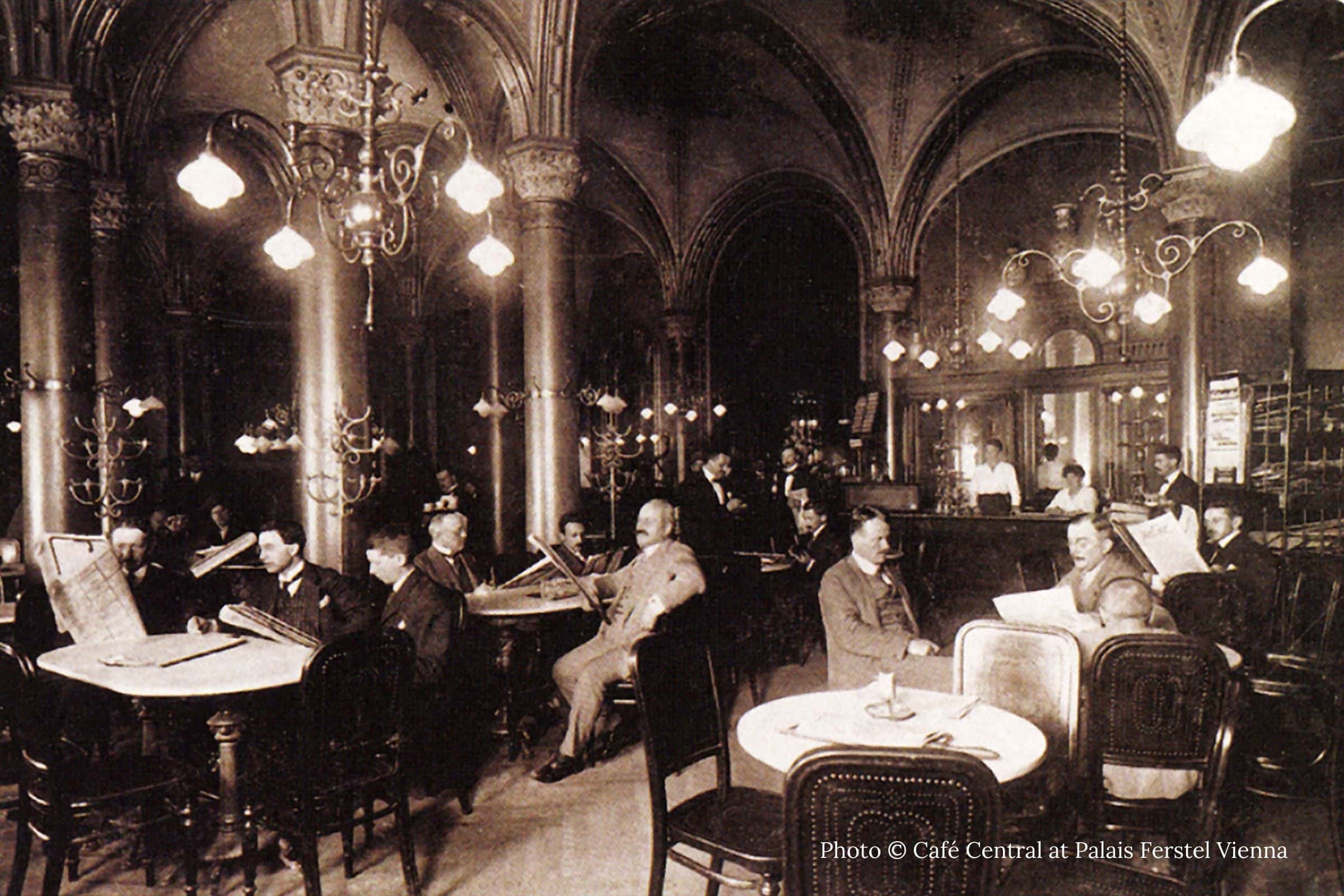
As beautiful as it may be, Café Central’s legend stems from its early 20th-century patrons. They came to drink coffee, debate ideas, and play chess. Sigmund Freud, Adolf Loos, Stefan Zweig, and Peter Altenberg were just a few regulars. Altenberg even had his mail and laundry delivered there; today, his statue greets visitors at the entrance.
The café was also the home away from home for many prominent political activists of the day. This gave rise to the cliché that if the world revolution ever started in a café, it would start at Café Central.
HISTORICAL CONTEXT
A City at the Crossroads
In 1913, Vienna stood on the fault line between an old empire and a new ideological age. The cosmopolitan capital of a fading Habsburg order had become a breeding ground for radical thought. Monarchists, Marxists, anarchists, Pan-German nationalists, and Slavic independence activists all jostled for influence.
Emperor Franz Josef
presides over an empire on the brink of collapse.
Leon Trotsky
edits Pravda over a mélange at Café Central.
Joseph Stalin
arrives briefly to coordinate tactics with his future rival.
Josip Broz Tito
embraces the class struggle as an industrial metalworker.
Adolf Hitler
sketches postcards along the Ringstraße, nurturing resentment.
In one extraordinary city, the twentieth century was already gathering its revolutionaries.
With so much attention on the men who would be dictators, another revolutionary fact tends to get lost in the annals of history. In the early 20th century, Café Central became the first café in Vienna to admit women patrons without a male companion.
Today, Café Central welcomes a contented crowd, drawn by its stunning setting, classic Viennese coffee, and mouthwatering patisserie. Try the Café Central Torte, a confection of chocolate, marzipan, subtle spices, and orange. Service is professional, though brisk at peak hours. Despite being a tourist hotspot, it’s worth visiting. Arrive before opening or book a table to skip the typical 20–40-minute queues mid-morning and afternoon.
VISITOR INFORMATION
Website: Café Central
Address: Herrengasse 14, 1010 Wien
Hours: Daily, 8:00 AM – 9:00 PM (check current hours)
Nearby: Hofburg (Michaelerplatz), Am Hof, Freyung / Palais Ferstel, Herrengasse, Graben, Kohlmarkt
Current status: Temporarily closed for renovation as of March 16, 2026. Reopening is planned for autumn 2026. Online reservations are not available during the closure. Temporary alternative: DECENTRAL, Freyung 3/1, 1010 Vienna. If travelling to Vienna in the fall, check their website for updates.
Café Hawelka
Fantastically Untrendy
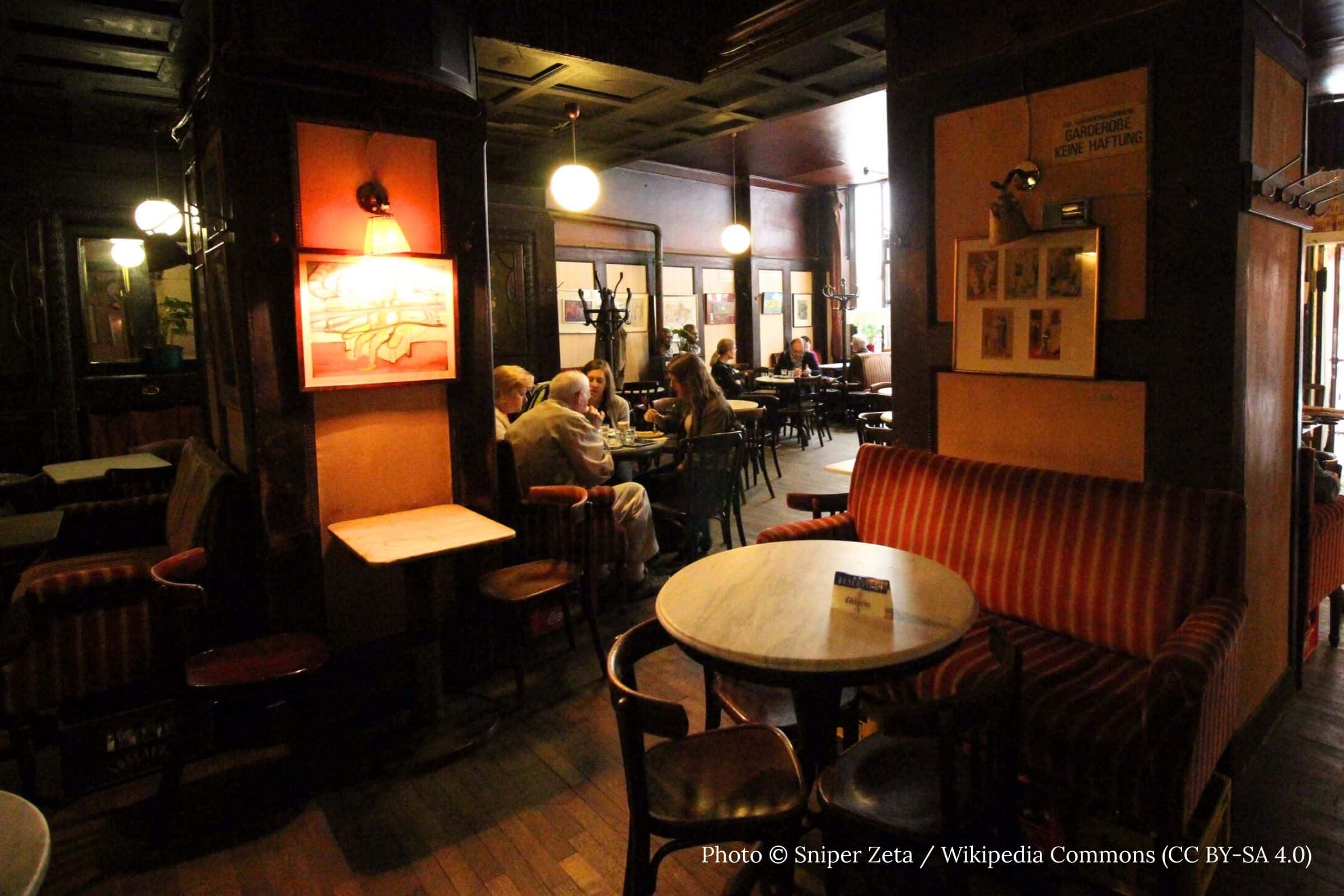
Café Hawelka Vienna is the smoky, bohemian soul of the city’s postwar café culture. The café survived WW2 intact, despite significant damage to surrounding buildings, and reopened thereafter. Owners Leopold and Josefine Hawelka manifested success through singular hospitality and a steadfast refusal to chase modern trends, except for the cappuccino machine. More than 80 years on, the café remains in family hands.
Café Hawelka is situated between the high-end shops of Graben and the Dorotheum auction house. Away from the bustle, the café is cozy and dim. Thick curtains, soft lighting, and walls stained by decades of smoke and conversation set the mood. Some of the original design by Rudolf Schindler, a student of Otto Wagner and Adolf Loos who later worked in Frank Lloyd Wright’s studio, survives to this day.
What began as a modest coffeehouse evolved into a magnet for writers, critics, painters, actors, and night owls who preferred warm wood, low light, and conversation that stretched into the dawn hours. In the 1960s and 70s, it was a favorite haunt of the avant-garde, including members of the city’s Fantastic Realism movement, along with playwright Arthur Miller and artist Andy Warhol, among other foreign visitors.
ART AND IDEAS
Vienna’s Fantastic Realism Movement
A post–World War II art movement, Fantastic Realism blended Old Master techniques with surreal and allegorical imagery rooted in myth, religion, and psychoanalysis. Their work reflected Vienna’s wartime trauma and the city’s postwar search for meaning.
Most of the movement’s founders were students of Albert Paris Gütersloh at Vienna’s Academy of Fine Arts. Key members included Ernst Fuchs, Arik Brauer, Rudolf Hausner, Wolfgang Hutter, and Anton Lehmden. Together, they became known as the Vienna School of Fantastic Realists.
The group exhibited internationally from the late 1950s onward, helping to reestablish Vienna as a cultural capital after the war. In Vienna, early exhibitions were held at the Künstlerhaus, with later works featured at the Ernst Fuchs Museum in Otto Wagner’s former villa and at the Belvedere.
Sources: Belvedere Museum, Vienna School of Fantastic Realism; Ernst Fuchs Museum (Otto Wagner Villa); Vienna Tourist Board (vienna.info), Fantastic Realism in Vienna; Peter Gorsen, essays on Fantastic Realism
Service at the Café Hawelka is informal. No one will hurry you along. Order a Wiener Melange, an Einspänner, or a Verlängertem. In the evenings, settle in and wait for the famous Buchtel to emerge warm and fragrant from the kitchen: soft buns filled with jam.
VISITOR INFORMATION
Website: Café Hawelka
Address: Dorotheergasse 6, 1010 Wien
Mon–Thu Hours: 9:00 AM – Midnight
Fri–Sat Hours: 9:00 AM – 1:00 AM
Sun Hours: 10:00 AM – 8:00 PM
Tastings: Thu–Fri, 10:00 – 11:00 AM
Nearby: Stephansdom, Graben, Dorotheum
Café Sperl
Understated Endurance, with Billiards
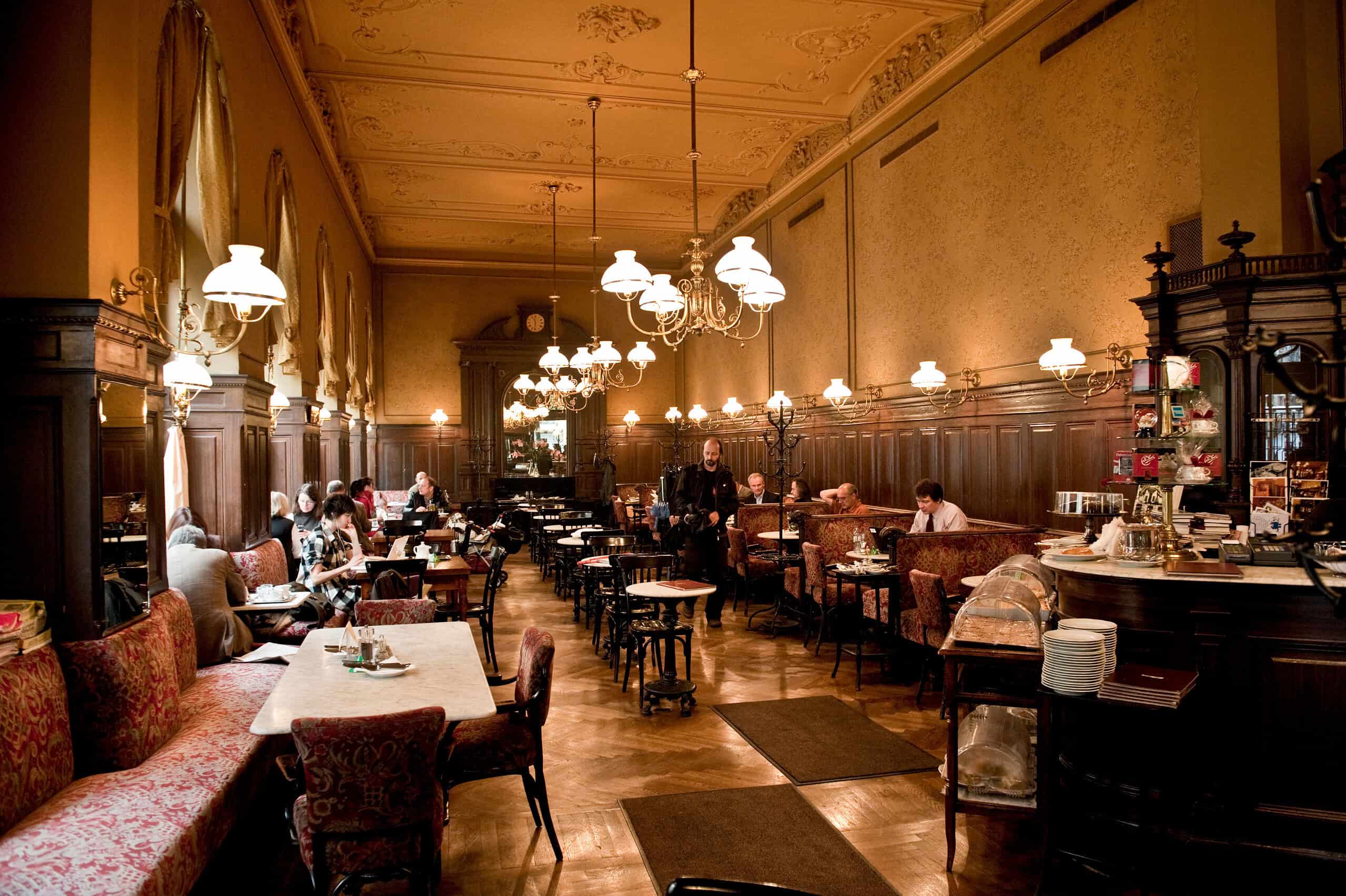
Photo: Rolf Adler Creutz/Alamy
At first glance, Cafe Sperl might appear as nothing more than a traditional “neighborhood” café. But don’t be fooled: behind its calm façade lies one of the most quietly radical stories in Vienna’s cultural history.
Founded in 1880, Sperl had an unlikely mix of patrons. Archdukes and military officers mingled with students from the nearby Academy of Fine Arts Vienna and the Kunstgewerbeschule (now the University of Applied Arts). Chafing against conservative doctrines of the late Habsburg era, the young artists found in Sperl a comfortable retreat. Here they sketched, exchanged ideas, and dreamed beyond the gilded confines of the Ringstrasse salons.
By the mid-1890s, several of these regulars formed the creative nucleus that would soon break away from the conservative Künstlerhaus. Among them were Gustav Klimt, Koloman Moser, Josef Hoffmann, and Josef Maria Olbrich who went on to establish the Vienna Secession, one of Europe’s most influential modernist movements.
ART AND IDEAS
The Vienna Secession—Viennese Art Breaks with the Past
Founded in 1897, the Vienna Secession was a bold revolt against the historicism of Austria’s cultural institutions. It championed artistic freedom, internationalism, and a synthesis of the arts known as Gesamtkunstwerk. The Secessionists embraced new forms, new materials, and new ideas, weaving together architecture, design, graphic arts, and painting.
Today, the movement’s defining motto is inscribed above the golden dome of the Secession building:
Der Zeit ihre Kunst. Der Kunst ihre Freiheit.
To every age its art. To art its freedom.
It remains one of the most enduring declarations of artistic independence in European cultural history.
Sources: Vienna Secession (secession.at), building and institutional history; Vienna Tourist Board (vienna.info), Vienna Modernism
Café Sperl’s bohemian legacy isn’t defined by smoky decadence or late-night escapades (though those undoubtedly occurred), but by an artistic rupture planned amid its high ceilings, gas lamps, and the clacking of billiard balls.
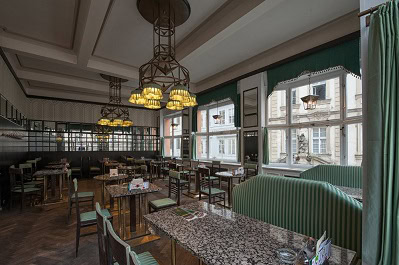
The interior remains one of the finest surviving examples of the late 19th-century coffeehouse aesthetic. Velvet-upholstered benches curve along the walls with Thonet chairs encircling marble tables. The soft glow from brass-framed lighting is reflected in a massive mirror, crowned by a clock, at the back of the room. The stately billiards area, with its original pool tables, contributes to the café’s authenticity. Film buffs may recognize Café Sperl from the PBS period crime series Vienna Blood, where it serves as the backdrop for several scenes.
Sperl’s atmosphere is quieter than its more tourist-heavy counterparts. Pop in for mélange or lunch and stay for hours, reading a newspaper, writing your novel, or observing café life. On the menu, Sperl excels at the classics: Sacherwürfel, Topfentorte, Apfelstrudel, and its beloved Sperl Torte (a composition of milk chocolate, vanilla, cinnamon, and almonds). Savories include goulash, sausages, and simple daily dishes. Service tends to be reserved but attentive.
VISITOR INFORMATION
Website: Café Sperl
Address: Gumpendorfer Straße 11, 1060 Wien
Mon–Sat Hours: 7:00 AM – 11:00 PM
Sun Hours: 10:00 AM – 8:00 PM
Nearby: Academy of Fine Arts Vienna, Secession Building, Mariahilfer Straße, Naschmarkt, Karlskirche
Café Museum
Gesamtkunstwerk, Undone
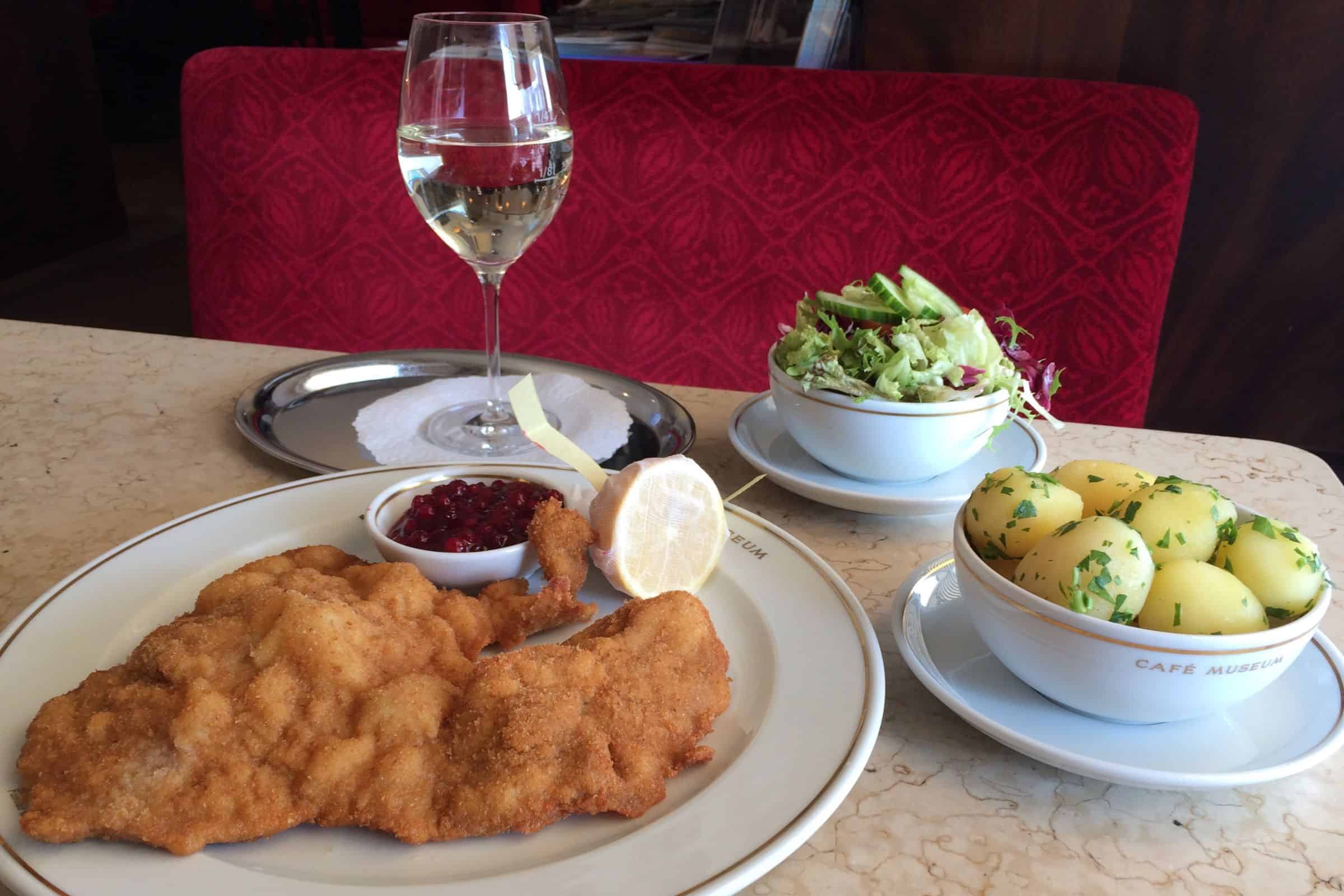
Photo: Catherine Barnes
Café Museum Vienna is located on a strategic corner, opposite the Secession building, near the Naschmarkt and Karlsplatz. Its design, by architect Adolf Loos, proved controversial from the start in 1899. Unlike the plush historicist style that defined Viennese cafes of the era, Loos’ concept was radically minimalist: plain walls, exposed fittings, and sparse furnishings.
The general public, accustomed to opulence and ornamentation, was incensed by the simplicity of the space, which soon gained the nickname “Café Nihilismus.” But artists flocked to Café Museum, among them Gustav Klimt, Egon Schiele, Oskar Kokoschka, and the architect Otto Wagner. Leading writers and composers of the day could also be found there. They elevated the Café Museum to a place to be (“scenelokal”). Still, Loos’ design continued to polarize opinion, echoing through each subsequent renovation.
By 1930, the aging décor needed a refresh, providing architect Josef Zotti (himself a student of Josef Hoffmann, founder of the Vienna Secession and Wiener Werkstatte) the perfect opportunity to refit the room. Zotti introduced semi-circular wall banquettes, upholstered in red, and added softer lighting. He achieved a comfortable “living room feel” that soothed the wider public for many decades to come.
Another renovation in 2003 attempted to recreate Loos’ original design. Zotti’s 1930s fixtures were removed, and some of the furniture found a new home at the Imperial Furniture Museum. Replicas of Loos’ pieces, however, were denounced as inauthentic, while the uncomfortable seating was widely decried. Disgruntled regulars stayed away, forcing the café to close its doors just six years later.
In 2010, the space was redesigned yet again, this time by architect Hans-Peter Schwarz. During a visit that year, I arrived to find the doors locked and the interior in a state of disarray, suspended between battling styles and eras. Schwarz followed Zotti’s plan, reintroducing, repurchasing, or reconstructing many beloved elements, including the chrome globe pendant lights. One headline from this period aptly summed up the saga: “The Re-Deconstruction: The Café Museum is open again. And looks like it did in between.”
ARCHITECTURE AND DESIGN
Café Museum—To the Future and Back Again
While Adolf Loos’ stark interior for Café Museum initially met with sharp criticism, it is now widely regarded as his first total work of art (Gesamtkunstwerk), firmly establishing his professional reputation and influence. Other cafés soon adopted his aesthetic, with smooth metalwork and straight table legs migrating into broader design practice.
Loos’ preference for mahogany-stained Thonet bentwood chairs helped cement their place in Viennese cafés and museums throughout the city. By 1931, Loos’ collaborator and biographer Heinrich Kulka declared Café Museum “the starting point for all modern interior design.”
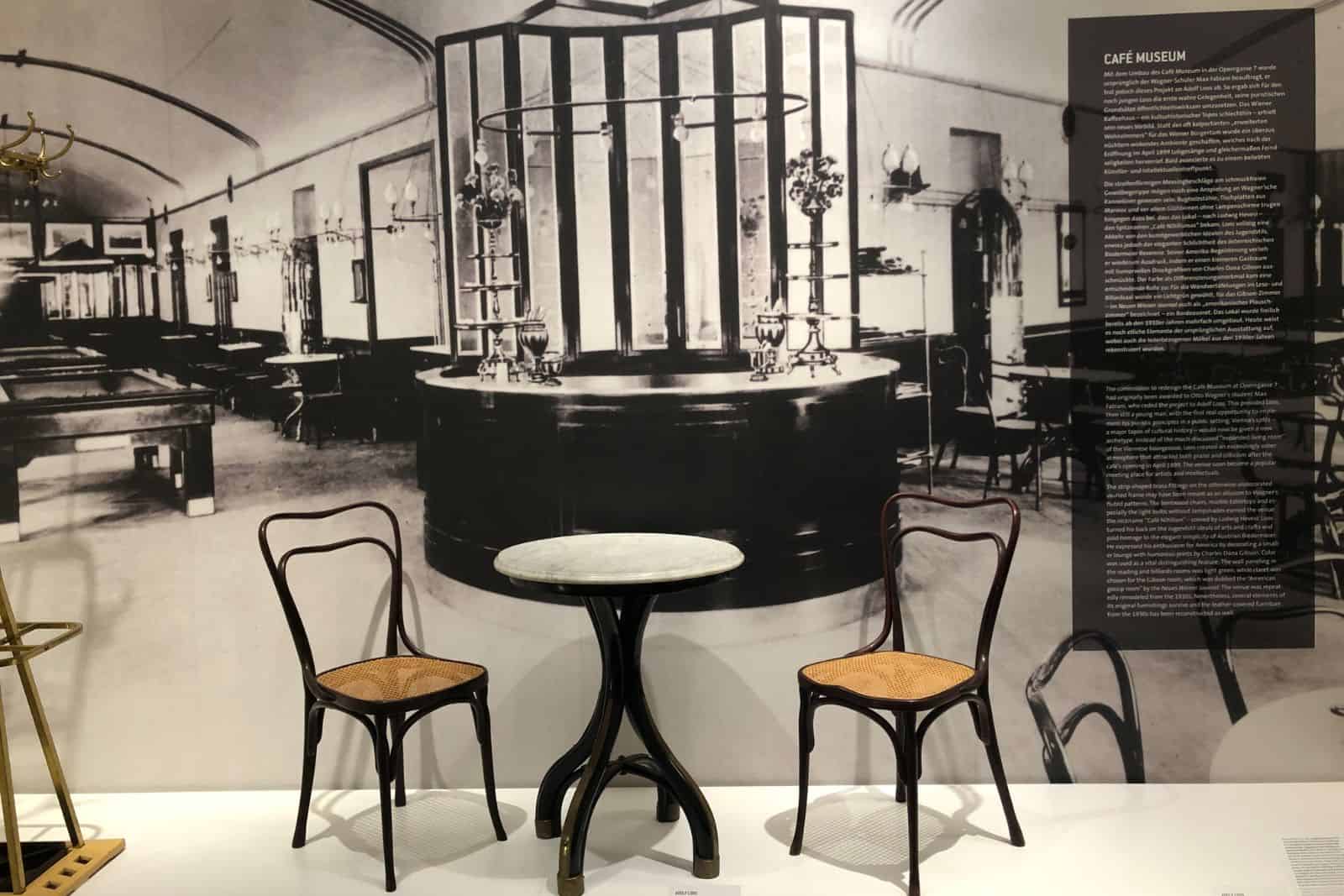
Vienna 1900 exhibit featuring interior and furniture design and
applied arts at the Leopold Museum in Vienna. Photo: Catherine Barnes
Sources: Johann Werfring, “Café Museum aka ‘Café Nihilism’,” Wiener Zeitung (March 19, 2021; updated December 9, 2022).
When the Café Museum reopened later that year, the regulars returned, assuaged. Meanwhile, public readings with audience discussions revive its tradition as an artistic meeting place. Today, curious tourists drifting in from Karlsplatz supplement the diverse local clientele. The atmosphere is relaxed. The menu includes reliable Viennese classics, think goulash and schnitzel. It’s one of my favorite places for a robust bowl of soup and seasonal salad, but it’s the pastry counter’s wide selection that “takes the cake” (as they say).
If you’re visiting the Secession Museum, Karlskirche, or the Naschmarkt, the Café Museum is the ideal spot to take a break. In the summer, you’ll be able to enjoy the terrace with a view.
VISITOR INFORMATION
Website: Café Museum
Address: Operngasse 7, 1010 Wien
Hours: Daily, 8:00 AM – 9:00 PM
Nearby: Karlsplatz, Karlskirche, Vienna Secession, Naschmarkt, Vienna State Opera, Albertina
Café Korb
Unbound By Convention
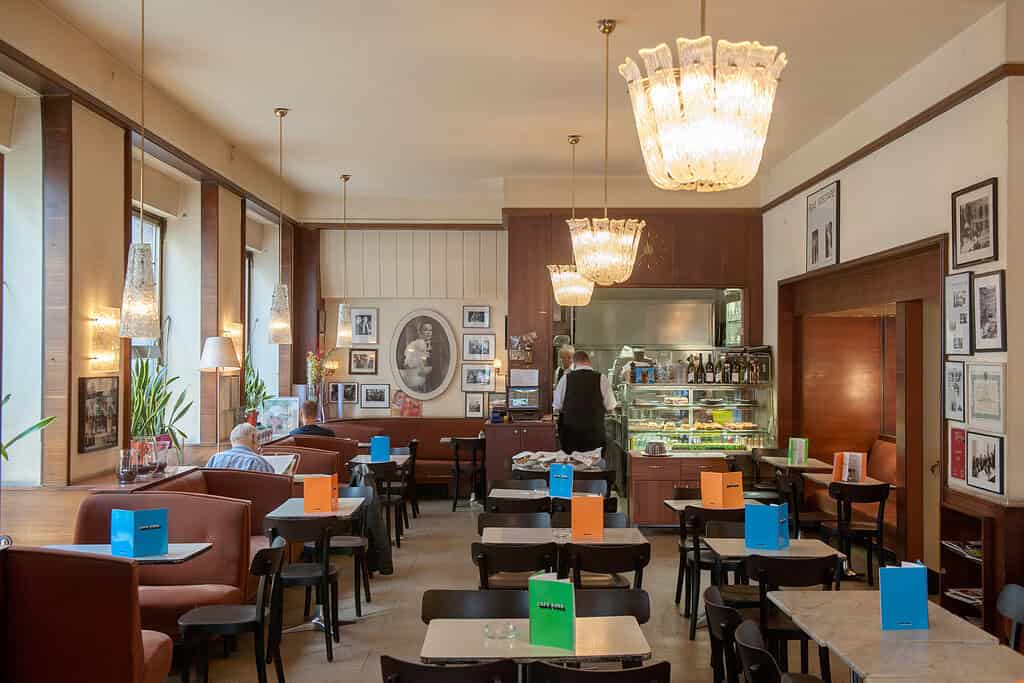
Photo: Hackenberg – Photo – Cologne/Alamy
A short stroll from Stephansplatz, Café Korb Vienna has long been associated with creatives and free thinkers thanks to two notable daughters. Amalie and Adolf Korb opened the Café Korb at its current address in 1904. Two years later, their daughter Jenny, already a highly acclaimed opera singer throughout Austria and Germany, took on the role that would propel her to superstardom.
Under Richard Strauss’s direction, Jenny sang the title role in the Austrian premiere of “Salome.” Censored in Vienna at the time, it premiered to a sold-out crowd in Graz. Leading composers, among them Gustav Mahler and Giacomo Puccini, attended. Jenny proved herself a forerunner of the modern-day “triple threat.” Her vocal and dramatic performance, along with the daringly exotic and morally risky “Dance of the Seven Veils, was hailed by critics. Her celebrity, combined with Café Korb’s central location within walking distance of the Burgtheater and Staatsoper, made it a natural draw for artists, critics, and journalists.
Decades later, the café was bought by the Widl family, whose own famous daughter, Susanne Widl, assumed leadership of the establishment in 2000. A femme fatale and idol of the stage, screen, and avant-garde, she was once described as Vienna’s only “female dandy of distinction.” Susanne was the first woman to appear at the Opera Ball in a tailcoat, confusing many a guest; the German Foreign Minister mistakenly followed her into the ladies’ room.
Under the Widl’s tutelage, Café Korb has undergone several transformations. When its building was substantially reconstructed in the 1950s, the café got a facelift. Gone were the historical embellishments in favor of the prevailing mid-20th-century style. Dark veneer, brass fittings, ice-glass pendant lighting, mirrors, and photographs of illustrious clientele define the cozy space to this day. Menus, flowerpots, and outdoor seating scattered around the 1928 Clothmakers’ Fountain add a pop of neon.
In 2002, an Art Lounge was added in the basement for literature readings, philosophical discussions, and cabaret, among other musical and theatrical performances. Under the architectural direction of Manfred Wolff-Plottegg, the space features ceiling art by Gunter Brus, wall art by Peter Kogler and Peter Weibel, and a video installation by Alfredo Barsuglia. So fully integrated is the artistic vision for the space that Wolff-Plottegg was asked to design a toilet.
CAFÉ LORE
Ask for Directions to the Spaceship
The café’s own description of its distinctive toilet is so original and evocative that it resists any attempt at summary or paraphrase:
Be warned, this marvel of a toilet—curved and floating, a blend of Rococo and science fiction, biomorphic and airy—has been sought in vain by many a guest. It is so far removed from conventional, cramped restrooms that many have failed to find it, even when standing right in front of it.
Source: Café Korb website, Art Lounge description (worth seeking out the write-up in full).
Pop by Café Korb primarily for a sighting of Susanne Widl, the quirky vibe, and utter authenticity. Given the café’s location by Stephansdom and St. Peterskirche, you can expect it to be bustling and a bit noisy, with service that’s either brusque or slow.
VISITOR INFORMATION
Website: Café Korb
Address: Brandstätte 9, 1010 Wien
Hours: Varies by day (check the website for current hours)
Nearby: Peterskirche, Stephansdom, Graben, Hoher Markt, Ankeruhr
What unites these cafés is not nostalgia, but continuity. Long after the manifestos were folded and the arguments cooled, the rooms remain—places where conversation still matters and ideas still linger longer than the coffee. To sit here today is to step into a living archive.
Other posts in this series:
Imperial Cafés | Old Town Institutions | Culinary Detours
If you’d like to explore Vienna’s local cuisine and café culture with an expert guide, Context offers a thoughtfully designed, food-focused private walking tour.